

How to use this page: Bali DMC Agency is an independent buyer’s guide to Bali MICE — we are not a DMC, PCO, venue, or transport operator ourselves. A DMC manages on-the-ground logistics, venues, and transport; it is not the venue or the conference organiser. Capacities, group sizes, and budgets shown are indicative ranges flagged [VERIFY] (mid-2026) and must be confirmed in writing with the relevant supplier, venue, or broker before you commit — this is general information, not legal, tax, or procurement advice; confirm delegate visas and event permits with the appropriate authority or your notary as relevant. We may earn a referral commission when we connect you to a vetted partner, which never changes the price you are quoted.
Bali corporate event cost per person is not a number any reputable supplier will publish as a fixed figure — and that is not evasiveness. It is arithmetic. A delegate budget for a 40-person incentive retreat at a beachfront resort looks nothing like the per-head number for a 500-delegate conference at a convention-grade facility, even if both happen on the same island in the same month. The cost is assembled, line by line, from components that each carry their own variability: venue tier, room-block size, food-and-beverage choice, production complexity, transfer distance, season, and the DMC margin model. This guide builds that model from the components up, gives you the ranges the SERP hides, and names the cost drivers that most planners only discover after the invoice lands.
This content is general information for planning purposes and does not constitute financial, legal or professional advice. All figures are illustrative ranges to help frame a brief — actual costs must be confirmed by quote from your supplier before any commitment is made.
Why There Is No Single “Cost Per Delegate in Bali”
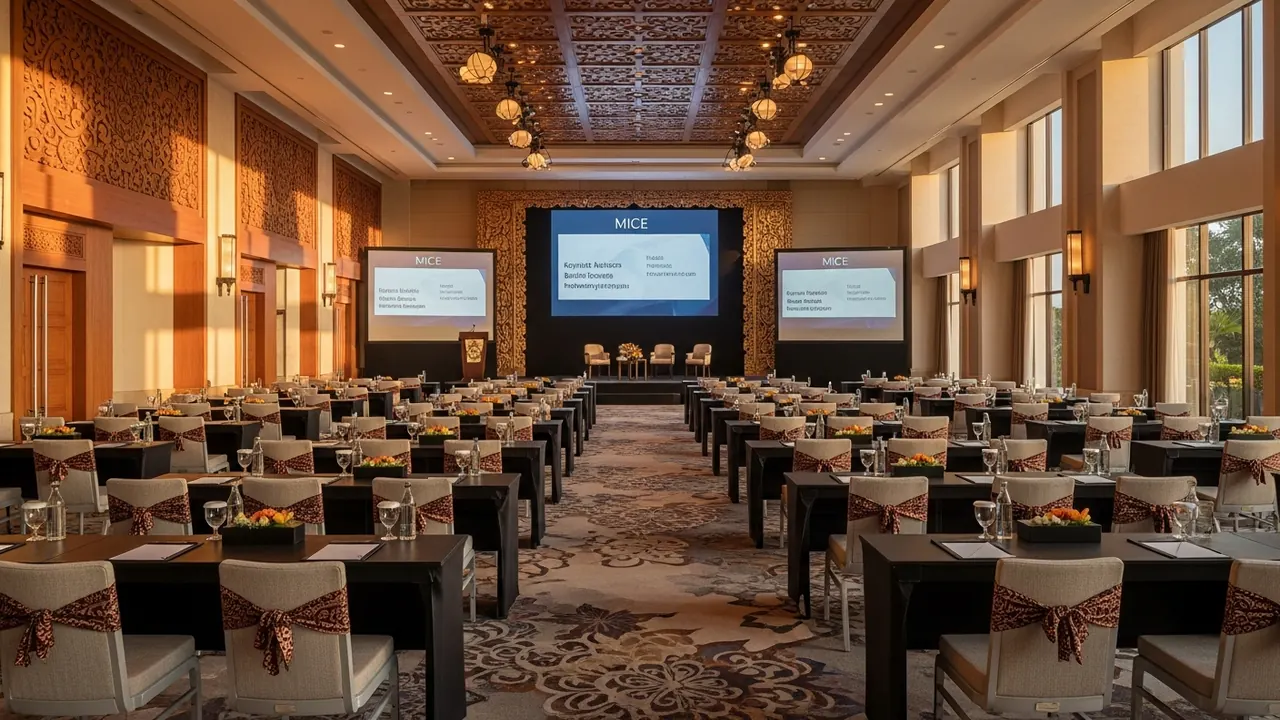
Event budgets are not priced like hotel rooms. A hotel room has one SKU. A corporate event has a dozen procurement categories, each with its own supplier and pricing logic, and those categories multiply differently depending on headcount, venue type, and program depth.
Consider two programs, both described as “a four-day corporate event in Bali for 80 people.” The first is an incentive retreat: a small luxury resort buyout, private-access excursions, a gala dinner at a cliff venue, daily F&B at set-menu level, and VIP coach transfers. The second is a training conference: a convention-floor ballroom, hotel-standard catering, a projector-and-screen AV setup, and shared shuttle transfers. The per-person cost on those two programs can differ by a factor of three or more — not because one supplier is overcharging, but because the scope is fundamentally different.
This is also why the frequently repeated claim that “Bali events cost roughly half the price of Singapore or Sydney” is worth treating carefully. It is a commonly cited positioning line, not a verified apples-to-apples comparison. Destination cost differentials are real — labor, venue-day rates, and local production costs in Bali sit at a different level than in Singapore — but the margin depends entirely on the program. Luxury resort buyouts in peak season with high-production galas can close the gap considerably. The honest answer is: Bali typically offers cost advantages for mid-tier to premium programs, and those advantages are real, but the exact differential requires a scoped quote from both destinations.
The Bali MICE Budget Breakdown: Component by Component
A properly structured bali mice budget breakdown covers ten discrete cost categories. Each one is a separate negotiation, often with a separate supplier, and each carries its own hidden-cost risk. Here is how to think about each in turn.
1. Venue Hire
Venue day rates in Bali vary enormously by tier and event type. At the large convention end, a full convention hall at a major purpose-built facility — the Bali Nusa Dua Convention Center (BNDCC) in Nusa Dua is the primary large-format option, with its largest pillarless hall covering 4,400 sqm at a theatre-style capacity of up to 5,000 delegates [venue-issued, verified] — commands day rates running from several thousand USD upward, depending on setup, days and ancillary space. [VERIFY with current venue rates.] At the mid-size hotel ballroom level, rates are considerably lower and are typically quoted as a full-day package that bundles basic AV and a minimum F&B spend. At the boutique resort or villa end, venue hire may be structured as a buyout — you pay for the accommodation block and a venue-use fee is implicit or negotiated separately.
For gala dinners and off-site events, venues like Garuda Wisnu Kencana Cultural Park (GWK) in Ungasan — a 60-hectare cultural landmark roughly 10 to 15 minutes from the airport — offer outdoor event spaces including the Lotus Pond, conventionally cited to accommodate up to 7,000 guests for standing events [multi-source benchmark; area figure of ~4,400 sqm is single-source, flag for verification]. Gala-venue hire at iconic outdoor locations carries an event-permit and security cost layer on top of the venue fee, which is covered below under Permits & Compliance.
Key driver: headcount relative to venue capacity. Underusing a large venue wastes spend. Over-packing a small one creates a poor delegate experience and may breach fire or density rules. Size the venue at 80-90% of capacity for comfort.
2. Room Block (Group Accommodation)
For multi-day programs, accommodation is often the largest single line item in the bali conference budget per delegate. Group rates are negotiated as a room block against a minimum nights commitment. The planning realities here are candid:
- Peak season (dry season, roughly April to October) tightens both availability and pricing. Inventory at premium properties adjacent to BNDCC in Nusa Dua — where accommodation density is high, making a single-venue cluster efficient — can book out months ahead for large-group dates. [Availability is a real risk in high-demand periods; verify early.]
- Attrition clauses typically require you to guarantee a percentage of contracted rooms (often 80-90%). Understand the attrition and cancellation terms before signing.
- Resort buyouts (you take all rooms) command a premium but provide exclusivity and simplified logistics. For incentive programs, the exclusivity is often worth the cost in delegate experience.
Rates vary by property tier, season, and block size. Present these always as by-quote — no published nightly rates from this guide.
3. Food and Beverage (F&B)
F&B is one of the most variable line items in any Bali incentive cost per pax model. Catering in Bali is frequently quoted in the range of USD 30 to 100 per person per meal occasion for group event catering [widely cited benchmark — VERIFY with current supplier quotes; this range reflects general market knowledge and not prices set or guaranteed by this guide]. What drives the range:
- Set menu vs buffet vs stations: plated set menus at a higher-end hotel run at the upper end; buffet for a breakout lunch sits at the lower end.
- Beverages: alcoholic beverages are taxed and, in some venues, carry a significant surcharge. Muslim-majority Indonesia has specific import-and-excise structures for alcohol — a detail that catches international planners who assume beer-and-wine at Western event pricing.
- Gala dinner F&B: a gala dinner at a scenic outdoor venue with live entertainment, a full bar, and multiple courses will sit at a different level entirely from a delegate lunch in a conference hotel. Budget these separately and by quote.
- Minimum spend commitments: hotel-based venues frequently include a minimum F&B spend in the venue hire package. Understand whether this minimum rolls into your per-delegate cost or sits on top of it.
4. AV and Production
For a straightforward internal conference with a podium, screen, and projector, AV costs are modest. For an incentive gala with staging, LED walls, rigging, sound design, branded lighting, and a live band or headline act, production costs can dwarf the venue hire. This is the line item that surprises planners most often.
Production in Bali is generally available at a lower labor cost than in Singapore or Australia, but equipment import, rigging requirements at non-convention venues, and generator hire for remote locations add up quickly. Get a detailed production specification into your RFP rather than requesting “AV for 200 pax” — the former produces a comparable quote; the latter produces guesswork.
If you bring international production crew or talent (DJs, MCs, keynote speakers from overseas), a separate compliance layer kicks in: a licensed impresario arrangement plus work-permit notification, typically requiring around one month of lead time. [VERIFY current requirements with the Directorate General of Immigration and relevant authority — rules change.]
5. Group Transfers and Ground Logistics
Ngurah Rai International Airport (DPS / Denpasar) handles approximately 24 million passengers a year — operating near its stated nominal capacity, with expansion planned to around 32 million by 2031 [secondary/compiled data; only H1-2024 throughput figure is directly verified official]. Peak arrival windows for large groups can create congestion at meet-and-greet points, so ground logistics planning matters more than planners from hub airports expect.
The airport sits in the southern isthmus. Nusa Dua is approximately 12 to 15 km away, roughly 20 to 30 minutes by road via the Bali Mandara Toll in normal traffic [mapping-derived, approximate — verify for your specific dates, as peak traffic extends these times materially]. Ubud and Canggu are meaningfully further, so programs that split accommodation between precincts carry a transfer cost and time burden that adds up across delegate movements.
Coach hire, VIP car fleets, and on-site logistics staff are all quoted per vehicle or per day. For large groups, a dedicated transfer coordinator managing manifests, staggered arrivals, and luggage handling is a staffing cost worth building in explicitly rather than absorbing into a DMC fee that may not cover it.
6. Gala Dinner and Special Events
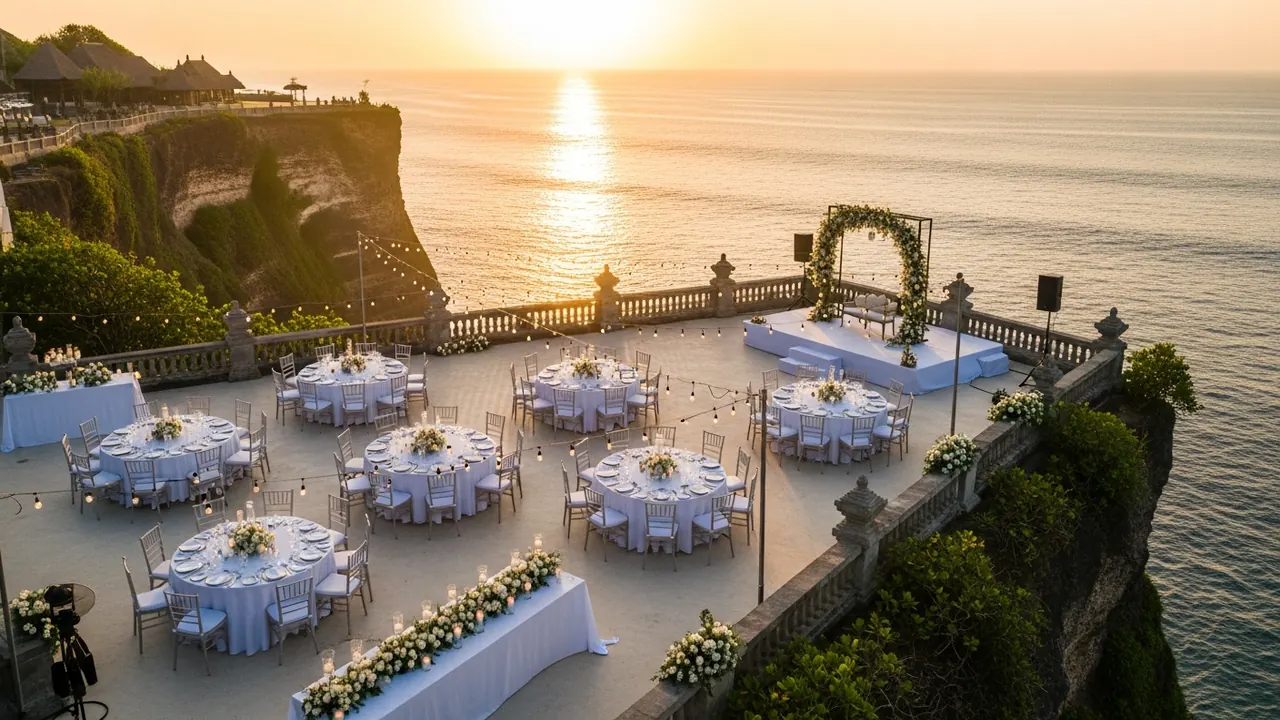
The gala or off-site evening event is often the signature moment of an incentive program and, correspondingly, one of the highest-cost elements per delegate. The components: venue hire (including any permit costs), F&B, production and staging, themed décor, entertainment (cultural performance, live music, DJ), photography and videography, and event staffing.
At beach clubs, cliff venues and landmark cultural spaces — Bali has a genuine density of spectacular outdoor event backdrops — production costs for weather-contingency planning, generator provision, sound-limit compliance, and load-in logistics add layers that a hotel ballroom gala does not. These are real costs, not padding, and they belong in the quote you review before signing.
7. Team-Building and Activities
Activity costs vary from minimal (a village cultural walk with a local guide is inexpensive) to significant (a private white-water rafting day with safety infrastructure, catering, and coaches). Bali’s genuine strength for MICE programs is experience density: culture, wellness, adventure, and culinary options are all accessible within a compact geography, which means a program can mix activity types without excessive transfer overhead.
Sustainability and CSR activities — beach cleanups, community projects, local-craft workshops — are frequently incorporated into incentive programs and, depending on scope, may carry a program-management cost plus a contribution to the community initiative. [These are common practice; scope and cost vary by operator.] For buyers with explicit CSR reporting requirements, confirm with your DMC how impact is measured and what documentation is available.
8. DMC Fee and Margin
This is the cost category that vendor guides never explain clearly. A DMC earns its fee in one of two primary models — or a hybrid of both. The first is a disclosed management fee (a percentage of total program cost or a flat per-delegate fee). The second is a margin built into each component quote, where the DMC procures from suppliers at one rate and invoices you at a marked-up rate.
Both are legitimate business models. The problem for planners is when the model is not disclosed. Ask directly: is this a management-fee model, a cost-plus model, or a blended approach? A supplier who cannot answer that question clearly is one to investigate before signing. The distinction matters because in a cost-plus model, production overruns — a 20% contingency on AV, for instance — can compound into significant undisclosed additional margin for the DMC rather than being passed through at cost.
Ready to build a scoped budget for your program? Share your event type, headcount, target dates and any key requirements and we’ll route your brief to one vetted, accredited Bali DMC partner for a detailed itemized quote. No one can pay to change what we publish; if you use our free help and proceed with a partner, they may pay us a referral fee at no extra cost to you. Submit your brief via our enquiry form or reach the team directly on WhatsApp at +62 811 3942 563.
9. Permits and Compliance
Permit costs are small relative to a full program budget but carry a disproportionate risk if missed. Large outdoor or public-facing events in Bali generally require location permits, police security and crowd-clearance approval (classified by event scale across Polsek, Polres, and Polda levels), noise and environmental compliance, and in many cases Balinese village council (banjar) consent for events near or within community areas. Private, closed-door events at hotel properties are typically handled by the venue and DMC within normal operations — the permit layer is more significant for off-site or landmark venue events.
There is no published numeric threshold — no rule that “events above X guests need permit Y.” Practice varies by regency (Badung, Denpasar, Gianyar each have their own authorities) and by event type and timing. Build a line item for permit facilitation fees and liaison time, and treat the timeline — permit applications can require several weeks of lead time — as a constraint on program planning rather than a detail to handle later.
10. Contingency
The most commonly omitted line in a Bali conference budget per delegate is a contingency reserve. A planning-standard contingency of 10 to 15% of total program cost is a sensible habit for any overseas corporate event — not a regulatory requirement, not a number this guide mandates, but a reflection of how often programs encounter scope changes, production overruns, weather-driven backup costs, or FX movement between budget approval and invoice payment.
On the FX point: most Bali event suppliers invoice in USD or IDR, and some larger components (international flights, hotel room blocks booked through global chains) may price in a third currency. If your organization’s budget is approved in AUD, GBP, or EUR, the rate between budget approval and final payment is a real variable. Lock rates where contracts permit or build the FX buffer into contingency.
The Cost Drivers That Move the Needle Most
Not all ten components above carry equal weight. In practice, three variables account for the majority of bali incentive cost per pax movement:
- Headcount and the fixed-cost floor
- Several cost items have a significant fixed component: production setup, permit applications, coordinator staffing, and transportation logistics do not scale linearly with delegate count. A 40-person program carries a higher per-head cost on these items than a 200-person program running the same format. This is why per-delegate benchmarks without a headcount context are nearly meaningless.
- Venue tier and buyout structure
- The single biggest per-delegate lever is the accommodation and venue tier. A standard four-star conference hotel delivers a materially different cost model than an exclusive boutique resort buyout. Both are legitimate choices for different program objectives — the question is whether the venue tier is appropriate for the program outcome, not which is objectively better.
- Season and inventory pressure
- Bali’s dry season (roughly April to October) is both the most attractive for outdoor programs and the most competitive for venue and room-block inventory. Availability and pricing can tighten materially in high-demand periods, particularly for buyouts and premium beachfront properties. Wet-season programs (November to March) generally face less inventory pressure but require robust weather contingencies for outdoor elements. The exact premium or discount is by-quote for specific dates.
Hidden Costs: What Vendors Do Not Volunteer
Every experienced corporate buyer has encountered the post-event invoice that exceeds the signed quote. In Bali, the most common sources are:
- Undisclosed supplier surcharges: some venues charge a service charge (often 10-21% on F&B in Indonesia) that is not included in the headline per-head menu price. Ask for all-inclusive pricing and confirm whether tax and service are included or additional.
- Double-margining: where a PCO engages a DMC who engages sub-suppliers, each tier may add margin. The buyer at the top sees only the final price. Clarify the supply-chain structure in your RFP and ask for transparency on sub-contractor relationships.
- Production overruns: technical difficulties, extended rehearsal time, overtime for crew and rigging — these are legitimate costs in event production and are difficult to price exactly in advance. Understand the overage model before signing: is overage billed at cost, at a marked-up rate, or is there a cap?
- Alcoholic beverage pricing: as noted above, import excise on alcohol in Indonesia is a real variable. A full open bar at an international event rate in Bali will cost more than planners from markets with lower alcohol duties expect.
- Last-minute changes: headcount revisions, program additions, and venue layout changes after the production has been specified generate change-order costs. These are rarely detailed in initial quote documents. Ask for the change-order policy in writing.
Bali vs Singapore, Sydney, London: What the Comparison Actually Means
The commonly repeated claim that a Bali event costs “roughly half” what the same program would cost in Singapore, Sydney, or London is a market positioning statement, not a verified benchmark. It is plausible as a general direction of travel — labor costs, venue day rates, and local F&B in Bali sit below those in Singapore and significantly below Sydney or London — but the differential depends heavily on program type and specification.
Consider what does not scale proportionately with a destination shift: international airfares for delegates do not drop because the event moves to Bali; in some cases they increase. Production equipment and international talent carry similar costs regardless of venue country. And a like-for-like luxury specification in Bali’s premium tier closes the gap with Singapore more than a mid-tier specification does.
For the specific comparison with Singapore: Indonesia ranked 37th globally and approximately 10th in Asia-Pacific in ICCA 2023 city rankings [VERIFY: sourced via TTGmice and Mix Meetings reporting ICCA data], while Singapore ranked first in the Asia-Pacific city ranking. Singapore’s convention infrastructure, airline lift, and visa-on-arrival breadth are advantages for large international association conferences. For incentive-led programs of 40 to 300 delegates where experience density, natural setting, and cultural programming are the brief, Bali competes strongly on value — the cost difference on those program types is real, and worth confirming by running a scoped RFP in parallel for both destinations if the decision is close.
Putting It Together: A Sample Framework (Not a Quote)
The following is an illustrative framework to help structure a budget model. It is not a quote, not a price guarantee, and not representative of any specific program or supplier. Treat every figure as a planning prompt to confirm by RFP.
| Budget Component | Typical Range Indicator | Notes |
|---|---|---|
| Venue hire (convention hall or hotel ballroom) | On quote — from several thousand USD/day for large convention space [VERIFY] | Highly variable by tier, size, included services |
| Room block / accommodation | On quote — largest single line item for multi-day programs | Attrition clauses, cut-off dates are key contract terms |
| F&B (per person per day) | Benchmark range often cited USD 30–100/pax per meal occasion [VERIFY] | Excludes alcoholic beverages; gala dinners budgeted separately |
| AV & production | On quote — modest for basic conference, significant for staged gala | Specify in detail; overruns are common without a cap clause |
| Group transfers | On quote — per vehicle per day; scale with headcount and precincts | DPS to Nusa Dua ~20–30 min normal traffic [approximate] |
| Gala or off-site evening event | On quote — wide range by venue and production level | Include permit, generator, weather-backup costs |
| Team-building / activities | On quote — low to moderate for cultural; moderate to high for multi-activity | CSR elements may include a community contribution line |
| DMC management fee | Ask for the fee model — % of total or per-delegate flat fee; both are common | Clarify whether sub-contractor margin is in addition |
| Permits & compliance facilitation | On quote — typically modest but non-trivial for outdoor/landmark events | Timeline risk if not started early; varies by regency and event type |
| Contingency reserve | 10–15% of total program cost is a common planning habit [illustrative] | Not mandated; adjust to your organization’s risk tolerance and FX exposure |
The Right Way to Use This Guide
This bali mice budget breakdown is a briefing tool, not a quoting tool. Its purpose is to help you structure a complete RFP, have an informed conversation with suppliers, and identify the questions to ask before you commit budget. No independent editorial guide — and certainly no vendor website — can give you a reliable cost per delegate without knowing your headcount, dates, venue tier, program scope, and the supplier’s current procurement costs.
What this guide can do is tell you what to ask for, what to verify, and where the surprises tend to hide. Take it into your next supplier briefing and ask directly about every line item above. The quality of the answers tells you a great deal about the supplier’s transparency before you sign anything.
Get an itemized quote for your program. We are an independent guide, not a DMC. When you’re ready to move from framework to actual figures, we route your completed brief to one vetted, accredited local partner and disclose that referral relationship openly. No one can pay to change what we publish; if you proceed with a partner, they may pay us a referral fee at no extra cost to you. Use our enquiry form to send your brief, or contact the team on WhatsApp at +62 811 3942 563 or by email at [email protected].
Frequently Asked Questions
What is a realistic cost per person for a corporate event in Bali?
There is no single figure, and any source that publishes one without knowing your headcount, program scope, venue tier and dates is not giving you useful information. Bali corporate event cost per person is assembled from ten or more variable components. A simple half-day internal meeting in a hotel boardroom sits at a very different level to a four-day incentive retreat with a gala dinner at a landmark venue. The most productive first step is to scope your program into the ten components above and request itemized quotes against each one.
How does Bali compare on cost to Singapore or Sydney for a corporate event?
Bali is commonly described as offering meaningful cost savings compared to Singapore, Sydney or London for equivalent-standard programs. That directional claim is reasonable — venue day rates, local labor costs and domestic F&B sit at a different level — but the actual differential depends heavily on the program type and specification. Luxury-tier programs with high production values close the gap considerably. International airfares for delegates are also a real variable that does not improve because the event is in Bali. For a close decision between destinations, run a scoped parallel RFP to compare like-for-like.
What hidden costs do Bali event budgets most often miss?
The four most common surprises on Bali event invoices are: alcoholic beverage pricing (import excise in Indonesia is significant, and an open bar costs more than planners from lower-duty markets expect); production overruns on staged events where an overage model was not agreed in writing; tax and service charges on F&B that are not included in the headline menu price; and permit and compliance facilitation costs for off-site or outdoor events, particularly at landmark venues. Building a 10 to 15% contingency reserve into the approved budget is a sensible planning habit for any overseas corporate event.
Does the DMC fee show up as a separate line or is it built into the quote?
It depends on the DMC and the model they operate. Some charge a disclosed management fee — a percentage of total program cost or a flat per-delegate amount — which appears as a named line item. Others build their margin into each component price, which means the management fee is not separately visible. Both models are standard practice. The important thing is to ask directly which model applies before accepting a quote, because in a cost-plus model, scope changes and overruns on individual components can compound into undisclosed additional margin. Any DMC that cannot explain its fee model clearly is worth scrutinizing before you proceed.
When should I book to get the best Bali event pricing and availability?
Bali’s dry season, roughly April to October, is both the most desirable period for outdoor programs and the most competitive for venue and room-block inventory. Premium properties in Nusa Dua, and exclusive boutique resorts suitable for incentive buyouts, can commit to large groups well in advance of peak-season dates. As a general planning principle, the more specific your venue requirements — full buyout, specific beach frontage, precise dates — the earlier you need to hold inventory. Wet-season dates (November to March) typically offer more flexibility, but any outdoor program elements require a weather contingency plan. Note that Nyepi — Bali’s Day of Silence, which includes airport closure for approximately 24 hours — falls on a different date each year and is a hard planning constraint; verify the exact date for your program year before confirming travel.