How to use this page: Bali DMC Agency is an independent buyer’s guide to Bali MICE — we are not a DMC, PCO, venue, or transport operator ourselves. A DMC manages on-the-ground logistics, venues, and transport; it is not the venue or the conference organiser. Capacities, group sizes, and budgets shown are indicative ranges flagged [VERIFY] (mid-2026) and must be confirmed in writing with the relevant supplier, venue, or broker before you commit — this is general information, not legal, tax, or procurement advice; confirm delegate visas and event permits with the appropriate authority or your notary as relevant. We may earn a referral commission when we connect you to a vetted partner, which never changes the price you are quoted.
Why Bali for MICE? The short answer is that Bali combines resort-grade appeal, a genuine mid-size convention infrastructure, and an experience density — culture, wellness, team-building activities, and compelling gala venues — that few destinations in Asia-Pacific can match at comparable price brackets. The longer answer requires honesty: Bali is not Singapore or Kuala Lumpur, its air connectivity trails those hubs, and its peak-season inventory pressures are real. This page gives you the balanced, evidence-grounded version that vendor brochures rarely publish.
This is general information for planning and procurement purposes. It is not legal, financial, visa, or professional advice. Figures and rankings are presented with uncertainty flags where applicable; verify current data with primary sources before committing budget.
The Core Case: What Bali Actually Delivers for Business Events
Bali’s claim as a bali mice destination rests on a combination of verified facts and legitimate competitive advantages — none of which require exaggeration to make the case.
Proven Large-Event Capability
The most credible evidence of Bali’s convention capacity is its track record with heads-of-state events. The G20 Leaders’ Summit in November 2022 was held in Nusa Dua, Bali, with plenary and key working sessions at the Bali Nusa Dua Convention Center (BNDCC) and the adjacent Bali International Convention Center (BICC). The IMF–World Bank Annual Meetings of 8–14 October 2018 were also held in Nusa Dua, anchored at BNDCC and nearby venues. These are not marketing claims — both events are verifiable through official government, IMF, and World Bank records.
What those events demonstrate is that Bali has the security logistics, accommodation volume, ground transport coordination, and convention-floor scale to support events requiring simultaneous head-of-delegation suites, press centers, bilateral meeting rooms, and high-security perimeters. Corporate MICE buyers at the 50–500 delegate range will find far more headroom than they typically need.
BNDCC: What the Venue Actually Offers
The Bali Nusa Dua Convention Center in Nusa Dua is Bali’s primary purpose-built convention facility. Its published headline specification: the Nusa Dua Hall is pillarless, covers 4,400 square metres, and seats up to 5,000 delegates in theatre configuration. The venue comprises multiple function rooms — industry-listing sources cite 44 multi-flexible rooms across the complex, though that figure comes from third-party trade publications rather than a headline figure on BNDCC’s own published specs, so treat it as indicative.
One point worth clarifying for buyers who have read older marketing materials: the BNDCC and the BICC (Bali International Convention Center, located at the Westin Nusa Dua) are two distinct facilities. The BICC was built for the 1992 Non-Aligned Movement Summit — that is the historically verified purpose-build claim. The BNDCC is a separate building. Confusing the two inflates apparent capacity; a good RFP process will specify which venue is being quoted.
From the airport — Ngurah Rai International (DPS), Denpasar — the Nusa Dua convention district is roughly 12–15 kilometres by road via the Bali Mandara Toll, typically 20–30 minutes in normal conditions. That is a short, manageable transfer for arriving delegates, assuming traffic is not at peak.
ICCA Rankings: What the Data Says and What It Does Not
The International Congress and Convention Association (ICCA) 2023 data — released in 2024 and reproduced by trade publications including TTGmice and Mix Meetings — places Indonesia 37th globally with 98 international association meetings tracked that year. In the Asia-Pacific city ranking, Bali sits at approximately 10th position.
That is a legitimate data point and a reasonable indicator of Bali’s standing as a bali mice destination in the association-meetings segment. It is not, however, top-tier — Singapore ranks first in the Asia-Pacific city list, Seoul second, Bangkok third, with Kuala Lumpur also in the top ten. Indonesia as a country ranks behind Thailand (25th, 158 meetings) and Singapore (27th, 144 meetings) in the global country table.
The honest framing: Bali is a credible mid-tier Asia-Pacific MICE city, meaningfully active in the international associations segment but not in the same tier as Singapore or KL for pure convention volume. For corporate incentive programs, company-wide conferences, and regional leadership meetings — the bulk of what most corporate buyers are actually sourcing — that ranking gap is largely irrelevant. ICCA measures association meetings with rotating host cities; it does not capture the full corporate and incentive market.
Government Priority Context
Indonesia’s Ministry of Tourism and Creative Economy (Kemenparekraf) explicitly treats MICE and business events as a priority segment under the Wonderful Indonesia destination brand. The ministry has a dedicated MICE and Special Interest Tourism function and actively supports bidding for international events through platforms including IMEX and IT&CM Asia.
One clarification that frequently gets muddled in vendor materials: the Indonesian government’s official tourism program designates five specific destinations as super-priority sites — Borobudur, Mandalika, Labuan Bajo, Likupang, and Lake Toba. Bali is not one of the five. Bali is Indonesia’s primary international tourism hub and receives institutional backing in that capacity, but it is not a super-priority site under that program. Buyers should not be sold on that framing; the distinction matters if you are evaluating government support structures or incentive programs.
Experience Density: The Genuine Competitive Advantage
If there is one area where Bali genuinely outperforms comparably-priced MICE destinations in Asia-Pacific, it is experience density. Planning a three-day incentive that includes a team-building activity, a cultural experience, a wellness component, and a gala dinner does not require stitching together four separate supplier relationships across four different micro-destinations. In Bali, all of that is within a 45-minute radius, often much less.
Team-Building Options
Bali’s geography supports an unusually wide range of team-building formats. Whitewater rafting on the Ayung or Telaga Waja rivers, cycling descents from the Kintamani highlands, cooking classes in Ubud, surfing lessons at Seminyak, and community service projects — beach cleanups, temple restoration, village agricultural programs — are all operationally established and regularly run for corporate groups. These are not curated novelties; they are working program components that Bali-based DMCs have operated long enough to develop refined logistics, contingency planning, and risk management frameworks.
Scope and quality vary by operator, and nothing here should be read as a guarantee of any specific provider’s offering. The point is structural: the variety is genuinely there, and it exceeds what most comparable-budget Asian MICE destinations can assemble in one location.
Cultural Programming
Balinese Hindu culture gives programme designers material that is both distinctive and visually compelling — temple ceremonies, kecak and legong dance performances, gamelan, batik and offering-making workshops, and village visits to areas such as Penglipuran and Tenganan. For international groups attending incentive programmes or leadership retreats, a cultural evening in Bali has a different character from a comparable evening in a purpose-built convention city. That distinctiveness has real value in delegate experience design.
Wellness Programming
Bali’s spa and wellness infrastructure is deep enough to support full-day delegate wellness programs rather than just add-on treatments. Ubud, in particular, has a concentration of retreat-grade spa facilities that can accommodate group bookings. For incentive programmes that position wellness as a core benefit rather than an amenity, this is a meaningful asset.
Gala Venue Variety
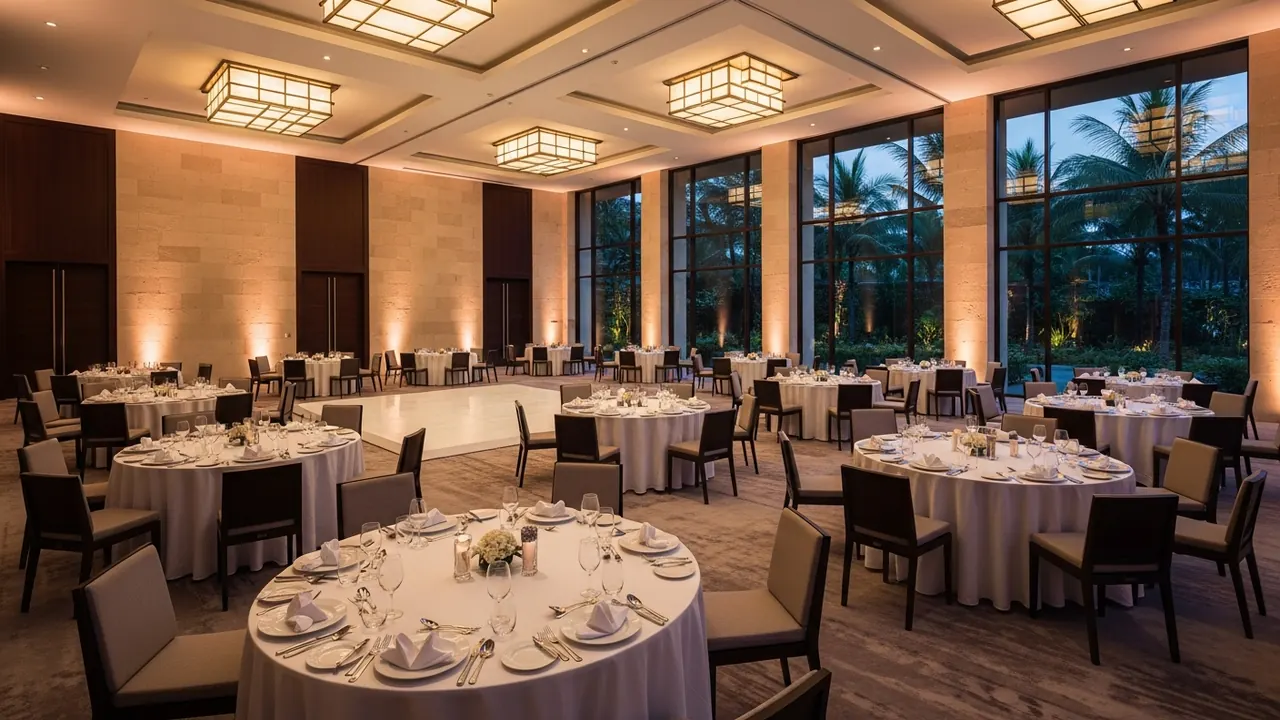
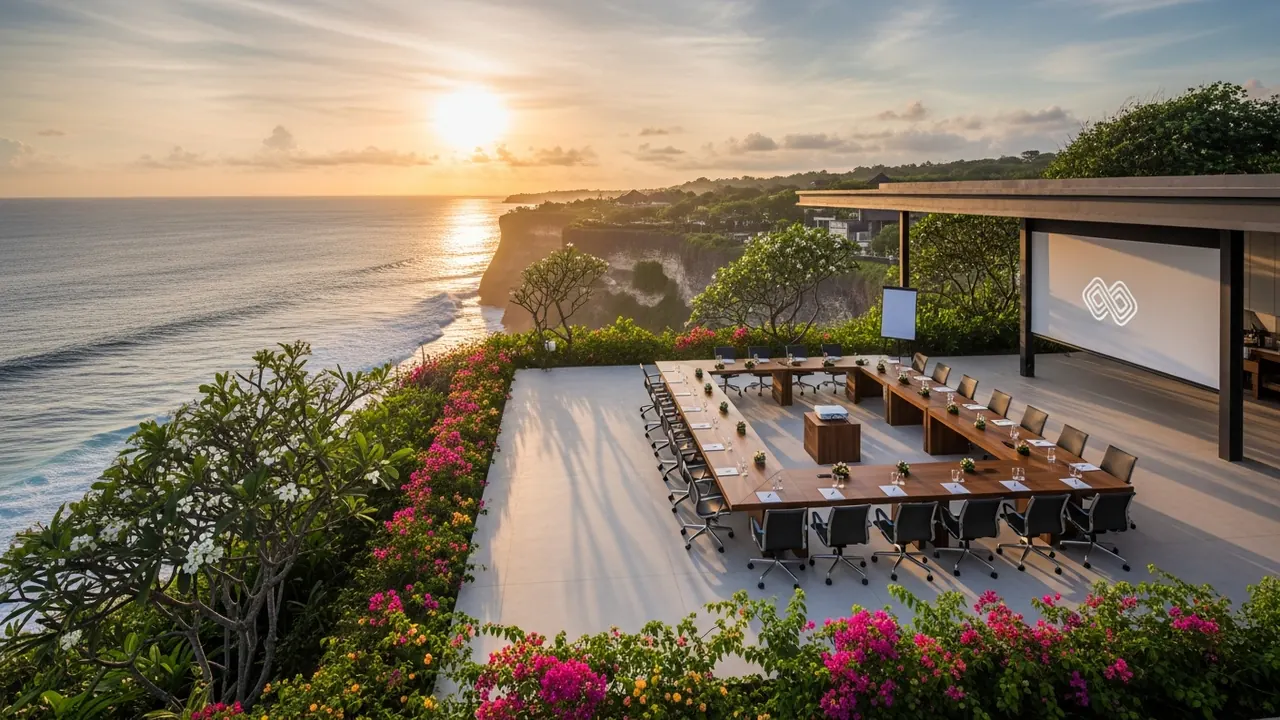
Conventional hotel ballrooms exist and perform reliably. What Bali adds is a range of venue types that most convention cities cannot replicate: clifftop venues above the Indian Ocean near Uluwatu and Jimbaran, beach clubs in Seminyak and Canggu that convert to private-event spaces, and the Garuda Wisnu Kencana (GWK) Cultural Park in Ungasan — a roughly 60-hectare cultural complex at approximately 263 metres above sea level, about 10–15 minutes from the airport.
GWK’s Lotus Pond, its largest outdoor plaza, is widely cited in event industry sources as capable of hosting up to 7,000 persons for large-format events. That figure comes from multiple industry sources; GWK’s own marketing uses higher numbers for standing festival configurations, which represents a different scenario entirely. Area figures for the Lotus Pond from a single source suggest approximately 4,400 square metres. For planning purposes, treat the 7,000-person figure as a reasonable upper reference for a controlled corporate event, while confirming specifics directly with the venue.
For beach clubs and clifftop private venues — Savaya Bali (formerly Omnia) and Karma Kandara at Uluwatu, AYANA Resort’s oceanfront lawns, Potato Head in Seminyak, Finns and Atlas Beach Club in Canggu — no neutral, verifiable published capacity figures exist that we are prepared to repeat. These venues quote capacities through their event sales teams; those numbers vary by event configuration. What is verifiable is that these are operational event venues with established corporate-event track records. Get quoted figures in writing from the venue itself.
| Venue Type | Representative Example(s) | Best For | Key Caveat |
|---|---|---|---|
| Purpose-built convention hall | BNDCC (Nusa Dua Hall: 4,400 sqm, 5,000 pax theatre) | Conferences, plenary sessions, large conventions | BNDCC and BICC are two separate facilities; confirm which is quoted |
| Hotel convention complex | Nusa Dua resort strip (multiple 5-star properties) | All-in-one delegate accommodation plus meeting rooms | Inventory tightens materially in peak dry-season months |
| Outdoor cultural park | GWK Cultural Park, Ungasan (~60 ha, ~263 m ASL) | Gala dinners, large incentive evenings, cultural showcase | Lotus Pond ~7,000 pax (multi-source, industry); confirm with venue for your configuration |
| Clifftop / oceanfront venue | Savaya Bali, Karma Kandara, AYANA | VIP incentive dinners, cocktail receptions | No neutral published capacities; quote directly from venue |
| Beach club / open-air | Potato Head, Atlas Beach Club, Finns Beach Club | Casual networking events, team evenings, product launches | Weather-dependent; wet season (Nov–Mar) risk for outdoor setups |
Airport and Air Connectivity
Ngurah Rai International Airport (DPS) handled approximately 23.9 million passengers in 2024 — close to its stated nominal capacity of around 24 million per year. An expansion plan to around 32 million capacity by 2031 is cited in media reports. The airport serves routes from major Asia-Pacific hubs including Singapore, Kuala Lumpur, Hong Kong, Tokyo, Seoul, Sydney, and a growing number of direct long-haul routes.
For buyers asking is bali good for corporate events, air connectivity is a legitimate factor. Direct service from major Asian gateway cities is generally adequate for regional incentive groups and intra-Asia conferences. Where Bali underperforms relative to Singapore or KL is in long-haul direct connectivity: delegates from Europe, the Americas, or Africa will typically route through a gateway hub. That adds a connection for non-Asia delegates and complicates group-arrival coordination. It is not a deal-breaker for most programs, but it is a cost and logistics variable worth building into your planning framework early.
The airport’s current throughput essentially at its stated capacity also means congestion is a real operational factor during peak travel windows — particularly around Indonesian public holidays, August high season, and December through January. If you are moving 300 delegates through arrivals in a 4-hour window, your ground transport and transfer timing plan needs to account for terminal congestion as a realistic scenario, not an edge case.
The Honest Disadvantages: What Bali Cannot Claim
This section is the part that vendor sites tend to skip. Understanding bali business events advantages requires understanding the ceiling, too.
Convention Hub Status Compared with Singapore and KL
Singapore and Kuala Lumpur are purpose-engineered MICE cities. Singapore’s Suntec and Marina Bay Sands convention infrastructure, combined with Changi Airport’s connectivity and Singapore’s concentration of multinational regional headquarters, creates a gravitational pull for Asia-Pacific association congresses and large corporate events that Bali does not replicate. Kuala Lumpur’s KLCC convention centre and its direct-flight network from South and Southeast Asia similarly outcompete Bali for pure convention volume.
That comparison is not a reason to rule out Bali — it is a reason to be clear about what kind of event Bali is optimal for. Large international association congresses with rotating host cities, events requiring extensive exhibition hall space, or programs where a significant delegate cohort is flying in from three or more continents: Singapore and KL will often win on logistics. Corporate incentive programs for 30–500 people, regional leadership conferences, leadership retreats, product launches with immersive cultural components, and team-building programs built around Bali’s specific geography: Bali is a strong candidate.
Peak-Season Pressures
Bali’s dry season — approximately April through October — overlaps with peak leisure demand. The same period that gives you reliable weather for outdoor gala dinners and team-building activities is the period when hotel inventory at premium beachfront and resort properties in Nusa Dua, Seminyak, and Jimbaran is tightest, and when venue buyout pricing is highest. This is not unusual; it is basic supply and demand. It does mean that a corporate event planned for July or August needs an earlier contracting timeline than the same event planned for February.
Availability and pricing can tighten materially in high-demand periods, particularly for events requiring a block of 100 or more rooms at a single property. If your programme depends on a specific resort property and specific dates, the risk of late booking is real. Work on contract timelines with your DMC at briefing stage — ideally 9–12 months out for larger conferences, 6–9 months for incentive groups — not after budget is approved.
Over-Tourism and Crowding
Bali processed nearly 24 million airport passengers in 2024. Kuta, Seminyak, Sanur, and parts of Ubud are congested at peak times in ways that can visibly undermine the premium delegate experience you are building. Traffic from southern Bali to Ubud can run 90 minutes in heavy conditions. A delegate who has just spent an hour in slow traffic through Kuta is not arriving at a gala dinner in the optimal frame of mind.
This is manageable with good programme design — routing, timing, helicopter transfers for VIP groups, sequencing arrivals outside peak traffic windows — but it requires active planning. Treating congestion as a background operational concern rather than a programme design variable is one of the more common mistakes in Bali incentive planning.
Permit and Regulatory Complexity
Large, outdoor, or public-access events in Bali require location permits, police security and crowd-clearance approvals, and — for events touching village or traditional land — banjar (village council) consent. Private, closed-door events in hotel ballrooms are typically handled within the venue’s own licensing framework, and the DMC manages this as a standard operational step.
What complicates things for buyers is that no publicly accessible legal text establishes clean numeric thresholds — no rule of the form events over X attendees require permit Y. Practice is case-by-case, varies by regency (Badung, Denpasar, Gianyar each have different administrative structures), and is best navigated by a local operator with an established working relationship with the relevant offices. A competent local DMC is not optional for complex programs; it is load-bearing infrastructure.
Visas for Business Event Delegates
Most international delegates attending conferences or incentive programs in Bali will enter on a Visa on Arrival (e-VOA), commonly valid for up to 30 days and extendable once, or on a single-entry business e-visa (B211A-type), often valid for up to 60 days with a local sponsor requirement. The distinction between passive conference attendance and active working (speaking, training, facilitating) can change the applicable visa category — this is legally sensitive and case-by-case.
Nationality-specific rules, fees, and permitted durations change with some frequency. This section describes general practice at the time of writing, not current legal requirements for your specific delegates. Direct delegates to the Indonesian Directorate General of Immigration (imigrasi.go.id) and confirm current requirements before distributing delegate briefing materials. Your DMC can provide practical guidance based on current operational experience, but immigration law interpretation is outside the scope of DMC services.
Ready to test whether Bali fits your programme? Submit an outline brief through our enquiry form or reach the team directly on WhatsApp at +62 811 2859 0000 — share your delegate count, event dates, and a rough activity wishlist and we will route you to the right local partner without pressure.
Quick Reference: Bali vs. the Asia-Pacific Field
- ICCA global country rank (2023 data, via TTGmice/Mix Meetings)
- Indonesia 37th, 98 international association meetings. Ahead: Thailand (25th, 158 meetings), Singapore (27th, 144 meetings).
- Bali city rank, Asia-Pacific (ICCA 2023)
- Approximately 10th in Asia-Pacific city ranking. Singapore 1st, Seoul 2nd, Bangkok 3rd, KL also in top 10. Bali is a credible mid-tier AP MICE city — not a top-three city.
- BNDCC: verified largest hall
- Nusa Dua Hall — 4,400 sqm, pillarless, 5,000 pax theatre. BNDCC and BICC (Westin) are two separate buildings. Confirm which is quoted in your proposal.
- Major verified events
- G20 Leaders’ Summit, Nusa Dua, November 2022. IMF–World Bank Annual Meetings, Nusa Dua, 8–14 October 2018.
- Airport (DPS) throughput
- ~23.9 million pax (2024, compiled secondary source). Stated capacity ~24 million/yr. Expansion to ~32 million by 2031 planned (media-cited).
- Airport to Nusa Dua convention district
- ~12–15 km by road via Bali Mandara Toll; approximately 20–30 minutes in normal traffic conditions.
- GWK Lotus Pond event capacity
- Up to ~7,000 pax (multi-source industry reference); area ~4,400 sqm (single-source). Confirm with venue for your event configuration.
- Peak season for MICE
- Dry season approximately April–October. Peak demand, highest prices, tightest inventory. Wet season approximately November–March: lower rates, outdoor weather risk.
- Government MICE policy status
- MICE is a Kemenparekraf priority segment under Wonderful Indonesia. Bali is Indonesia’s main international tourism hub. Bali is NOT one of the five official super-priority destinations (Borobudur, Mandalika, Labuan Bajo, Likupang, Lake Toba).
- Delegate visa (general practice)
- e-VOA (commonly up to 30 days, extendable) or B211A-type single-entry business e-visa. Rules change; verify with Indonesian Directorate General of Immigration.
Who Should Shortlist Bali — and Who Should Think Twice
Bali belongs on the shortlist when the programme needs experience density alongside meetings infrastructure: incentive groups for whom the destination is part of the reward, corporate conferences that want cultural and team-building programming without bussing delegates to a separate activity zone, leadership retreats where immersion and relative distance from head-office routines is an asset, and product launches that benefit from distinctive venue options beyond a hotel ballroom.
Bali deserves harder scrutiny when the majority of delegates are flying from outside Asia, when the event requires more than 5,000 delegates in a single plenary space, when exhibition floor area requirements exceed what BNDCC can deliver, when the programme absolutely cannot tolerate weather risk for outdoor components, or when the event calendar falls in peak holiday periods and budget constraints rule out early contracting.
Neither scenario is a binary rule. Most programmes land somewhere in between, which is exactly why a destination-selection brief is worth doing properly — with verified specs, honest tradeoffs, and cost-range modelling — before the venue shortlist is circulated to senior stakeholders. If you want independent help structuring that brief, our enquiry form is the starting point. No one can pay us to change what we publish; if our guidance leads you to work with a partner through us, that partner may pay us a referral fee at no extra cost to you.
Frequently Asked Questions
Is Bali considered a top MICE destination in Asia-Pacific?
By ICCA 2023 data (released 2024, reproduced by TTGmice and Mix Meetings), Bali ranks approximately 10th in the Asia-Pacific city ranking for international association meetings, with Indonesia placing 37th globally at 98 meetings tracked. That makes Bali a credible mid-tier MICE city in the region — active and established, but behind Singapore (1st in AP), Seoul, Bangkok, and Kuala Lumpur in pure convention volume. For corporate incentive programs and regional conferences, that ranking gap matters considerably less than it does for large rotating association congresses.
What is the largest venue in Bali for conferences?
The Bali Nusa Dua Convention Center (BNDCC) in Nusa Dua hosts the largest purpose-built convention space on the island. Its Nusa Dua Hall is a pillarless space of 4,400 square metres with a verified theatre-style capacity of 5,000 delegates. Note that the adjacent Bali International Convention Center (BICC, located at the Westin) is a separate facility — proposals often cite both; confirm which building’s specifications you are reviewing. For outdoor scale, GWK Cultural Park’s Lotus Pond is cited in multiple industry sources at up to 7,000 persons for large event formats.
Does Bali have a track record with major international events?
Yes, and with verified examples. The G20 Leaders’ Summit was held in Nusa Dua, Bali in November 2022, with key sessions at BNDCC and BICC. The IMF–World Bank Annual Meetings ran in Nusa Dua from 8–14 October 2018. Both are confirmed by official government, IMF, and World Bank records. These are the most reliable proof points for Bali’s capability with high-security, large-delegation international events — more reliable than venue marketing claims or general reputation.
When is the best time of year to hold a corporate event in Bali?
The dry season, approximately April through October, offers the most reliable weather for events with outdoor components — team-building activities, gala dinners at clifftop venues, beach club events. The tradeoff is that this is also peak leisure tourism season: hotel rates are higher, premium venue inventory is tighter, and hotel room blocks at popular Nusa Dua or Seminyak properties need to be contracted further in advance. The wet season (approximately November through March) brings lower rates and more contracting flexibility, but outdoor programme components carry genuine weather risk. For most corporate programmes, early dry season (April–June) and late dry season (September–October) offer a reasonable balance of weather reliability and inventory availability.
How does Bali compare with Singapore or Kuala Lumpur for a corporate conference?
Singapore and KL outperform Bali on pure convention infrastructure scale, direct long-haul air connectivity, and proximity to multinational headquarters clusters. Bali outperforms them on resort and incentive appeal, experience variety within a compact geography, and often on the quality of the delegate experience for programmes where the destination itself is part of the value proposition. A regional leadership conference where delegates are flying in from four continents and the priority is logistics efficiency: Singapore or KL. A 200-person incentive programme for a sales team where the destination is a reward and the schedule includes cultural evenings, team-building, and a gala dinner with an Indian Ocean backdrop: Bali becomes a serious contender. The choice depends on what the programme actually needs to deliver.