

How to use this page: Bali DMC Agency is an independent buyer’s guide to Bali MICE — we are not a DMC, PCO, venue, or transport operator ourselves. A DMC manages on-the-ground logistics, venues, and transport; it is not the venue or the conference organiser. Capacities, group sizes, and budgets shown are indicative ranges flagged [VERIFY] (mid-2026) and must be confirmed in writing with the relevant supplier, venue, or broker before you commit — this is general information, not legal, tax, or procurement advice; confirm delegate visas and event permits with the appropriate authority or your notary as relevant. We may earn a referral commission when we connect you to a vetted partner, which never changes the price you are quoted.
Bali event transport for large groups is the logistics layer that determines whether a well-planned conference actually runs on time — or whether 200 delegates are standing in a hotel lobby at 9 pm waiting for coaches that were never properly sequenced. It covers everything from the moment a delegate lands at Ngurah Rai International Airport (DPS) through every movement between venue, hotel and off-site activity, to the final airport transfer on departure day. Getting it right requires pre-event planning that most venue and program budgets undervalue. Getting it wrong is one of the few event failures visible to every single delegate simultaneously.
This guide gives corporate buyers a ground-level picture of bali delegate transfers, corporate coach hire bali, and bali on-site event logistics: the realistic transfer times, the planning ratios, the coordination layers, and the operational risks that most vendor pitches skip over entirely.
Ngurah Rai International Airport: What Planners Need to Know

DPS — Ngurah Rai International Airport — sits on the southern isthmus of Bali, in the Tuban and Kuta area near Jimbaran. It is the single gateway for virtually all international delegate arrivals. The airport handled approximately 23.9 million passengers in 2024 — a figure drawn from compiled secondary sources, not a directly viewable official annual report, though it is consistent with other data. For context, the airport’s stated nominal capacity is around 24 million passengers per year, and the January to June 2024 throughput of 11.26 million is the only figure officially confirmed by airport management. The practical implication for planners: DPS is operating at or very near capacity. That matters because it directly affects ground-side processing speed.
What this means for bali delegate transfers: immigration hall queues at DPS can be long and variable, particularly when multiple international flights arrive within a narrow window. When a MICE group has delegates arriving on 6 to 10 different flights from 4 different origin cities across a 3-hour window, the spread of actual arrival times at the arrivals hall can easily be 90 minutes wider than the flight schedule suggests. Meet-and-greet teams need to be positioned for the real-world spread, not the ideal-case schedule.
Baggage reclaim adds further variability. Carousel assignment at DPS is not always predictable, and in peak periods — July to August and December to January are typically the busiest for international arrivals — reclaim times extend. Build at least 30 minutes between scheduled arrival and expected arrivals-hall exit into your ground transport sequencing. For VIP delegates, a dedicated airport representative with priority baggage identification tags on the group’s checked luggage, pre-arranged trolley support, and a fast-track meet-and-greet position near the exit reduces this compression. For standard delegates, a clearly badged greeter holding a group signboard at the arrivals exit, with a clearly printed transfer information card for each delegate, does most of the work.
Transfer Times from DPS to Bali’s Main Event Precincts
Distance from the airport to a delegate’s first destination is the starting point of every transport plan — but the distance figure alone is close to useless without the traffic context.
| Destination precinct | Approximate road distance from DPS | Indicative transfer time (off-peak) | Indicative transfer time (peak / high-demand period) |
|---|---|---|---|
| Nusa Dua (BNDCC, resort belt) | ~12–15 km via Bali Mandara Toll | ~20–30 minutes [mapping-derived, approximate] | 45–75 minutes or more in heavy traffic |
| Jimbaran / Uluwatu | ~8–20 km depending on specific destination | ~20–40 minutes off-peak [approximate, verify for specific venue] | 50–90 minutes in peak conditions |
| Seminyak / Kuta | ~5–10 km | ~15–30 minutes off-peak [approximate, verify] | 45–90 minutes — the Kuta–Seminyak corridor is among Bali’s most congested |
| Canggu | ~15–22 km | ~30–50 minutes off-peak [approximate, verify] | 60–120+ minutes possible in peak season |
| Ubud | ~35–40 km | ~60–90 minutes off-peak [approximate, verify] | 90–150 minutes in congested conditions |
All transfer times are approximate, mapping-derived estimates and not guaranteed. They should be treated as planning starting points to be verified against current road conditions, your specific venue’s access road, and the time of day your coaches will move. Traffic conditions in Bali are sensitive to season, time of day, local ceremonies, and the overall volume of tourism activity at the time of your event. Do not use these figures in delegate communications without independent verification for your specific event parameters.
Nusa Dua deserves specific attention because it houses Bali’s largest convention infrastructure, including the Bali Nusa Dua Convention Center (BNDCC), and because the Bali Mandara Toll road connecting it to DPS is a genuine logistical advantage. The toll route is relatively free-flowing compared to the surface roads through Kuta and Seminyak. The roughly 12 to 15 kilometre drive, taking approximately 20 to 30 minutes in off-peak conditions, is the fastest major airport-to-venue corridor in Bali. This is one operational reason why Nusa Dua has become the natural anchor for large-format corporate events: the airport-to-hotel-to-venue transfer chain is efficient in a way that Seminyak, Canggu, and particularly Ubud cannot match for large groups.
Planning Coach Counts and Shuttle Sequencing
Corporate coach hire bali planning starts with one number: how many coaches do you need, and when? There is no universal answer, but there are planning ratios that give buyers a useful starting framework.
Indicative coach capacity ratios
Standard full-size coaches in Bali typically seat 40 to 55 passengers depending on the vehicle. This is an indicative range — specific vehicles vary, and accessible-configuration coaches may have lower nominal passenger counts. For planning purposes, most transport coordinators use a working assumption of around 40 usable seats per full-size coach when accounting for guide positioning, luggage allocation in the passenger compartment for shorter transfers, and the reality that full physical capacity is rarely the operational capacity.
A group of 200 delegates moving simultaneously from airport to hotel, using 40-seat working capacity, requires a minimum of 5 coaches. A group of 300 delegates moving from hotel to conference venue for a morning plenary requires a minimum of 8 coaches at the same ratio. These are floor figures. In practice, a coordinator adds 15 to 25 percent headroom to allow for staggered boarding, delegates who miss their assigned transfer, VIP allocations in separate vehicles, and operational buffer for one vehicle being unavailable at departure time.
These ratios are illustrative planning tools, not fixed operational rules. A vetted local transport coordinator will apply them to your specific group profile, driver briefing schedule, vehicle configuration, and destination’s unloading constraints. Avoid using these ratios to lock a final coach count before a ground-level assessment of your specific event’s movement plan.
Shuttle timing and staggered departures
Large groups rarely move as a single block efficiently. Moving 250 delegates through one hotel lobby exit and into 7 coaches simultaneously creates a boarding bottleneck that can add 30 to 45 minutes to what looks like a short transfer. Staggered departures — departing the first coaches once they are full rather than waiting for the entire group to assemble before any vehicle moves — significantly reduce effective transfer time, but require a delegate communication system that tells each person which coach they are on and when it departs.
For bali on-site event logistics, the shuttle run becomes a repeating operation across multiple days. Each day’s movement plan needs a written sequence: hotel departure, arrival at venue, venue departure, destination, approximate round-trip time for each shuttle cycle. If coaches are cycling (returning to pick up a second wave while the first wave arrives at the venue), the timing needs to account for unloading time, venue access road constraints, and the fact that the return journey on the same road can take longer than the outbound at a different time of day.
VIP Transfers: Coordination Versus Standard Shuttle
VIP delegate transfers are a distinct logistics layer from group shuttle movement — and conflating the two is a common planning error that frustrates both the VIP guests and the ground team trying to manage both simultaneously.
VIP transfers typically use smaller executive vehicles — four-wheel-drives, executive MPVs, or premium sedans — with a dedicated driver and a named escort. The escort’s role is to hold a boarding position at the arrivals exit before the VIP clears immigration, carry the delegate’s name, handle porter coordination, and manage the transfer to the hotel or venue without the VIP needing to navigate anything independently. This is not the same as a standard greeter standing with a group signboard. The escort needs a confirmed mobile number for the VIP’s travel companion, a flight-tracking feed, and the authority to hold the vehicle if the delegate is delayed in immigration.
For senior delegates whose programme diverges from the group (different hotel check-in time, direct transfer to a private meeting, separate dinner engagement), the VIP transport requirement needs to be mapped against the group shuttle plan from day one — not treated as an add-on. A VIP who needs a 7 am private transfer to a government meeting cannot be placed on the 8:30 am group shuttle and back-planned later.
Ready to scope your transport requirements? Use our enquiry form or reach the team directly on WhatsApp at +62 811 2859 0000 to be introduced to a vetted logistics partner for your Bali event.
Meet-and-Greet Operations: What Runs Them Well
A meet-and-greet operation for a large group at DPS is more complex than sending one person with a sign. For groups of 50 or more arriving across multiple flights, effective meet-and-greet typically requires: a team leader who holds the master arrival manifest and has direct communication with both drivers and the hotel; individual greeters stationed at the arrivals exit for each flight window, with group-branded signage and individual delegate name lists; a real-time flight-tracking view (not just the morning’s schedule, which may already be outdated by 6 am); a luggage-tagging system so baggage can be identified and loaded by group, not sorted in the hotel lobby; and a communication protocol for delegates who arrive significantly late or miss the connection.
Signage quality matters more than most planners expect. A generic event-name sign works for 30 delegates arriving on one flight who are all expecting to be met. For a group arriving across 8 flights from 5 cities over 4 hours, the sign needs to carry enough information — delegate name or flight origin — that a delegate who lands in an unexpected terminal or exits through a different gate can still identify their greeter. Branded materials that match the event’s visual identity are better than generic; they also signal to the delegate that the operation is organised, which starts the event impression on the right note.
Luggage Logistics and On-Site Marshalling
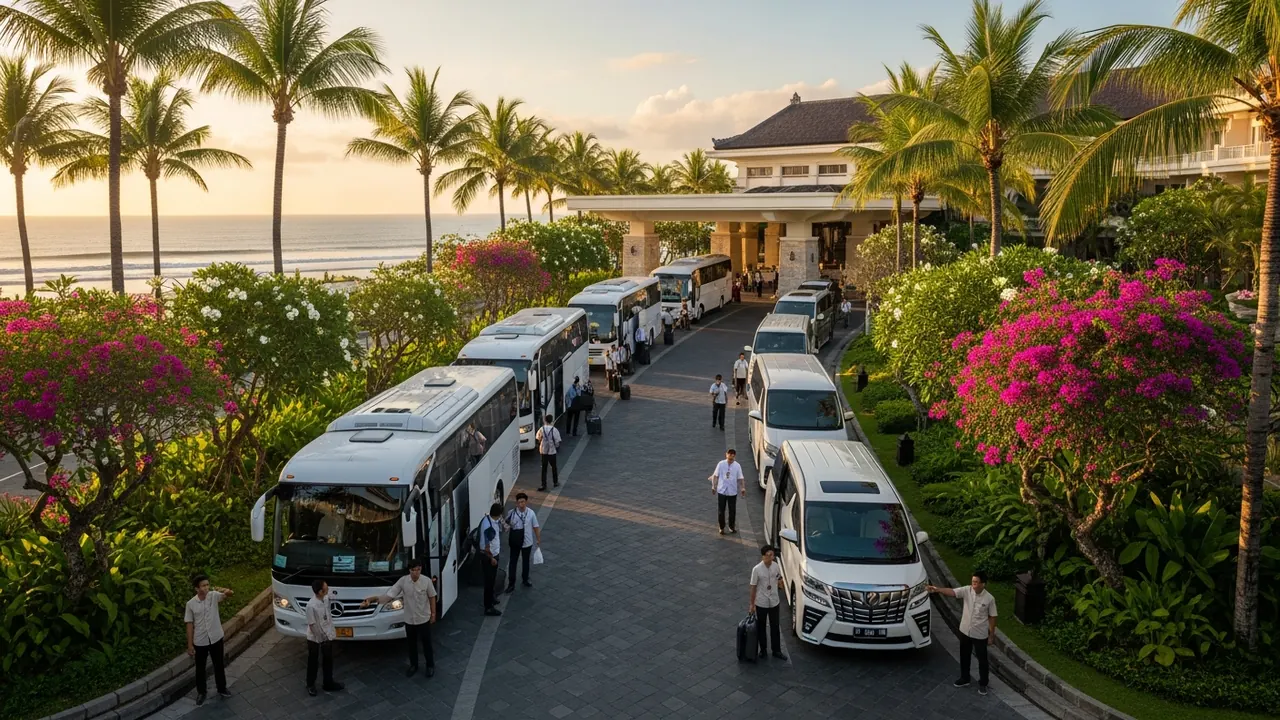
Luggage is the most time-consuming physical element of large-group airport transfers. A group of 150 delegates typically generates 200 to 300 checked bags, which must be loaded onto coaches in a way that allows unloading at multiple hotels if the group splits across properties. Without a loading system — bags grouped and labelled by hotel destination, coaches loaded accordingly — the hotel lobby becomes the sorting room. That is where bali delegate transfers go wrong in a visible, slow, and deeply frustrating way for the delegates experiencing it.
Luggage tagging before departure from the origin city (typically done via the delegate registration pack or the event’s pre-departure communication) is the clean solution. Alternatively, a luggage desk at the arrivals hall where each piece is tagged and sorted into coach allocation adds 10 to 20 minutes per delegate but eliminates hotel-lobby chaos. For multi-day programmes with delegates moving between venues or properties, a baggage-forward operation — where luggage is collected from hotel rooms by a ground team, transferred ahead, and in-room when the delegate arrives — removes the physical burden from delegates entirely and is a strong incentive-programme differentiator.
On-site marshals at each transfer point — hotel departure, venue arrival, venue departure — are the physical coordination layer that keeps the schedule running. Each marshal needs a radio or phone link to the operations centre, a copy of the daily movement plan, and the authority to hold or advance a coach departure within agreed tolerances. Without named marshals at each point, the transfer operation runs on the assumption that every delegate knows where to go and arrives on time — an assumption that reliably fails for at least 10 percent of any group.
Weather, Traffic and Contingency Planning
Two Bali-specific risks make transport contingency planning non-optional: weather and peak-season traffic.
Weather: the wet season and outdoor movement
Bali’s wet season runs roughly November through March (general climatology — no single verified meteorological data source has been referenced here; verify for your specific dates). An afternoon tropical downpour during wet season can begin in minutes, drop significant volume, and clear just as quickly. For groups moving between venues in open-sided vehicles, or walking between coaches and outdoor event spaces, a downpour without rain gear or covered walkways creates an arrival experience that no amount of staging can fully recover from.
Contingency for wet-season outdoor movement means: covered drop-off points at every venue arrival, or a confirmed tented walkway if the venue’s natural cover is insufficient; rain ponchos in coach storage (branded as a programme touch, not a crisis response); and a written protocol for which movements get delayed and by how much if rain is active at departure time. The last point requires someone with the authority to make the call on the day, not a plan that assumes the rain will stop.
Traffic: peak season and ceremony days
Peak season in Bali — roughly June to August, and again in December — sees the Kuta-Seminyak and Canggu corridors reach their worst congestion. Events scheduled to move from Seminyak hotels to Nusa Dua venues for a 9 am plenary need to allow significantly more transfer time in July than the same run in March. This is not a minor adjustment — a 25-minute off-peak run can become 75 minutes or more on a peak-season morning with a traffic incident on Jalan By Pass Ngurah Rai.
Bali-specific calendar events add unpredictable disruption. Nyepi — the Balinese Day of Silence — closes the airport and restricts all movement island-wide for approximately 24 hours. The exact date shifts annually with the Saka lunar calendar. If your event dates fall anywhere in the Nyepi window, check the year-specific date through an authoritative Balinese calendar source before finalising the programme. Galungan, Kuningan and other major Balinese ceremonies generate localised traffic as community processions move through surface roads — a convoy of ceremonial vehicles on a road your coaches need to use can add meaningful delay with no advance warning.
The working rule for transport contingency in peak season or during a high-ceremony period: add 50 percent to your off-peak transfer time estimate when building the plenary-day schedule. Keep a standby vehicle — typically a minivan or small coach — staged near the main hotel throughout the programme day so the operations team can respond to a missed shuttle or a late-arriving VIP without disrupting the main coach sequence.
On-Site Staffing: The Coordination Architecture
Bali on-site event logistics for a multi-day corporate event typically requires a staffed operations structure that runs across the whole programme, not just during peak movement moments. The minimum viable structure for a group of 150 to 300 delegates, based on common DMC practice, includes an operations manager who owns the full transport and logistics plan and maintains direct contact with transport providers; a dedicated driver briefing lead who communicates the daily plan to all vehicle operators at the start of each day; and named marshals at each key physical point — hotel lobby, airport meet-and-greet, venue arrival, venue departure.
For larger groups or more complex programmes with multiple simultaneous movements (some delegates on a team-building activity, others at a site visit, others preparing for the evening gala), the operations structure expands: sub-teams per movement stream, with a radio network linking all coordinators to the central ops lead. The staffing cost for this layer is a real line item in the logistics budget and is priced per day per coordinator. It is not zero, and it is not included in the vehicle hire rate. When comparing transport quotes, confirm whether coordination and marshalling staff are included or separately priced.
Working With a Vetted Transport Partner
Bali DMC Agency does not operate transport, hire coaches, or staff events. We publish the buyer-side intelligence that ground transport providers will not tell you: the planning ratios, the coordination architecture, and the contingency requirements that protect the delegate experience when things do not go to the ideal-case schedule.
When you are ready to scope your bali event transport for large groups programme — airport arrivals manifest, coach count planning, VIP coordination, departure-day logistics — we route your brief to one vetted, accredited local partner and disclose that referral relationship openly. No one can pay to change what we publish; if you use our free guidance and proceed with a partner, they may pay us a referral fee at no extra cost to you.
Reach the team on WhatsApp at +62 811 2859 0000 or via our enquiry form. Give us your group size, arrival profile (number of flights, spread of arrival times), hotel and venue locations, and programme dates — and we will introduce you to a partner who can quote accurately against your specific brief.
Everything on this page is general information, not legal, financial, transport or professional operations advice. Transfer times are mapping-derived approximations to verify for your specific event dates and destinations. Airport passenger figures are from compiled secondary sources; only H1 2024 data is officially confirmed. Planning ratios are illustrative, not guaranteed. Verify all operational details with your on-the-ground logistics partner before committing to delegate communications or programme schedules.
Frequently Asked Questions
How long does an airport transfer from DPS to Nusa Dua take for a large group?
DPS to Nusa Dua is roughly 12 to 15 kilometres by road via the Bali Mandara Toll. In off-peak conditions, that is approximately 20 to 30 minutes — a mapping-derived, approximate figure, not a guarantee. In peak season or during heavy traffic periods, the same run can take 45 to 75 minutes or more. For group planning, build in a minimum of 30 minutes of buffer beyond the off-peak estimate when sequencing airport-to-hotel transfers. The toll route to Nusa Dua is one of the most consistent corridors in Bali, but it is not immune to incidents or peak-period congestion. Verify current conditions with your logistics coordinator for your specific dates.
How many coaches does a group of 200 delegates need for bali event transport?
Using a working assumption of roughly 40 usable seats per standard full-size coach — accounting for guide positioning, operational buffer, and the reality that nominal vehicle capacity is rarely the practical operational capacity — a group of 200 delegates moving simultaneously requires a minimum of 5 coaches. In practice, most coordinators plan for 6 to 7 to allow for staggered boarding, a standby vehicle, and VIP separation. These are illustrative planning ratios, not fixed rules. Your final coach count should be confirmed by a transport coordinator who has assessed your group’s specific movement schedule, hotel pickup points, and venue access constraints.
What is the difference between a VIP transfer and a standard delegate shuttle in Bali?
A VIP transfer uses a dedicated executive vehicle — typically a premium SUV or executive MPV — with a named escort who meets the delegate at the arrivals exit, manages baggage and porter coordination, and accompanies the transfer to the first destination. It is a one-to-one or small-group service timed precisely to the individual’s flight arrival. A standard delegate shuttle is a group-capacity coach or minibus operating on a fixed route and schedule, departing when full or at a set time. For senior delegates whose programme diverges from the group schedule, or whose arrival experience is part of the impression your event makes, a VIP transfer is not a luxury add-on — it is the right tool for a different logistics requirement.
Does Bali’s wet season affect group transfers significantly?
Yes. Bali’s wet season runs roughly November through March, and afternoon tropical downpours are common. For group transfers, the main risks are comfort (delegates caught in rain between coach and venue entrance) and timing (rain can delay outdoor boarding and reduce visibility for drivers). The practical response is covered drop-off points at all key venues, rain contingency in the operations brief, and rain ponchos stored on each coach during wet-season programmes. For outdoor movement sequences — pre-dinner cocktail receptions, team-building activities — a weather contingency that specifies what moves, what delays, and who decides is more useful than hoping the forecast holds. Wet-season events are absolutely feasible in Bali; they just require a more detailed contingency layer in the transport and logistics plan.
Who handles on-site logistics coordination for a Bali corporate event?
A local DMC (Destination Management Company) typically manages on-site logistics for corporate events in Bali — providing the operations manager, driver briefing lead, and venue marshals that make large-group movement work in practice. This is distinct from a venue’s own event manager (who manages the venue, not delegate movement) and from your overseas PCO or event agency (who manages programme and communications, but typically subcontracts ground logistics to a local DMC). The cost of on-site coordination staff is a real budget line — it is not included in coach hire rates and should be explicitly itemised in any logistics quote you receive. Bali DMC Agency can introduce you to a vetted partner who provides this coordination layer; reach us via our enquiry form or WhatsApp.