

How to use this page: Bali DMC Agency is an independent buyer’s guide to Bali MICE — we are not a DMC, PCO, venue, or transport operator ourselves. A DMC manages on-the-ground logistics, venues, and transport; it is not the venue or the conference organiser. Capacities, group sizes, and budgets shown are indicative ranges flagged [VERIFY] (mid-2026) and must be confirmed in writing with the relevant supplier, venue, or broker before you commit — this is general information, not legal, tax, or procurement advice; confirm delegate visas and event permits with the appropriate authority or your notary as relevant. We may earn a referral commission when we connect you to a vetted partner, which never changes the price you are quoted.
Bali group accommodation for corporate events means more than booking enough beds. It is a procurement decision that determines whether your delegates move efficiently between rooms, meeting spaces, and social venues — or spend half their programme in transit. The accommodation precinct you choose sets the logistics ceiling for everything else: transfer times from the airport, the viability of a single-venue cluster, and how much of the delegate experience you control versus leave to the road network. Get the room-block strategy right and the event logistics almost run themselves. Get it wrong and you will be managing complaints about coach wait times before the opening plenary begins.
This guide covers the mechanics of group accommodation contracting that most supplier pitches skip — attrition clauses, cut-off dates, rooming list timelines, concession negotiation — then maps the five Bali precincts by their honest trade-offs for corporate groups. All accommodation rates are on-quote; this guide publishes no fixed nightly prices and does not present any hotel or resort as endorsed. Named hotels appear only as venue-type illustrations.
Why Accommodation Precinct Is a Logistics Decision, Not a Preference
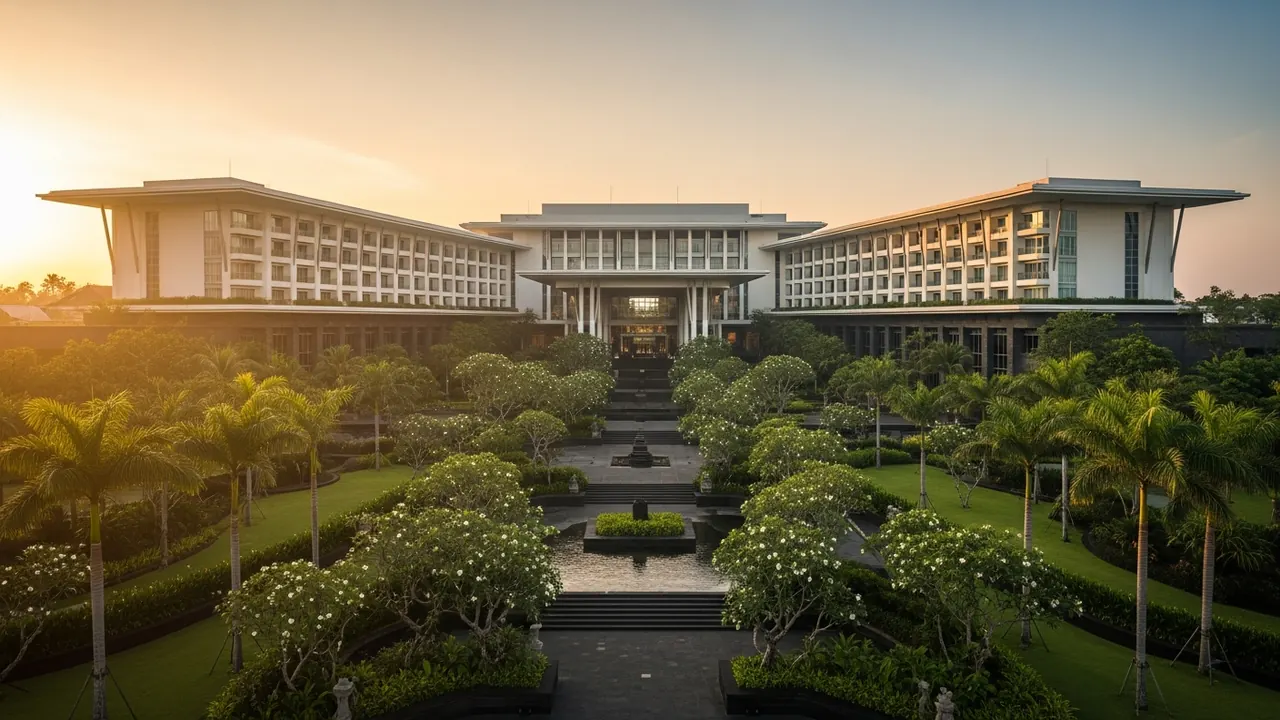
The most common planning error on Bali corporate programmes is treating the accommodation search as a separate exercise from venue selection. It is not. Where your delegates sleep determines: how many coaches you need and how early, how much buffer to build into every schedule movement, whether a single-venue cluster for conference, rooms, and dinner is operationally viable, and whether a resort buyout makes logistical sense at all.
Nusa Dua is the clearest example of why precinct logic matters. The area holds the densest concentration of large international hotel room blocks on the island, situated within a few kilometres of the Bali Nusa Dua Convention Center (BNDCC) — a purpose-configured convention complex whose largest hall, the Nusa Dua Hall, carries a venue-issued, verified theatre-style capacity of up to 5,000 delegates across 4,400 square metres. For a programme that needs a plenary of 400 or more, accommodation near BNDCC in Nusa Dua is not merely convenient. It eliminates an entire layer of daily group transport, removes the departure-time buffer you would otherwise need, and lets your logistics team focus on the event rather than the commute.
Contrast that with a 350-delegate conference roomed across three hotels in Seminyak: perfectly comfortable properties, good restaurants nearby, but the morning movement to Nusa Dua for the plenary session could take 60 to 90 minutes in peak-season traffic. That is a logistics cost absorbed by every delegate, every morning, for the duration of the programme. It does not appear in the accommodation quote.
Room-Block Mechanics: What Buyers Need to Understand
A room block is a reserved allocation of rooms at a negotiated group rate, held against a minimum nights commitment. The terminology is standard across the industry but the contract terms underneath vary considerably, and the consequences of misunderstanding them arrive late — usually during reconciliation or at invoice.
This section describes how room blocks typically work in practice. It is general information, not legal or financial advice. Every clause must be read in the specific contract you are signing, and material terms should be reviewed by someone with appropriate authority in your organisation before you commit.
Attrition Clauses
Attrition is the hotel’s protection against you contracting for 150 rooms and ultimately filling only 80. An attrition clause defines the minimum percentage of contracted rooms you are financially obligated for, regardless of actual pickup. The norm in Bali’s mid-to-upper hotel tier is a commitment to 80 to 90 percent of the block; the hotel’s revenue team will push for the higher end, and planners with strong negotiating leverage or large blocks may achieve something closer to 75 percent. The financial exposure is the difference between your actual room nights used and the contracted floor, charged at the agreed room rate. On a 200-room block at a premium Nusa Dua property, the attrition floor is a material dollar figure. Understand it before signing, not after the event.
Cut-Off Dates
The cut-off date is the deadline by which your delegates must book within the group block to secure the group rate and be counted against your contracted allocation. Rooms not booked by cut-off revert to the hotel’s general inventory and become available at open rates, which may be higher or lower than your group rate depending on prevailing demand. Cut-off dates for large blocks at peak-season properties in Bali typically sit four to eight weeks before arrival. For programmes with delegates registering late — an incentive qualifier programme where the final headcount confirms close to the date — negotiate the cut-off date explicitly, and confirm in writing what happens to the rate for delegates who book after cut-off if rooms remain available.
Rooming Lists and Arrival Manifests
The rooming list is the document that tells the hotel who is arriving, when, in what room type, and with what special requests. For the hotel’s rooms division, it is the production schedule for your allocation. For your logistics team, it is the live data source for airport meet-and-greet sequencing and coach manifests. Rooming lists are typically due 21 to 30 days before arrival for large groups — earlier for properties with complex room-type mixes or a high proportion of suite-level accommodation. Build the rooming list submission deadline into your programme calendar as a hard milestone, not an admin task to handle during the final week.
Concession Negotiation
Room blocks of a meaningful size — the threshold varies by property, but 30 to 50 rooms is often sufficient at a mid-size resort, and 80 to 100 at a large Nusa Dua property — give you genuine negotiating leverage for concessions beyond the group rate itself. Common concessions to put on the table: complimentary room ratio (one comp per 30 to 50 rooms paid is a realistic target at many properties), suite upgrades for VIP delegates, early check-in and late checkout for key arrivals, complimentary meeting room usage for an operations hub or pre-conference workroom, welcome amenities in-room, and a dedicated group check-in desk rather than routing 150 arriving delegates through the main lobby reception. None of these are guaranteed, and the hotel’s yield at your target dates affects how much flexibility exists. Ask for all of them and treat what you receive as a function of the block size, the property tier, and the competitive alternatives you have demonstrated you are considering.
Sourcing room blocks through a vetted partner. Bali DMC Agency is an independent editorial guide — we do not negotiate room blocks or manage events. When you are ready to source accommodation, we can introduce you to a single vetted local partner who has established relationships with properties across all five precincts. No one can pay to change what we publish; if you use our free guidance and proceed with a partner, they may pay us a referral fee at no extra cost to you. Submit your brief via our enquiry form or reach the team on WhatsApp at +62 811 2859 0000.
Resort Buyouts: When They Make Sense and When They Do Not
A resort buyout — contracting every room in a property for your exclusive use — is the high-control end of bali resort buyout corporate group planning. The delegate experience is entirely self-contained: your event is the only event at the property, all F&B venues serve your programme, and common areas are available for casual networking without the friction of public guests sharing the pool. For incentive programmes where exclusivity is the point — senior leadership retreats, top-performer recognition trips, high-confidentiality product briefings — a buyout delivers something a room block in a large property cannot.
The practical constraints are real. Boutique properties in Bali that are attractive for buyouts typically carry 40 to 80 keys. If your group runs to 150 delegates, a boutique buyout means distributing the overflow across a second property — which immediately reintroduces the logistics complexity you were trying to avoid. Larger resorts with 200-plus keys can accommodate full groups without a second property, but at that scale, you are no longer buying the intimacy of a boutique setting. You are buying a large resort with good negotiating leverage.
Buyout pricing is on-quote and property-specific. The headline rate is typically a minimum revenue guarantee — the total room revenue you are committing to — rather than a per-room nightly rate. Understand whether F&B minimums are included in that guarantee or additive. Off-peak buyouts at smaller properties can be structured more creatively; peak-season buyouts at sought-after properties involve less flexibility because the property has alternative demand.
The Five Bali Precincts: Accommodation Trade-Offs by Group Type
Each of Bali’s main event precincts offers a different combination of room inventory, proximity to convention and event infrastructure, transfer time from Ngurah Rai International Airport (DPS), and delegate experience character. The right choice depends on your programme type, headcount, and the balance you are trying to strike between operational efficiency and environmental experience.
Nusa Dua: The Efficient Convention Cluster
For conferences and conventions where accommodation near BNDCC is a logistical priority, Nusa Dua is the starting point for most planners — and for good reason. The precinct’s high-density hotel belt gives you the largest room-block depth anywhere in Bali. Large international resort properties in this area can absorb blocks of 200 to 400 rooms without splitting your group across brands. The Bali Mandara Toll road links DPS to Nusa Dua in approximately 20 to 30 minutes under normal traffic conditions — a mapping-derived estimate, not a guarantee, but consistently the fastest airport-to-event-precinct corridor on the island.
The practical implication: for a 300-delegate conference with a three-day programme at BNDCC, rooming your entire group in adjacent Nusa Dua hotels means daily transfers between rooms and the convention centre may be a short walk or a brief shuttle run, not a 45-minute coach convoy. That operational difference compounds across every programme movement for three days.
The trade-off is character. Nusa Dua is a gated enclave built around convention infrastructure and resort hotels. It is efficient and professionally managed, but it is not the Bali of cultural immersion and visual distinctiveness that makes incentive programmes memorable. For conferences where the programme is the product, that trade-off is correct. For incentive programmes where the destination experience is the reward, it may not be.
Ubud: Retreat Character, Low Room Inventory
Ubud is the natural choice when the delegate experience brief specifically calls for cultural immersion, wellness integration, or executive retreat aesthetics. The area’s boutique and mid-scale properties — set among rice terraces, forest slopes, and traditional village architecture — create an environment that no Nusa Dua hotel can replicate. For leadership retreats of 20 to 80 delegates, or wellness-integrated incentive programmes where the setting is a core part of the value, Ubud competes on differentiation rather than efficiency.
The accommodation constraints are significant. Boutique Ubud properties rarely exceed 40 to 60 keys. For a group larger than 80 delegates, you will almost certainly split across multiple properties — introducing the coordination overhead of a distributed group that defeats much of the consolidation benefit. Room-block negotiation at smaller properties works differently than at large resorts: you may be taking most of the property’s inventory rather than a percentage of a large allocation, which changes your leverage dynamics on concessions.
Transfer time from DPS to Ubud runs approximately 60 to 90 minutes in normal conditions and 90 to 150 minutes during peak-season congestion — mapping-derived approximations, not guarantees. For multi-day conferences with delegates arriving across multiple flights, those transfer times affect arrival-day operations materially. For a three-night incentive retreat where delegates arrive in a single batch and the programme is entirely self-contained at the property, the distance becomes a one-time cost absorbed at arrival and departure.
Seminyak: Mid-Tier Hotels, Beach-Club Proximity
Seminyak sits in Bali’s main tourism belt, roughly 20 to 40 minutes from DPS under normal traffic conditions — though peak-season congestion in the Seminyak-Kuta corridor is real and can extend journey times considerably. The precinct’s mid-tier conference hotels offer ballroom-capable spaces suitable for groups up to around 200 to 250 delegates, with room blocks available in the same property. For mid-size conferences that do not require convention-scale plenary infrastructure, Seminyak can deliver conference space and rooms without distributing delegates to a separate precinct.
The bali hotel room block conference use case in Seminyak suits programmes of roughly 80 to 200 delegates where the agenda is primarily internal — team conferences, annual kick-offs, regional sales meetings — and where proximity to Seminyak’s restaurant and beach-club scene is a positive delegate amenity for evening programmes. Beach clubs in the area are regularly used for incentive receptions and closing-night events; coordinate these into the accommodation-and-logistics plan from the start, not as an add-on.
Uluwatu and Jimbaran: Cliff Exclusivity, Limited Room Depth
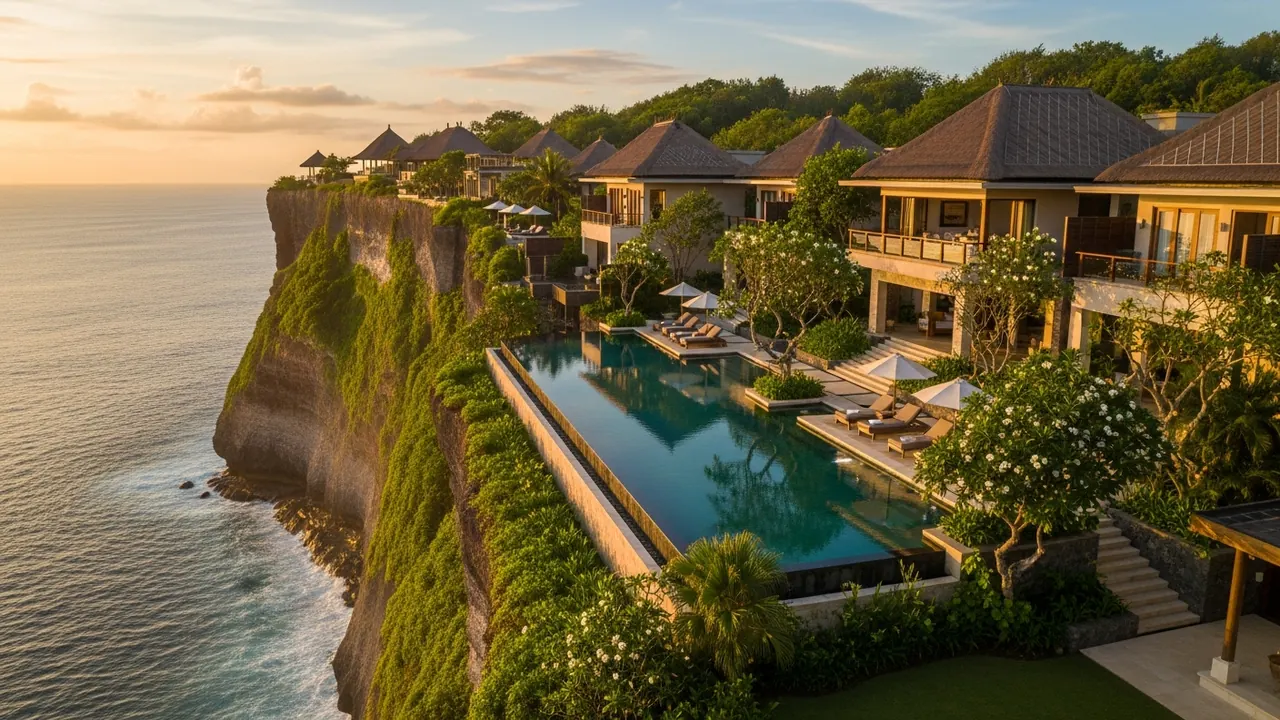
The Bukit peninsula south of DPS — Uluwatu and Jimbaran — carries the most dramatic coastal scenery in southern Bali and some of the island’s most recognisable event venues. For incentive programmes where a clifftop gala dinner or oceanfront reception is the centrepiece, rooming delegates on the Bukit eliminates the transfer logistics of bussing a large group from Nusa Dua or Seminyak to the event venue at the end of the programme day.
Room inventory on the Bukit is concentrated in a small number of large resort properties and a larger number of boutique and villa-style operations. For groups requiring 100 or more rooms in a single property, the options are narrower than in Nusa Dua. Road access on the Bukit peninsula is also a real operational consideration: some venues are on roads that constrain coach-convoy throughput, and arrival sequencing for large groups requires more planning than a standard hotel drop-off. Verify road access and unloading capacity for your specific property before finalising group transport logistics.
Canggu: Creative Character, Long Transfers
Canggu attracts corporate clients who want creative energy and an informal delegate experience — a counterpoint to the polished corporate environment of Nusa Dua. It works for incentive programmes and team-building events where the brief explicitly calls for this character, and where the group is small enough to fit within Canggu’s boutique accommodation offer.
Transfer time from DPS to Canggu runs approximately 30 to 50 minutes off-peak, but the Canggu-Kuta corridor is among the most traffic-sensitive in Bali. In peak season, 60 to 120 minutes is not unusual — and for large groups moving in multiple coaches, that time extends further with queuing at the property’s access roads. Canggu is a strong choice for boutique programmes of 30 to 80 delegates where the beach club and creative precinct are central to the experience, and a poor logistics choice for groups that need to transfer to Nusa Dua or other southern precincts repeatedly during the programme.
Precinct Comparison: Accommodation Fit at a Glance
| Precinct | Room inventory depth | DPS transfer (off-peak, approx.) | Best programme fit | Key constraint |
|---|---|---|---|---|
| Nusa Dua | High — largest hotel blocks on the island | ~20–30 min via Bali Mandara Toll | Conferences, conventions; accommodation near BNDCC | Limited cultural immersion; enclave character |
| Ubud | Low — boutique properties, 40–60 keys typical | ~60–90 min (verify; peak up to 150 min) | Executive retreats; wellness incentives; groups up to ~80 | Room-count ceiling; transfer time from DPS |
| Seminyak | Moderate — mid-tier hotel blocks, 80–250 rooms | ~20–40 min (peak congestion real risk) | Mid-size conferences; team events; beach-club evening programmes | Peak-season traffic; no large convention space on-site |
| Uluwatu / Jimbaran | Low-to-moderate — concentrated in a few large resorts | ~20–40 min (road access varies by venue) | Cliff-venue gala focus; incentive with oceanfront setting | Narrow road access; limited room depth for 100+ groups |
| Canggu | Low — boutique and villa accommodation | ~30–50 min (peak: 60–120+ min) | Boutique incentives; creative/informal programmes; groups up to ~60 | Peak traffic; no convention infrastructure; transfer overhead |
Transfer times are mapping-derived approximations and must be verified for your specific property and event dates. Room inventory ranges are indicative and property-specific — confirm current availability with the venue or a vetted local partner before citing these ranges in planning documents.
Peak-Season Constraints: Book Before You Send the Delegate Save-the-Date
Bali’s dry season runs roughly April through October (standard climatological range — verify for your specific location and dates). This period is also peak demand for both leisure and corporate travel, and the interaction between those two demand pools creates a real inventory problem for planners who leave room-block contracting late.
For premium Nusa Dua properties adjacent to BNDCC, group room blocks for large events in June, July, and August can be committed 12 to 18 months ahead of date. That is not a scare figure: it reflects the combination of large international conferences that book two years in advance, leisure buyouts from the incentive-travel market, and the simply limited number of high-capacity properties in Bali’s most efficient precinct. If your programme requires a specific property type in Nusa Dua for peak-season dates, begin accommodation contracting before you finalise the conference venue, not after.
The pricing dimension matters equally. Availability and rates for bali resort buyout corporate group programmes tighten materially in high-demand periods. A boutique property that might offer a competitive buyout package in November is in a different yield environment in August, when leisure demand absorbs much of its inventory at open rates. The price differential between a peak-season and shoulder-season room block at the same property can be significant; if your event dates have flexibility of even four to six weeks, it is worth running a rate comparison before locking dates.
One hard constraint that catches planners: Nyepi, the Balinese Day of Silence, closes the airport and restricts movement island-wide for approximately 24 hours. The date shifts annually on the Saka lunar calendar. If your programme dates are within range of the Nyepi period, verify the exact year-specific date through an authoritative Balinese calendar source before confirming delegate travel. This is not a preference to work around — it is a physical constraint that cannot be managed with contingency coaches.
Working With a Vetted Partner to Source Accommodation
Bali DMC Agency is an independent editorial guide. We do not negotiate hotel contracts, manage room blocks, or represent any accommodation property. Our role is to publish the buyer-side intelligence — the room-block mechanics, the precinct trade-offs, the peak-season risks — that vendor sites and hotel sales teams have no incentive to share with you.
When you are ready to source accommodation, we route qualified briefs to one vetted, accredited local partner who has active relationships across all five precincts described above. That referral relationship is disclosed openly: no one can pay to change what we publish, and if you proceed with a partner, they may pay us a referral fee at no extra cost to you.
To start an accommodation search, reach the team on WhatsApp at +62 811 2859 0000 or via our enquiry form. Give us your event type, confirmed or indicative headcount, target dates, preferred precinct or flexibility, and any specific requirements — buyout, accessibility, on-site meeting space — and we will route your brief to a partner who can return a real shortlist with current availability, not a brochure PDF.
For the full logistics picture — group transfers, coach sequencing, airport meet-and-greet — see the group transport and logistics guide. For venue selection and configuration, see the Bali MICE venues guide. For a full cost-per-delegate model that integrates accommodation as a budget line, see the MICE cost guide.
Everything on this page is general information, not legal, financial, or accommodation contracting advice. Room-block norms, attrition structures, and seasonal pricing described here reflect general market practice and may differ from the specific terms in any contract you receive. Transfer times are mapping-derived approximations only. Verify all material details with your accommodation partner and review contract terms with appropriate authority before committing budget.
Frequently Asked Questions
What is the best precinct for group accommodation near BNDCC in Bali?
Nusa Dua offers the highest room-inventory density adjacent to the Bali Nusa Dua Convention Center (BNDCC), making it the most logistically efficient precinct for conferences and conventions that use BNDCC as the primary venue. Large resort properties in Nusa Dua can accommodate room blocks of 100 to 400 rooms within the same precinct, minimising daily group transport overhead. The Bali Mandara Toll road connects Nusa Dua to DPS in approximately 20 to 30 minutes under normal traffic — the fastest airport-to-convention-precinct corridor in Bali. For programmes where proximity to BNDCC is a priority, begin Nusa Dua room-block contracting early: peak-season inventory at leading properties commits 12 to 18 months ahead of date.
What is an attrition clause and how does it affect a corporate room block?
An attrition clause in a hotel room-block contract sets the minimum percentage of contracted rooms you are financially committed to, regardless of actual delegate pickup. The typical range at Bali’s mid-to-upper hotel tier is 80 to 90 percent of the block. If your programme contracts 200 rooms and the attrition floor is 85 percent, you are financially committed to 170 room nights even if only 140 delegates attend. The financial exposure on the shortfall — charged at the agreed group rate — is a material figure on a large block. Negotiate the attrition percentage as part of the initial contracting discussion, not as an afterthought when reviewing the contract draft. Understand it clearly before signing.
When does a resort buyout make sense for a corporate group in Bali?
A resort buyout makes sense when exclusivity is operationally or experientially central to the programme — senior leadership retreats, high-confidentiality product briefings, top-performer incentive trips where the programme is the reward and shared resort access with public guests would undermine it. Buyouts work best for groups that fit naturally within the property’s key count: a 60-room boutique property for a 55-delegate group gives you genuine exclusivity without overflow logistics. For groups of 150-plus, buyout economics often push toward larger properties where the exclusivity character is less intimate. Buyout pricing is on-quote and property-specific; peak-season buyouts at sought-after properties have less flexibility than shoulder-season ones.
How early should we contract room blocks for a Bali corporate event in peak season?
For large-group room blocks at premium Nusa Dua properties during peak season — roughly June through August — a booking window of 12 to 18 months ahead is realistic for the best available inventory. Boutique resort buyouts in Ubud or the Bukit for incentive programmes may have more flexibility, but popular properties at sought-after dates still commit months ahead. The safest sequencing: confirm accommodation availability and hold dates before finalising delegate invitations or publishing conference registrations. Releasing a hotel hold to re-confirm later in a peak period is a risk that regularly resolves against the planner when competing demand has moved in.
Can Ubud accommodate a corporate group of 100 delegates?
Most boutique and mid-scale Ubud properties top out at 40 to 80 keys, which means a group of 100 delegates will almost certainly require two properties. Splitting a group across properties reintroduces logistics complexity — separate check-in queues, separate morning coach pickups, potential inequity in room standard between properties — that defeats some of the advantages of Ubud’s retreat character. For groups of 80 to 100, a hybrid structure is worth considering: accommodate 80 delegates at a single Ubud property for a buyout or near-buyout, with 15 to 20 overflow delegates at a second nearby property operating under a small room block with a confirmed shuttle link. Confirm current availability with a vetted local partner rather than assuming any property’s published room count equates to its group block capacity.