How to use this page: Bali DMC Agency is an independent buyer’s guide to Bali MICE — we are not a DMC, PCO, venue, or transport operator ourselves. A DMC manages on-the-ground logistics, venues, and transport; it is not the venue or the conference organiser. Capacities, group sizes, and budgets shown are indicative ranges flagged [VERIFY] (mid-2026) and must be confirmed in writing with the relevant supplier, venue, or broker before you commit — this is general information, not legal, tax, or procurement advice; confirm delegate visas and event permits with the appropriate authority or your notary as relevant. We may earn a referral commission when we connect you to a vetted partner, which never changes the price you are quoted.
Bali corporate team building refers to structured, facilitated group experiences designed to reinforce collaboration, communication, or shared culture within an organisation — delivered in-destination as part of an incentive, conference, or standalone offsite program. The term covers a wide range from immersive cultural workshops and CSR projects to high-energy outdoor activities, and the right choice depends heavily on your audience, objectives, and risk appetite, not on which option photographs best.
That distinction matters because most team-building content online is written by vendors who want to fill activity slots. This guide is written from the planner’s seat: what questions to ask before you brief a supplier, which Bali options carry genuine executive-appropriate value and which are better suited to younger field-sales cohorts, and where the weather, group size, and cost realities can catch a first-time Bali buyer off guard.
Start with Objectives, Not Activities
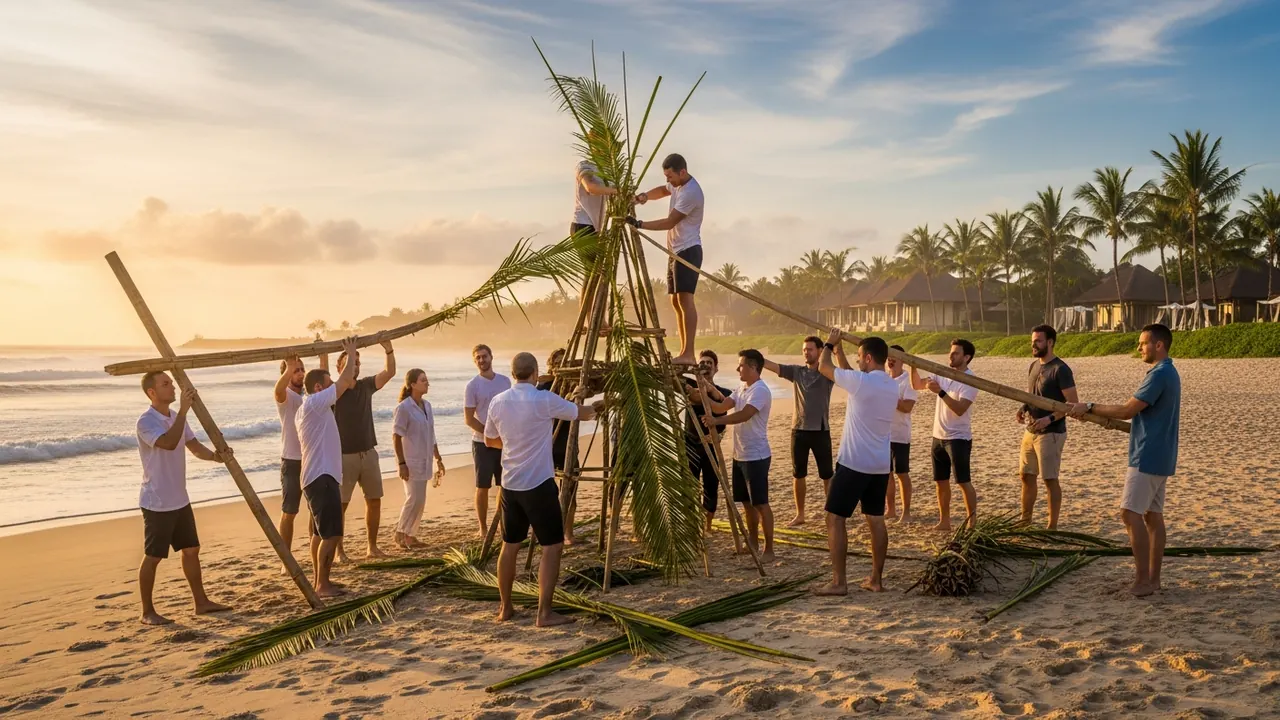
The most common procurement error in team building is briefing an operator with a list of activities before articulating what the program needs to achieve. Operators then propose what they can cheapest-supply, not what fits your group. Before you circulate an RFP, get clarity on three questions:
- What is the business objective?
- New-team integration after a merger, cross-functional relationship building, leadership alignment, or reward-and-recognition for high performers each call for different program designs. An integration objective benefits from activities that require actual interdependence; a recognition objective may call for shared experience and prestige over problem-solving.
- What is the audience composition?
- A 40-person senior leadership team from six countries has very different physical comfort thresholds, cultural norms around competition, and hierarchy sensitivities than a 200-person regional sales force in their early thirties. Mixed nationality and seniority always require a specific design brief — not a generic template.
- What is the energy level you want to leave people with?
- If team building falls the afternoon before a gala dinner and keynote remarks from the CEO, you want participants energised but not sunburned, muddy, or fatigued. If it sits after the main program as a wind-down, something slower and culturally immersive may land better. Timing in the program arc matters as much as the activity itself.
Operators who do not ask these questions in a scoping call are not the ones to trust with your group.
Commonly Offered Team-Building Activities in Bali
The following options are frequently offered by Bali operators and appear consistently across the corporate-events market. They are illustrative examples of what the market commonly provides — scope, quality, and execution vary significantly by operator, and none of these are statistically verified as the most popular. Use them as a starting framework for your brief, not as a confirmed menu.
Cultural and Culinary Workshops
Cooking classes and Balinese cooking ceremonies are among the most consistently corporate-appropriate team building activities in Bali. They are inherently collaborative (group preparation, divided tasks, shared outcome), accessible regardless of fitness level, and culturally grounded in ways that feel earned rather than touristy when facilitated well. A Balinese cooking class set in a working compound, sourcing from a local market, carries genuine differentiation from a hotel resort version that uses pre-cut ingredients and branded aprons. Ask operators specifically how the setting differs and whether the facilitator speaks to the cultural context or just the recipe.
Other cultural formats that translate well to executive audiences include traditional craft workshops (offering, weaving, batik or silver work), gamelan or kecak dance introductions with a practicing artist rather than a tourist show performer, and Balinese blessing or purification ceremonies that are conducted with permission and proper facilitation. The last category requires genuine cultural sensitivity in scoping — mishandled, it becomes the kind of appropriation that generates internal complaints. Ask your operator who facilitates it and what the briefing process looks like for participants.
CSR and Community Projects
Beach cleanups, mangrove replanting, school infrastructure projects, and community art initiatives are frequently offered as CSR-integrated executive team building in Bali. When structured well, they satisfy sustainability requirements increasingly common in corporate RFPs, create durable shared memory, and align with Bali’s conservation challenges — the island’s relationship with single-use plastics and coastal waste is real and well-documented, so participants can engage with a genuine issue rather than a staged exercise.
The buyer-protection caveat: not all CSR programs produce meaningful impact. Some are effectively beach-walk activities branded as cleanups, with minimal community benefit and no measurement. Before including a CSR component, ask your operator for the community or NGO partner’s name, what the measured output of past programs was, and whether the benefit remains after the group leaves. If the operator cannot answer those questions concretely, the program is cosmetic. See our sustainable and CSR events guide for a fuller briefing framework.
Outdoor and Adventure Activities
Mount Batur sunrise treks are among the most frequently cited Bali team-building experiences for corporate groups. The trek involves an early-morning departure (often departing from accommodation around 2–3 a.m.), a two-to-three hour ascent, and sunrise at the summit. It is physically demanding for groups not accustomed to hiking, which makes audience profiling essential. For a field-sales or operations cohort with a broad age range and mixed fitness levels, this can be genuinely energising and memorable. For a senior leadership group that includes delegates with joint issues, or those flying in from a significant time zone difference, it can be miserable. Always build in an opt-out activity for those who cannot or choose not to participate — forcing participation in a physically strenuous activity creates liability and resentment.
White-water rafting on the Ayung River near Ubud is another commonly offered option for groups seeking more energy. The river section typically used for corporate groups is classified as moderate — most healthy adults can complete it — but it is outdoor and weather-dependent. Confirm your operator’s guide-to-participant ratio, safety briefing protocol, and wet-season policy in writing before signing. Rafting in the wet season (roughly November through March) carries different risk and water-level conditions than the dry season; a credible operator will have a clear wet-weather protocol.
Team challenge formats — obstacle courses, Amazing Race-style city hunts, dragon boat racing — are frequently offered and are best suited to larger, younger, more competitive groups. They require space, logistical coordination, and clear facilitated debrief to connect the activity to the business objective. Without the debrief, you have run a company sports day, not a team-building program.
Hybrid and Wellness Formats
For executive team building in Bali where the brief is relationship-deepening rather than challenge-based, wellness formats are increasingly common: sunrise yoga with a local practitioner at a rice terrace or private villa compound, sound healing or meditation in a traditional setting, and spa-partner formats that build in conversation time. These work particularly well when the group is senior, has already spent intensive time in plenary sessions, or includes delegates from cultures where competitive team activities feel uncomfortable. They also carry lower weather risk than outdoor adventure formats.
The procurement note: wellness formats vary enormously in quality. A sunrise yoga session led by an experienced teacher at a genuinely beautiful location is very different from one run by a hotel F&B team in a conference room. Push operators to confirm who facilitates, where the setting is, and what the contingency is if weather does not cooperate.
The Executive Audience Test
One question worth applying to every proposed activity before you include it in a brief: would a senior executive feel this is a thoughtful use of their time, or would they feel infantilised? Some activities that work well for a team of 25-year-olds — elaborate trust-fall formats, costume-based challenges, enforced competitive games with public scoring — land poorly with mixed-seniority groups where some participants are C-suite or board level. This is not about protecting executives from fun; it is about not designing something that the most senior participants in the room will mentally check out of or actively resent.
A useful test: if you were explaining the activity to your CFO in a planning meeting, would you feel the need to qualify or apologise for it? If so, reconsider.
Corporate-appropriate team building in Bali generally shares these characteristics: it has a clear facilitated link to the business objective, it is accessible to adults of varying fitness and mobility, it does not require participants to be publicly embarrassed or physically uncomfortable without warning, and it generates conversation during and after the experience rather than just logistical coordination during it.
Scoping your team-building program? Share your group profile, objectives, and program timing with our concierge and we will route your brief to a vetted partner — use our enquiry form or message us on WhatsApp at +62 811 2859 0000.
Weather-Sensitivity: What Buyers Often Miss
Bali has two seasons in broad terms: a dry season running roughly April through October, and a wet season from approximately November through March. This is standard climatology and the general pattern holds, though actual weather in any given week can and does deviate. The buyer implication is not simply that wet-season events are impossible — it is that outdoor activities planned without a weather contingency in the wet season carry meaningful execution risk.
A beach cleanup at low tide in November requires a contingency if there is heavy rain. A sunrise trek to Mount Batur in December requires a contingency if the summit is cloud-covered (which substantially affects the experience). A river-rafting program in February requires a wet-weather protocol. A rice-paddy walk that is exquisite in June may be muddy and unpleasant in January.
What good operators do: they design activities with a named alternative and make the call at least 24 hours in advance rather than on the morning of execution. What weak operators do: they propose the activity, collect payment, and adapt on the day. When you brief a supplier, ask them to include their wet-weather protocol and backup option in writing as part of the proposal. If they cannot or will not, flag it.
Dry-season months (roughly May through September) are generally the most reliable for outdoor programming, but they are also the highest-demand period for Bali overall — which means venue, accommodation, and transport availability can tighten, and pricing can reflect that pressure. Planning around school holiday peaks within the dry season also matters for groups with delegates based in Europe or Australia. There is no definitively perfect month; there are trade-offs that your operator should help you navigate with specifics about your dates.
Group Size: What the Industry Shorthand Means
Bali’s team-building market is commonly described as capable of handling groups from roughly 20 to 1,500 delegates [VERIFY — single industry source; not independently confirmed]. This is industry shorthand for the general range of group sizes that Bali’s venues and operators collectively support across MICE events, not a guaranteed capacity for any individual activity or operator.
In practice, most team-building activities have meaningful sweet spots. A cooking class workshop works very well for 20–80 participants across multiple stations and breaks down logistically for 300 unless you are running parallel sessions at different sites and re-assembling. A beach cleanup can accommodate hundreds, but the facilitated debrief and the quality of the experience per participant typically degrade past a certain scale. A dragon boat regatta may need a minimum viable group to fill boats properly.
When you brief suppliers, specify your headcount precisely and ask them to describe how they will actually structure the activity for that group size — not just confirm they can do it. The answer tells you whether they have run it at that scale or are theorising.
Cost Ranges: What You Should Expect to Pay
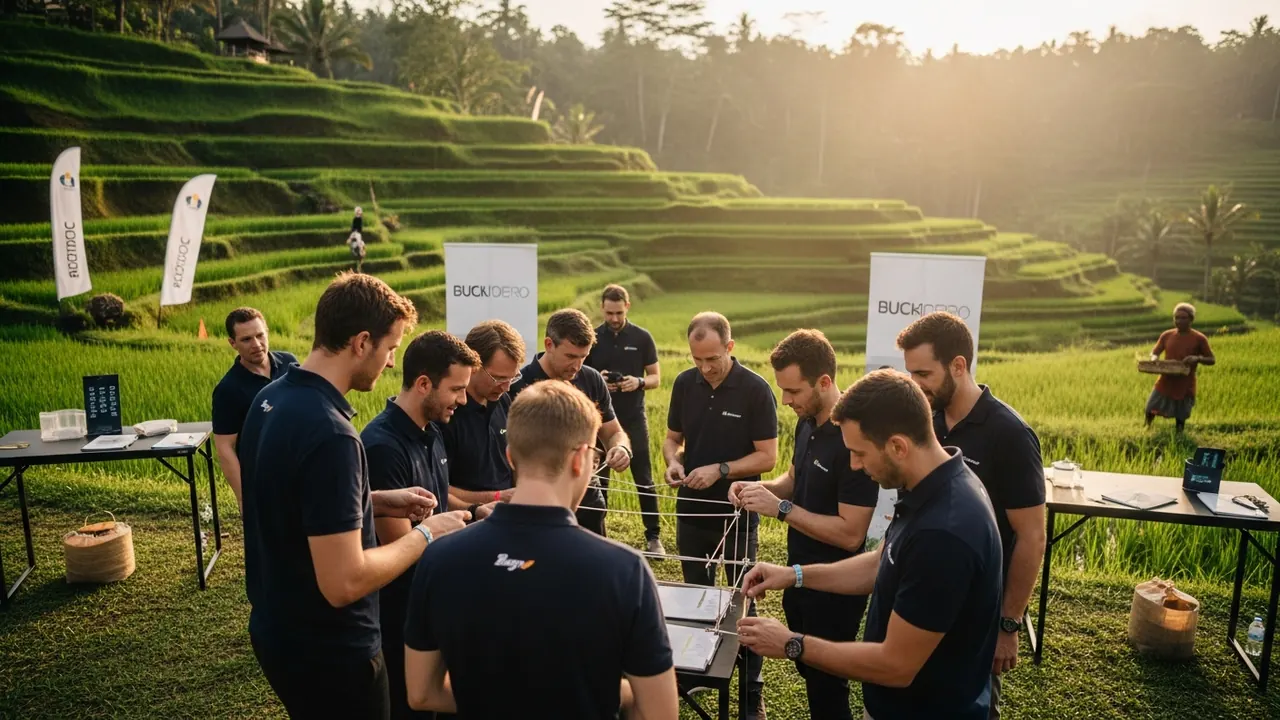
Team-building costs in Bali are quote-based and vary widely depending on activity type, group size, session length, location complexity, facilitator calibre, and inclusions. Any specific per-person figure you see published by a vendor is a starting-price anchor, not a complete cost. The table below presents illustrative bracket ranges for planning purposes only — verify against actual quotes from vetted operators, as pricing fluctuates with demand, season, and scope.
| Activity Type | Typical Bracket (per pax, on quote) | Key Cost Drivers |
|---|---|---|
| Balinese cooking class (facilitated) | On quote — bracket varies by setting, inclusions, chef profile | Location (hotel vs. local compound), market visit inclusion, meal service |
| Cultural craft workshop | On quote — varies by craft type, artist, materials, session length | Artist seniority, take-home piece quality, group size |
| Mount Batur sunrise trek | On quote — guides, permits, transport, breakfast at summit | Group size, departure hotel location, guide ratio |
| White-water rafting (Ayung River) | On quote — safety staff ratio and equipment condition vary significantly | Operator tier, guide:pax ratio, post-activity F&B |
| CSR beach cleanup (facilitated) | On quote — community partner, waste logistics, certificates | Measurement reporting, NGO partner fee, post-activity debrief quality |
| Team challenge / Amazing Race format | On quote — facilitation staff count scales with group size | Logistical complexity, transport, prizes, permit if public space used |
| Executive wellness / yoga | On quote — setting and facilitator calibre drive cost more than activity duration | Location (private villa vs. resort), teacher credentials, group size |
What is almost never included in a headline per-person price unless you specifically ask: group transport to and from the activity location, permits for outdoor or public-space use, gratuities, photography and video, a facilitated debrief session, and wet-weather backup arrangements. When you receive a quote, ask your operator to confirm what is explicitly included and excluded in writing. Itemised quotes allow you to compare suppliers honestly; all-in package quotes make it difficult to know what you are paying for.
Mixed Nationality and Seniority: The Design Variables Most Briefs Ignore
A group of 60 delegates from eight countries, spanning ages 28 to 61, with four C-suite participants and 56 mid-level managers, requires a genuinely different program design than a homogeneous national group. The complicating variables are not exotic — they are procurement-grade considerations that belong in your brief.
Physical activity comfort: Some nationalities have strong cultural norms around physical exertion as a corporate activity; others find it uncomfortable or undignified. Ask whether participation is mandatory or whether a parallel opt-out is available at each activity. This is not mollycoddling — it is respecting the range of bodies and backgrounds in any real corporate group.
Dietary restrictions and food safety: A cooking class or culinary experience with a mixed international group requires upfront dietary mapping. Halal requirements, vegetarian and vegan diets, shellfish and nut allergies, and alcohol restrictions all need to be briefed clearly to operators at the RFP stage, not on the morning of the event.
Language: Facilitated activities rely heavily on instruction and debrief. If your group includes delegates whose working language is not English, and all facilitation is in English only, the experience degrades materially for a meaningful proportion of your group. Ask operators whether bilingual or multilingual facilitation is available and at what cost.
Hierarchy in competitive formats: In several Asian corporate cultures, being visibly seen to lose or fail — particularly in front of more junior colleagues — carries real social cost. Competitive formats with public scoring and elimination rounds carry hierarchy risk that relaxed Western team cultures might not anticipate. Structure matters: collaborative problem-solving between mixed teams tends to be more culturally neutral than head-to-head competition.
What to Put in Your Team-Building Brief
A brief that generates useful, comparable quotes from multiple operators should include:
- Confirmed headcount and group composition (nationality mix, age range, seniority spread, any known physical limitations or dietary needs)
- Business objective in one sentence — what does a successful program look like in terms of group behaviour or feeling at the end?
- Timing in the program (morning of day two, afternoon before gala dinner, standalone day, etc.)
- Target session length (half-day, two hours, full day)
- Budget posture — not a fixed figure, but a directional bracket (lean/moderate/premium) helps operators calibrate proposals
- Any hard constraints: no alcohol, no physical contact formats, must be weather-proof, must include a debrief
- Confirmation of wet-weather contingency requirement
- Required deliverables: photography, participant certificates, impact report for CSR
Operators who respond with a generic brochure rather than a tailored proposal against your brief are telling you something about how they will execute your event.
Ready to scope your program? Share a brief with our team and we will route your enquiry to one vetted, accredited Bali partner and disclose that referral relationship openly. Contact us via our enquiry form or WhatsApp at +62 811 2859 0000 — or email [email protected].
Questions to Ask Any Team-Building Operator
The MICE market in Bali includes operators across a wide quality range. Below are the questions experienced corporate buyers use to separate credible suppliers from ones that will underdeliver on the day.
- What is your guide or facilitator-to-participant ratio for this activity at our group size?
- Who specifically will facilitate the program — can we see their background and speak to them before signing?
- How many times have you run this activity at this group size in the past 12 months?
- What is your wet-weather contingency and at what point do you make the call?
- Is the per-person price inclusive of transport, permits, photography, and debrief — or what exactly is excluded?
- What are your payment and cancellation terms, and what happens if we need to adjust headcount 48 hours before?
- For CSR programs: who is the community or NGO partner, what is the measurable output, and can you provide a post-program impact report?
- For cultural programs: who holds the relationship with the local facilitator or artisan, and have they consented to and been briefed on working with a corporate group?
There are no guarantees in event execution — the island’s logistics, weather, and supply chain introduce variability that no operator can fully control. What differentiates a credible partner is their contingency planning, communication when things shift, and transparency about what they cannot guarantee. This is general information, not professional event-planning advice; execution is delivered by a vetted partner and all contracts should be reviewed by your own advisers before signing.
Frequently Asked Questions
What team-building activities in Bali are genuinely appropriate for senior executive groups?
Cultural and culinary workshops tend to be the most consistently well-received with senior audiences: Balinese cooking in a traditional compound setting, craft workshops with a local artisan, or a guided cultural experience such as an offering ceremony facilitated with genuine local expertise. These are inherently collaborative, physically accessible, and generate real conversation. Wellness formats (sunrise yoga, sound healing in a private setting) also work well when the brief is relationship-deepening and the group has spent heavy time in plenary. High-energy outdoor formats like obstacle courses or competitive team challenges are better suited to younger, mixed-level cohorts where social hierarchy is less of a variable. The executive audience test: would a senior participant feel this is a thoughtful use of their time, or a HR exercise they are obliged to endure?
How far in advance should we plan team-building activities in Bali?
For groups under 50, most operators can accommodate bookings six to eight weeks out in shoulder-season periods. For groups above 100, during dry-season months (roughly May through September), or for activities requiring permits, buyouts of specific locations, or specialist facilitators, three to six months is a safer lead time. Peak-season availability for premium settings, specialist artisans, and outdoor venues can tighten materially — early engagement gives you negotiating room and genuine choice rather than what is left.
What happens to outdoor team-building activities during Bali’s wet season?
Wet season runs roughly November through March. Outdoor activities are not impossible, but they require a designed contingency rather than an improvised one on the day. Any operator you brief should be asked to include their named wet-weather backup as part of the proposal. Indoor formats — cooking workshops, craft sessions, cultural programs in covered compounds — carry zero weather risk and can serve as the primary program in wet-season programs. The practical advice is not to avoid the wet season (costs can be lower, venues less congested) but to plan explicitly for it rather than hoping the weather cooperates.
Can team building and CSR activities be combined in a single program?
Yes, and this is increasingly common in corporate RFPs — a beach cleanup or community project structured with a facilitated team-building debrief serves both the CSR and the relationship objectives simultaneously. The design requirement is that the CSR component be genuine, not cosmetic: a real community or conservation partner, measurable output, and a debrief that connects the experience to the business objective. See our sustainable and CSR events guide for how to write a brief that produces meaningful impact rather than greenwash. Ask any operator for the name of their community partner and what the post-program impact report covers before committing.
How do we ensure our team-building program accounts for different nationalities in the group?
Specify nationality mix, dietary requirements, and any known cultural sensitivities in your RFP from the start — do not leave it to onboarding paperwork. Ask whether facilitation is available in languages beyond English. Review whether competitive or physical formats might create hierarchy discomfort in the cultural mix of your group. Build in an explicit opt-out option for any strenuous physical activity, regardless of how it is framed. Operators experienced with multinational corporate groups will ask these questions proactively; those that do not may be more accustomed to leisure travel groups than corporate clients with genuine accountability for participant welfare.