How to use this page: Bali DMC Agency is an independent buyer’s guide to Bali MICE — we are not a DMC, PCO, venue, or transport operator ourselves. A DMC manages on-the-ground logistics, venues, and transport; it is not the venue or the conference organiser. Capacities, group sizes, and budgets shown are indicative ranges flagged [VERIFY] (mid-2026) and must be confirmed in writing with the relevant supplier, venue, or broker before you commit — this is general information, not legal, tax, or procurement advice; confirm delegate visas and event permits with the appropriate authority or your notary as relevant. We may earn a referral commission when we connect you to a vetted partner, which never changes the price you are quoted.
A Bali corporate conference is a multi-session business event — plenary, breakouts, delegate dining — staged in Bali’s convention infrastructure or hotel meeting space and managed by a combination of a Professional Conference Organiser (PCO) and a local Destination Management Company (DMC). These two roles are industry convention, not legal definitions: a PCO typically handles the full conference architecture (programme, registration, budget, sponsorship) and may subcontract local ground operations to a DMC, while a DMC brings deep local knowledge of Bali’s venues, suppliers and logistics. The right split between them depends on your event type, not on any fixed rule.
Bali has hosted events at the scale most corporate planners will never need to match. The G20 Leaders’ Summit in November 2022 and the IMF–World Bank Annual Meetings from 8 to 14 October 2018 both took place in Nusa Dua — credible, independently verifiable proof that the island’s convention infrastructure can support the security, logistics and delegate-services demands of the world’s largest gatherings. Neither event is a marketing claim. Both are matters of public record.
This guide gives you the verified infrastructure facts, the planning sequence for combining plenary and breakout venues, a frank look at delegate flow realities, and the questions to put to your suppliers before you commit a budget. All costs in this guide are by quote. This is general information, not legal, financial, immigration or professional advice.
Bali’s Conference Infrastructure: What the Verified Data Shows
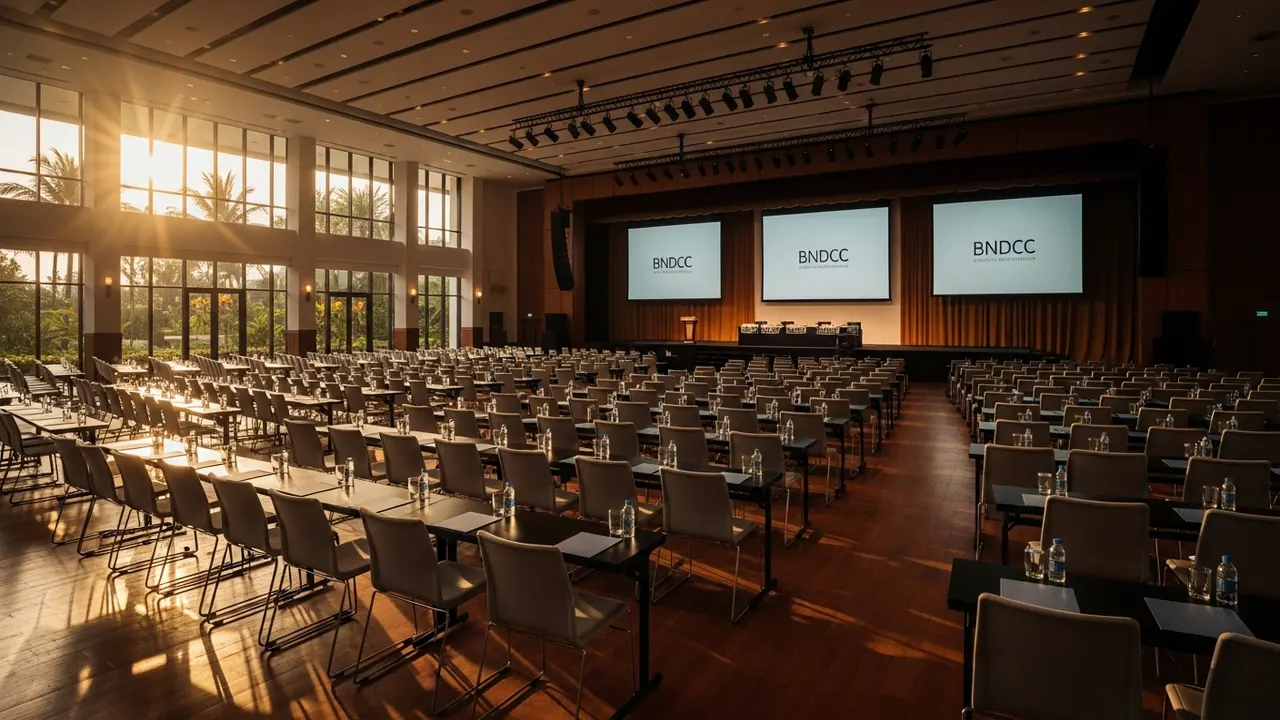
The anchor of large-scale bali convention planning is the Bali Nusa Dua Convention Center (BNDCC), located in the tightly managed Nusa Dua resort precinct in Badung Regency. BNDCC is the venue most commonly cited for major international events, and two of its specifications are worth quoting precisely because they appear in venue-issued documentation and independent industry listings.
The largest hall is the Nusa Dua Hall — a pillarless space of 4,400 sqm with a verified theatre-style capacity of up to 5,000 persons. These figures come from BNDCC’s own Facts and Figures documentation, corroborated by AIPC and Meetings Show APAC listings. The pillarless configuration is operationally significant: it means unobstructed sightlines across the full floor, which matters for both the delegate experience and the staging team.
BNDCC is also listed across industry sources as having 44 multi-flexible function rooms. That figure appears in AIPC and Meetings Show APAC listings rather than as a headline on BNDCC’s own primary web pages, so treat it as a reliable industry-sourced number rather than a venue-issued headline stat.
Two figures you will see on travel and marketing aggregator sites are best avoided in your planning documents. Total function-space figures of 50,000 to 70,000 sqm appear on third-party sites and conflate landscaped garden area with usable function space — no authoritative single figure from BNDCC or its parent ITDC confirms this. Similarly, opening-year claims of 2010 or 2011 are widely repeated but have not been confirmed by a verifiable primary source. Neither figure is load-bearing for your planning, but both are worth flagging if your event brief requires citations.
There is also a distinct, separate venue that planners should not conflate with BNDCC: the Bali International Convention Center (BICC) at the Westin Resort Nusa Dua. The BICC was purpose-built for the 1992 Non-Aligned Movement Summit — a verified historical fact — and remains an active conference facility. It is within the same Nusa Dua complex as BNDCC but is a different building with its own management, capacity profile and booking process.
PCO Versus DMC: Deciding Who Leads Your Conference
The practical question for most planners scoping bali conference for international delegates is not which supplier type is theoretically correct but which one your event actually needs in the lead role. Here is how experienced buyers typically draw the line — and where it blurs.
- When a PCO leads
- Multi-day conferences with a formal scientific or business programme, external delegate registration, abstract submission, sponsorship sales or exhibition management almost always need a PCO as the primary supplier. The PCO manages the conference as a project: timeline, budget, delegate communication, on-site registration, speaker management and post-event reporting. The PCO may then subcontract Bali-specific ground operations — venue sourcing, transfers, gala arrangements, permits — to a local DMC.
- When a DMC leads
- Internal corporate conferences, incentive programmes with a conference component, leadership offsites and annual sales meetings often go direct to a DMC because the programme is set by the corporate client rather than built around an open-registration academic or industry format. The DMC handles the full on-the-ground delivery: venue, accommodation, transfers, team-building, gala dinner, staffing and permits.
- Where the line blurs
- Many large Bali DMCs offer full PCO services, and many international PCOs maintain or subcontract to Bali-based DMC partners. Suppliers will present themselves in whichever framing wins the brief. The buyer’s protection is a detailed RFP that separates the scope clearly and asks each bidder to state which elements they deliver directly versus subcontract.
These distinctions are industry convention, not legal definitions. Neither term is regulated, and what any supplier actually delivers must be read in the contract, not assumed from the label.
Scoping the Plenary, Breakout and Dinner Configuration
For most bali plenary breakout venues, the planning challenge is not finding a large enough plenary room — Bali has that — but assembling the right combination of plenary capacity, adjacent breakout rooms, on-site accommodation and gala-dinner space without forcing delegates into long transfers between sessions.
Plenary configuration
Theatre-style is the standard for large plenaries: rows of chairs facing a stage, no tables, maximum capacity per square metre. Classroom-style (tables and chairs) uses roughly 40 to 50 percent more floor space per delegate. Cabaret and banquet layouts further reduce the delegate count. When a venue quotes a capacity, establish which layout it applies to before accepting the figure.
The Nusa Dua Hall’s 5,000 theatre-style figure is a ceiling under optimal conditions. Practical conference capacity in theatre-style typically sits somewhat below the published maximum once you account for production rigging, lighting towers, camera platforms, FOH sound positions and emergency egress requirements. Your production and AV team will give you the working capacity after a site inspection.
Breakout configuration
Breakout rooms for group work, workshops or parallel sessions need to be close enough to the plenary that delegates can move between sessions without a coach transfer. In Nusa Dua this is achievable: BNDCC’s 44 function rooms (industry-listed) and the adjacent hotel meeting facilities make it possible to keep the full programme within a small geographical footprint. The risk is booking conflict — peak conference season compresses availability, and the same rooms that host your morning breakouts may be under competing contract from another event.
For smaller conferences in the 100 to 500 delegate range, Nusa Dua’s large resort hotels offer self-contained ballroom-plus-meeting-suite configurations that can handle plenary, breakout and accommodation within a single property, which simplifies logistics and reduces exposure to inter-venue transfer delays.
Gala dinner configuration
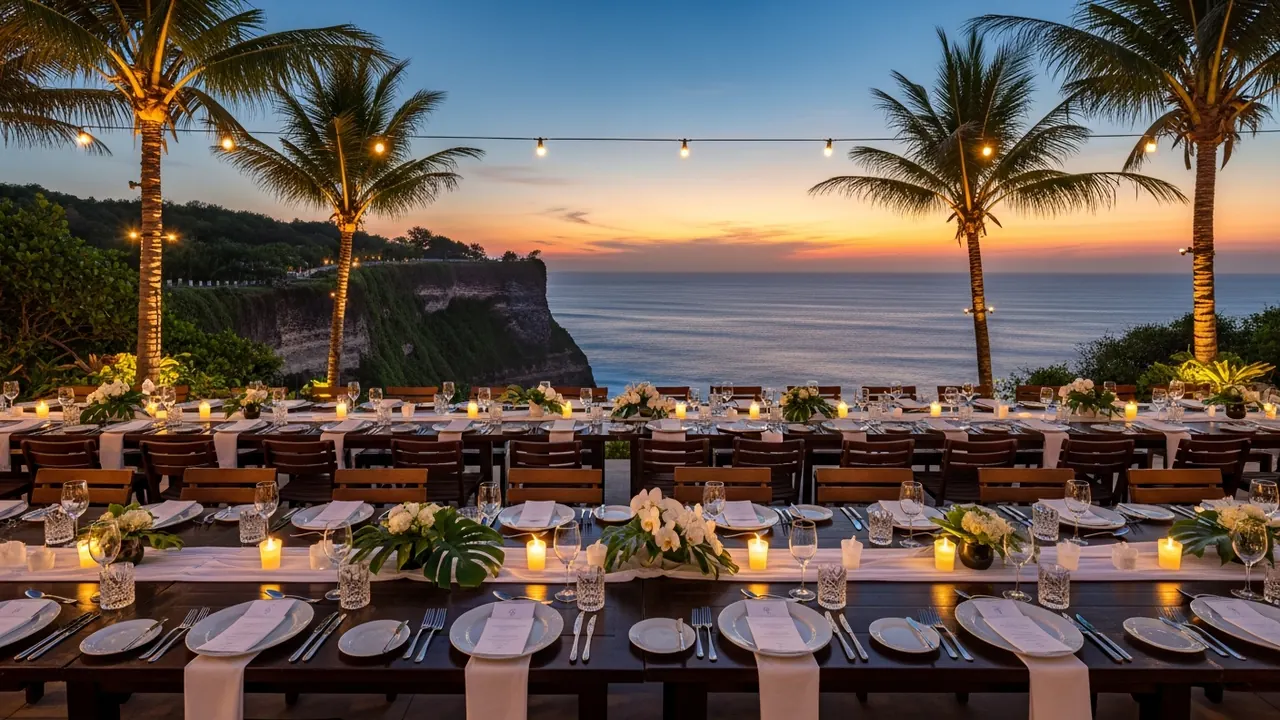
The formal close-of-conference dinner creates a separate venue decision. Options in Bali range from hotel ballrooms (weather-proof, controllable, formal) to outdoor lawn settings at beach clubs and cliff venues (atmospheric, weather-dependent, subject to sound curfew and permit requirements). Capacities for outdoor beach and cliff venues are not published in independently verifiable neutral-source form, so this guide describes those settings by type and use rather than by pax number. Your DMC will provide venue-specific capacity data during the brief stage.
Ready to map your plenary, breakout and gala across one or more Bali venues? Use our enquiry form to start a scoped brief, or message us directly on WhatsApp for a faster first response.
Delegate Flow: The Realities That Venue Brochures Skip
Ground-handling is where conferences succeed or fail in the delegate experience, and it is where most planning documents are weakest. Several factors specific to Bali deserve a frank assessment.
Airport arrivals and the transfer window
Ngurah Rai International Airport (DPS), operated by InJourney Airports, handles approximately 24 million passengers per year — a throughput that puts it near its stated nominal capacity. International delegates arriving on connecting flights from Asia-Pacific hubs, the Middle East and Europe do not land on a single schedule: you will typically be managing a spread of arrivals across six to twelve hours, sometimes across two days. The transfer from DPS to Nusa Dua is roughly 12 to 15 km by road via the Bali Mandara Toll, which maps to approximately 20 to 30 minutes under normal traffic conditions — but both figures are mapping-derived approximations, and peak-hour or high-demand periods extend them materially. Plan meet-and-greet staffing and coach scheduling around a realistic arrival spread, not a single wave.
Inter-venue transfer
Multi-venue conferences that split plenary, breakouts and evening events across different precincts — say, plenary in Nusa Dua and gala dinner in Uluwatu or Seminyak — add meaningful transfer time and logistical complexity. Uluwatu cliff venues can be 20 to 40 minutes from Nusa Dua depending on traffic; Seminyak and Canggu are further. For 500-plus delegates that means a significant coach fleet, phased departure management and a realistic load-in window for the dinner venue. Single-precinct or single-property configurations reduce this exposure significantly.
Session flow and curfew
Hard end-time enforcement at outdoor Bali venues is a real operational constraint, not a planning footnote. Amplified sound restrictions vary by regency (Badung, Denpasar and Gianyar have differing rules) and by venue type. Gala dinners at outdoor cliff or beach venues with live music or DJ sets need sound permits and must be programmed with a real end time that the venue management enforces. Plan your conference schedule with the last session to gala-dinner buffer in mind, and ask for the confirmed curfew time in writing before signing the venue contract.
Season and weather
Bali’s dry season runs roughly from April through October; the wet season roughly from November through March. This is standard climatological guidance, not a precise meteorological forecast. Outdoor conference elements — welcome dinners, team-building, pre-conference site visits — are lower-risk in the dry season but should carry backup plans regardless. Bali is not typhoon-prone, but afternoon rain during wet season can be heavy and fast-arriving. Any outdoor session without a covered backup option is a risk that a competent ground handler will flag before you sign the programme.
Bali in the Asia-Pacific Conference Context
For buyers evaluating Bali against other Asia-Pacific destinations for international conferences, the ICCA 2023 data — published in 2024 and reported by TTGmice and Mix Meetings from ICCA releases — gives a useful benchmark. Indonesia ranked 37th globally with 98 international association meetings tracked. Bali ranked approximately 10th among Asia-Pacific cities. For context, Singapore ranked first in the AP city list, Seoul second, Bangkok third, with Kuala Lumpur also in the regional top ten.
These figures carry caveats worth reading carefully. ICCA’s primary data tables are behind a paywall, so the figures above come from trade press reproduction of ICCA releases — reliable for relative position but treat absolute meeting counts as indicative. The figures also measure international association meetings specifically, which is a subset of total MICE activity; corporate conferences and incentive events are not captured in ICCA data.
The practical implication for buyers is honest: Bali is a credible, well-proven conference destination for events up to several thousand delegates and for association meetings that value experience, culture and delegate engagement alongside formal programme delivery. It is not a peer of Singapore or Kuala Lumpur as a pure convention hub if your primary requirement is direct long-haul lift, maximum hotel room inventory or a deep financial-services and government precinct. The right destination depends on what your delegates need from the experience, not on league-table position alone.
Key Planning Checkpoints Before Committing Budget
The following checklist draws on common planning failures rather than prescribed procedure. Your own advisers, PCO and DMC will have their own sequencing — treat this as a prompts list, not a contract.
Venue
- Obtain venue-issued capacity data for every configuration you are considering (theatre, classroom, cabaret, banquet) — do not rely on third-party aggregator figures.
- Confirm plenary and breakout adjacency on a scaled floor plan, not a marketing diagram.
- Ask for the ceiling height, rigging points and available power load in writing — critical for production teams.
- Establish the confirmed curfew time and amplified-sound limits before signing.
- Confirm load-in and bump-out windows, including overnight access if your production schedule requires it.
Accommodation
- Room-block attrition clauses and cut-off dates are standard but not standardised — read every term before signing and have your advisers review the contract.
- Peak season in Bali (broadly April through October, with specific windows around major holidays) tightens both availability and rates materially. Contract room blocks early if your event falls in a high-demand window.
- Confirm the walking or transfer distance from delegate accommodation to the plenary venue. A 15-minute coach transfer twice a day across a five-day conference adds up in cost and delegate patience.
Permits and compliance
- Large outdoor or public-facing events in Bali typically require location permits, police security and crowd-clearance approvals (the level — Polsek, Polres or Polda — depends on size and risk profile), noise and environmental approvals, and banjar or village-council consent. There is no published numeric threshold that triggers each requirement; practice varies by regency and event type.
- Private closed-door hotel conferences are usually handled by the venue or DMC under their existing operating licences, but confirm this explicitly.
- Foreign delegates attending as participants typically enter on a Visa on Arrival or e-VOA (commonly up to 30 days, extendable once) or a single-entry business e-visa (B211A type, often up to 60 days with a sponsor). The distinction between passive conference attendance and active speaking or working can affect the visa category required — this is legally sensitive and case-by-case. Direct delegates to verify current rules with the Indonesian Directorate General of Immigration before travel.
- Foreign talent (keynote speakers requiring a fee, performers, international AV crew) may trigger work-permit notification and licensed-impresario requirements with roughly a one-month lead time. Verify current requirements with a qualified local partner.
Costs
All costs for Bali corporate conferences are by quote and assembled from components: venue hire, room block, food and beverage, AV and production, staging, transfers, staffing, permits, CSR or team-building elements, DMC or PCO fee, and a contingency buffer. There is no publicly available fixed price list that is reliable across suppliers, seasons or event scales. Any single number presented as a standard package rate deserves a line-by-line breakdown before you accept it.
To scope a full cost model for your conference, submit an enquiry or reach our team on WhatsApp at +62 811 3914 563 (6281128590000). We will route qualified briefs to a vetted local partner and disclose that referral relationship openly — if you proceed with that partner, they may pay us a referral fee at no extra cost to you.
Comparing Conference Venue Types in Bali
| Venue type | Plenary scale | Breakout adjacent? | On-site accommodation | Best suited for |
|---|---|---|---|---|
| Dedicated convention centre (e.g. BNDCC, BICC) | Up to 5,000 pax (Nusa Dua Hall, venue-issued) | Yes — 44 function rooms listed (industry source) | Adjacent hotel stock in Nusa Dua precinct | Large international conferences, 500-plus delegates |
| Large resort ballroom | Typically 200–1,500 pax (by venue, confirm) | Usually yes — on-property meeting suites | On-site (buyout or room-block) | Mid-size corporate conferences, all-in-one logistics |
| Boutique hotel or villa estate | Typically 20–200 pax | Limited — often one or two breakout rooms | On-site (often full buyout required) | Executive retreats, leadership offsites, small team conferences |
| Beach club or outdoor lawn | Capacity unverified from neutral sources — by venue brief | Rarely adjacent in conference format | Off-site (transfer required) | Welcome dinners, closing galas, social programme — not plenary |
Note: All capacities except BNDCC Nusa Dua Hall are indicative ranges based on venue type. Obtain venue-issued figures for any site you are actively briefing. Costs are by quote across all categories.
Frequently Asked Questions
What is the largest conference venue in Bali and what capacity does it hold?
The largest verified conference space in Bali is the Nusa Dua Hall at the Bali Nusa Dua Convention Center (BNDCC). It is a pillarless hall of 4,400 sqm with a theatre-style capacity of up to 5,000 persons. These figures come from BNDCC’s own venue documentation and are corroborated by AIPC and Meetings Show APAC industry listings. The separate Bali International Convention Center (BICC) at the Westin Nusa Dua is a distinct facility with its own capacity profile — confirm current specs directly with the venue.
Does Bali have the infrastructure to handle a conference for international delegates?
Yes, with a clear track record. Bali hosted the G20 Leaders’ Summit in November 2022 and the IMF–World Bank Annual Meetings from 8 to 14 October 2018, both held in the Nusa Dua precinct. These are independently verifiable events, not marketing claims. For ICCA-tracked association meetings, Bali ranked approximately 10th among Asia-Pacific cities in 2023 data (ICCA via TTGmice and Mix Meetings — treat absolute counts as indicative). The infrastructure supports large-scale international events; the key planning considerations are air connectivity for non-Asia delegates, seasonal availability and early room-block contracting.
Should I hire a PCO or a DMC to organise my Bali conference?
For conferences with formal programme architecture — open registration, abstract submission, scientific or business programme, sponsorship and exhibitions — a PCO should typically lead, subcontracting local ground operations to a Bali DMC. For internal corporate conferences, leadership summits and incentive programmes with a meeting component, a DMC with full conference capability is often sufficient and more efficient. These role distinctions are industry convention, not legal definitions, and many suppliers offer both. Define your scope clearly in the RFP and ask each bidder to itemise what they deliver directly versus subcontract.
What permits are needed for a corporate conference in Bali?
Private, closed-door conferences held within a licensed hotel or convention centre are generally managed under the venue’s existing operating permits, with the venue or DMC coordinating the specifics. Large outdoor events, events with public elements, or events with amplified sound require additional permits: location/event permits, police security and crowd-clearance approvals (at Polsek, Polres or Polda level depending on size and risk), noise and environmental approvals, and banjar or village-council consent in some areas. There is no publicly available numeric threshold — requirements vary by regency (Badung, Denpasar and Gianyar have different practices) and event profile. A qualified local DMC handles this in practice; verify current requirements before signing a venue contract. This is general information, not legal or regulatory advice.
How far in advance should I book conference venues and room blocks in Bali?
For large conferences during peak season (broadly April to October), twelve to eighteen months ahead for primary venue and room-block contracting is common practice among experienced PCOs and DMCs working the Nusa Dua market. The Bali Mandara Toll Road has reduced transfer times between the airport and Nusa Dua to roughly 20 to 30 minutes under normal traffic, but accommodation near BNDCC is finite and competes with leisure demand during the same high-demand windows. Smaller conferences at mid-tier venues may have more flexibility, but availability and pricing tighten materially in high-demand periods across the whole market. Booking early also gives you more leverage on attrition clauses and room-block terms — items that are easier to negotiate before the inventory is committed.