

How to use this page: Bali DMC Agency is an independent buyer’s guide to Bali MICE — we are not a DMC, PCO, venue, or transport operator ourselves. A DMC manages on-the-ground logistics, venues, and transport; it is not the venue or the conference organiser. Capacities, group sizes, and budgets shown are indicative ranges flagged [VERIFY] (mid-2026) and must be confirmed in writing with the relevant supplier, venue, or broker before you commit — this is general information, not legal, tax, or procurement advice; confirm delegate visas and event permits with the appropriate authority or your notary as relevant. We may earn a referral commission when we connect you to a vetted partner, which never changes the price you are quoted.
Sustainable MICE in Bali refers to the planning and execution of corporate meetings, incentives, conferences, and events in ways that measurably reduce environmental harm, deliver verifiable community benefit, or both — and that can be evidenced to procurement, ESG leads, and delegates who increasingly ask to see proof. The keyword is evidenced. Bali is genuinely well-positioned to support responsible corporate events: its conservation challenges are real, its community infrastructure is accessible to organised groups, and its local-food supply chain is among the most diverse in Southeast Asia. What the destination lacks is a reliable buyer-side guide that separates meaningful sustainability from the greenwash that fills most operator brochures. This page is that guide.
Almost nothing written about sustainable MICE in Bali is written from the buyer’s seat. The vendor side of the SERP tells you about beach cleanups and local sourcing; it does not tell you how to write an RFP clause that requires evidence of impact, how to distinguish a genuine community-benefit program from a staged photo opportunity, or how Bali’s own environmental permitting requirements now intersect with event planning. Those are the gaps this guide addresses.
Why Sustainability Has Moved from Nice-to-Have to RFP Clause
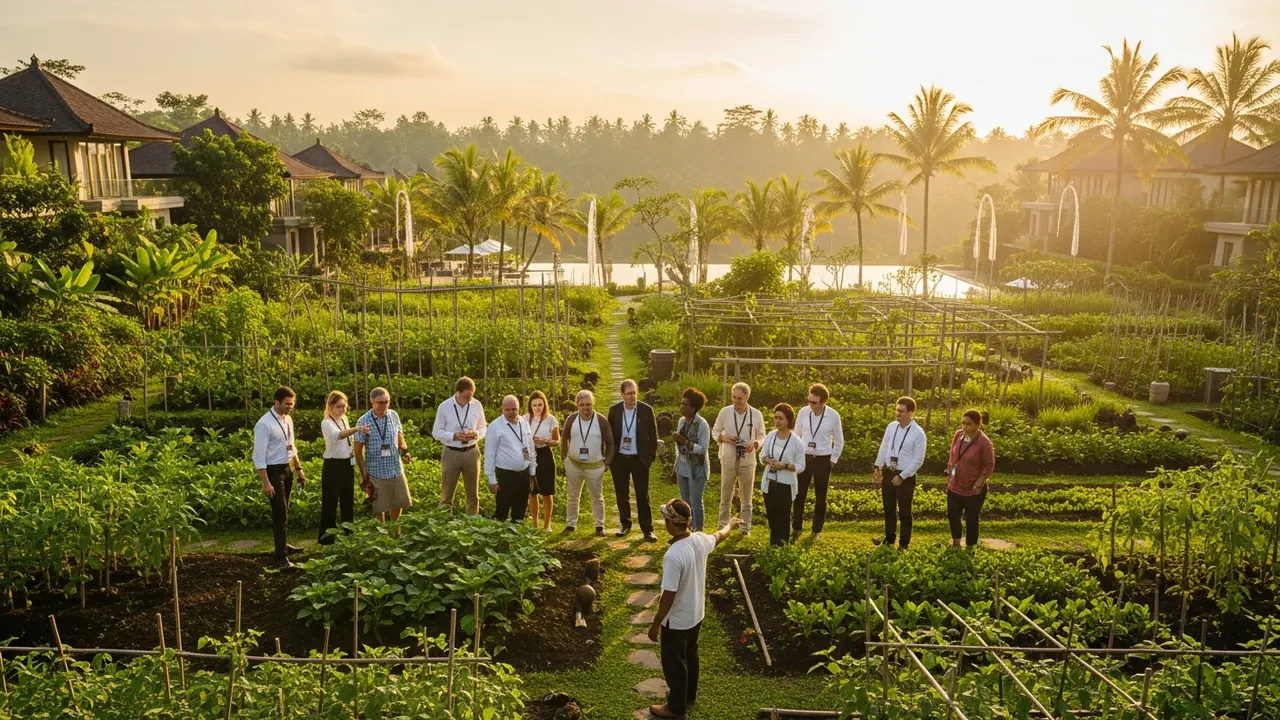
Five years ago, sustainability content in a MICE RFP was typically a single checkbox: does the venue have a recycling programme? Today, the bar is considerably higher. Listed companies operating under frameworks such as GRI, TCFD, or EU CSRD are under pressure to account for Scope 3 emissions — which include business travel and events. HR teams are briefing programs against stated ESG commitments that the finance function can audit. Procurement leads in regulated industries face supplier codes of conduct that extend to event partners and destinations.
Practically, this means two things. First, a sustainability section in your MICE brief is no longer unusual; in many corporate buying contexts it is expected. Second, suppliers have noticed, which means they have learned to provide sustainability-flavoured content whether or not the underlying practice is substantive. Your job as a buyer is not to accept claims at face value — it is to ask the questions that separate genuine practice from marketing copy.
Bali’s positioning as a responsible corporate events destination is, in broad terms, honest: the island has genuine conservation needs, active civil-society organisations, and a culture in which community-level engagement is structured through the banjar system. Responsible MICE can do real work here. The risk is not the destination — it is operators who package the appearance of impact without the substance.
Common CSR and Sustainability Approaches in Bali: What Is Offered and What to Verify
The following formats are frequently offered by Bali event operators as part of responsible corporate events or CSR team building programs. They are illustrative examples of common market practice, not statistically verified rankings of popularity or effectiveness. Scope, community benefit, and quality vary significantly by operator and specific program design.
Beach and Coastal Cleanups
Coastal cleanups are the most frequently offered CSR format in Bali — and also the one most prone to being cosmetic. At their best, a cleanup is coordinated with a legitimate waste-management partner, targets a specific site where the waste problem is real and recurring, produces a measurable output (kilograms collected, waste types categorised), and feeds into a disposal or recycling chain that continues after the group leaves. At their worst, it is a branded beach walk where participants are photographed with bags that are never properly disposed of, and the community impact is negligible.
The buyer test: ask your operator for the name of the community or waste-management partner, what happened to the collected waste in the most recent program they ran, and whether they can provide a post-program impact summary. If the answer to any of those questions is vague, the program is cosmetic. A credible cleanup operator will know exactly where the waste goes — to a sorting facility, a recycling partner, or a managed disposal site — because they coordinated that logistics in advance.
Bali has implemented restrictions on single-use plastics (bags, straws, polystyrene) under provincial regulation, and the island’s relationship with plastic waste in coastal and river systems is well-documented. A cleanup brief that acknowledges this specific context — rather than presenting the activity as generically charitable — gives operators something real to work with and signals to delegates that the program is grounded in a genuine local issue. Verify the current status of Bali’s single-use plastic restrictions with your operator or local authority, as regulations can evolve.
Community, Temple, and School Projects
Infrastructure support, school material drives, temple maintenance assistance, and community garden projects are offered as longer-format CSR programs — typically half-day or full-day, suited to groups where the brief is genuine community engagement rather than a quick symbolic gesture. The format lends itself to smaller groups (10–60 participants) where close community interaction is feasible; for large incentive groups of 200-plus, the logistics of meaningful community work become more complex and require genuine pre-planning with the host community.
The buyer considerations here go deeper than for a cleanup. Community projects require genuine consent and advance coordination with the host community, not just a payment to a facilitating operator. The banjar system — Bali’s foundational neighbourhood governance structure — means that community-level activities typically require coordination and agreement at the banjar level before any external group arrives. An operator who cannot explain how they obtained community consent for a program is either skipping that step or handling it so superficially that the community derives little benefit.
Ask your operator: how far in advance was this community contact made, who within the community made the agreement, and has the community expressed a preference for the type of support they actually need versus what a corporate group finds photogenic? The second question matters more than it sounds — a school that receives seventeen sets of identical donated equipment it did not request and cannot use is not a beneficiary; it is a set for a photo opportunity.
Single-Use Plastic Reduction Commitments
Many corporate event buyers now include a single-use plastic reduction clause in their brief — requesting that F&B service eliminate plastic bottles, straws, and packaging in favour of filtered water stations, reusable serviceware, and biodegradable alternatives. In Bali, this request has real local context: the island’s plastic waste challenges are well documented, and the provincial government has moved to restrict specific single-use plastic items, making operator compliance with this brief element both practically achievable and locally meaningful.
The procurement approach: make this a specification in your RFP, not a request. List what you expect — no single-use plastic bottles at F&B stations, water provided via filtered dispensers or large-format refillable containers, no plastic straws or stirrers, packaging for packed lunches or delegate gifts to be biodegradable or returnable. Ask operators to confirm this as a line item in their quote, not as a general commitment. If there is a cost differential for biodegradable alternatives, you want it itemised so you can decide whether to absorb it or pass it through.
Not every venue in Bali has the logistics infrastructure to eliminate single-use plastics entirely, particularly for outdoor events or remote off-site locations. A credible operator will tell you where the constraints are and propose a realistic partial solution rather than over-committing and under-delivering.
Local Sourcing for F&B
Bali has one of the most diverse local food supply chains in Southeast Asia — wet markets, organic farms in the Kintamani and Tabanan highlands, fresh seafood from Jimbaran, and a well-developed artisan food and beverage scene. Local sourcing in event F&B is both genuinely achievable and meaningfully beneficial: it supports local producers, reduces cold-chain transport emissions, and tends to produce menus that are more interesting and more culturally authentic than imported equivalents.
The buyer approach: specify a minimum local-sourcing percentage in your brief, typically applied to fresh produce and primary proteins rather than to processed goods or beverages where local alternatives may be limited. Ask your operator to describe their supply chain for the specific menu proposed — not just claim that they use local suppliers. A credible answer will name the types of suppliers involved (farm, market, specific area) and acknowledge where local alternatives are not available. An answer that simply asserts local sourcing without specifics is not a supply chain; it is marketing language.
Local sourcing also has a direct connection to carbon footprint: food transport is a measurable emission driver in event catering, and a locally-sourced menu is one of the more practical levers a buyer can pull without complex carbon accounting. If your CSR brief requires you to evidence emission-reduction measures, local F&B sourcing is one of the easier items to substantiate with supplier documentation.
Carbon Offset Options
Carbon offset programs for responsible corporate events are offered by some Bali-based operators either directly or in partnership with third-party offset providers. The buyer caveat here is more significant than for the physical-activity CSR formats: carbon offset quality varies enormously across the global voluntary carbon market, and a claim that an event is “carbon neutral” means very little without disclosure of the methodology, the standard to which offsets are certified, and the additionality of the specific project.
As a buyer, you should approach any carbon-offset component with three questions. First, what methodology was used to calculate the event footprint — flights are typically the largest single item, followed by accommodation, ground transport, and catering, and the calculation should cover all material items rather than just a subset. Second, to what standard are the offsets certified? Recognised voluntary carbon market standards include Gold Standard and Verified Carbon Standard (also marketed as Verra). Third, is the offset project additional — meaning the carbon reduction would not have happened without the offset funding — and is it verifiable by a third party?
Bali DMC Agency does not certify or endorse any supplier’s carbon offset claims. If your company’s ESG reporting requires a carbon-neutral event designation, engage your own sustainability adviser to validate the methodology before committing to a provider’s offering. The offset market is active and there are credible options available; there are also superficial ones that would not survive audit scrutiny. Present offset programs in your internal reporting at the level of evidence you actually have, not at the level of the vendor’s claim.
Scoping a CSR-integrated event brief? Share your sustainability objectives and group profile with our concierge — we will route your enquiry to a vetted partner DMC and disclose that referral relationship. Reach us via our enquiry form or WhatsApp at +62 811 2859 0000.
Sustainability and Event Permitting: The Compliance Connection
One sustainability-adjacent topic that most operator websites do not address — because it sits in the compliance column rather than the marketing column — is the connection between environmental planning and event permitting. An environmental or waste-management plan is commonly required as part of the permitting process for outdoor or large-scale events in Bali, alongside police security clearances, noise permits, and banjar consent.
This matters for buyers for two reasons. First, if your event includes an outdoor component, a beach activation, or any gathering that exceeds the effective private-event threshold at a given venue, your operator will need to engage with this permitting process, and the quality of their environmental plan will be part of the submission. An operator who is serious about sustainability will have a coherent waste-management approach built into their event operations — not just a marketing CSR narrative — because they need to demonstrate it for permitting purposes.
Second, this means that sustainability measures like waste segregation, contracted waste removal, and absence of single-use balloons or other items flagged by local authorities are not optional extras that you negotiate into a brief. In some contexts, they are baseline requirements for the event to be permitted at all. Your operator should be able to tell you which elements of their sustainability approach are permitting requirements versus additions.
Permitting requirements in Bali vary by regency (Badung, Denpasar, Gianyar, and others) and by event type and scale. There is no publicly available numeric threshold that specifies exactly when an environmental plan is required — it is practice-based and venue- and format-specific. See our permits and delegate visas guide for a fuller overview of the Bali event permitting landscape. Frame all permitting information in this guide as general practice to verify with your operator and local authorities, not as legal or regulatory advice.
Writing CSR Objectives That Are Meaningful, Not Greenwash
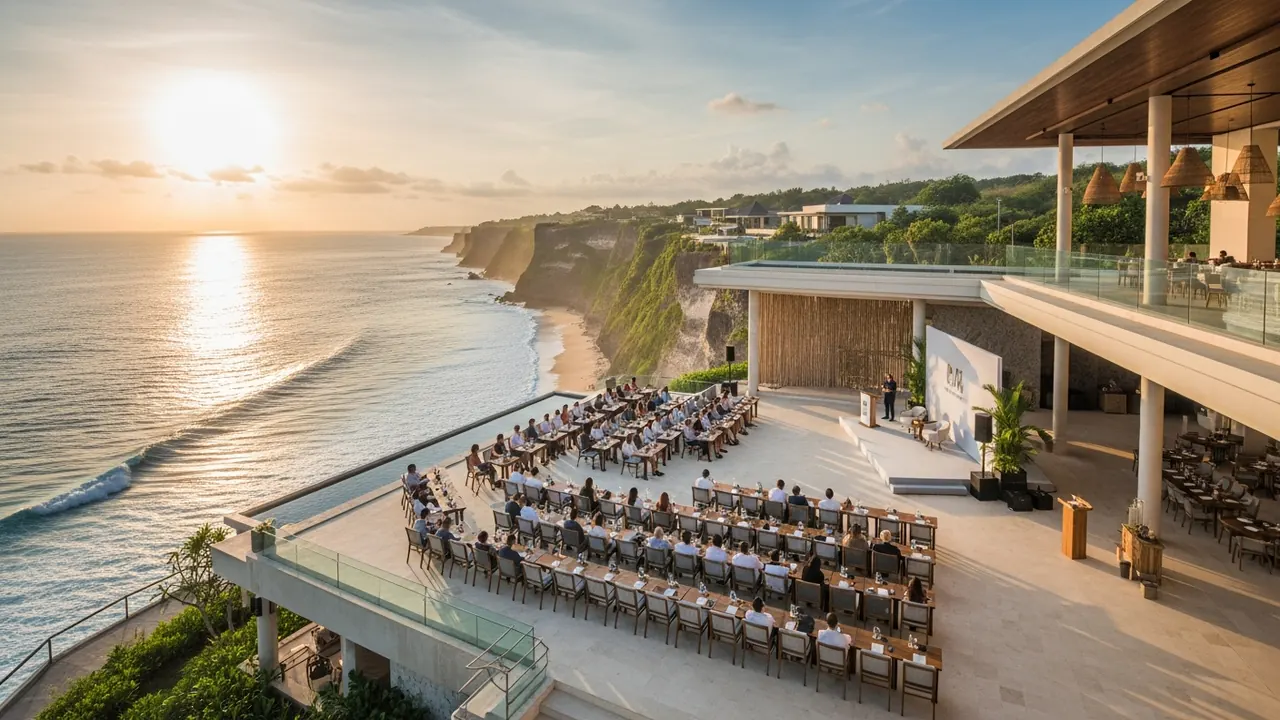
The most useful thing a procurement planner can do before briefing a CSR program is to write the objective before writing the activity list. Not “we want to do a beach cleanup” but “we want our program to contribute to a specific, measurable environmental or community outcome that we can report against our ESG objectives, with evidence we can present to our sustainability team.”
That reframing changes what you ask of operators. Instead of asking for a beach cleanup, you are asking for a program with: a defined community or environmental outcome; a named partner with standing in the relevant field; measurement of output (weight, volume, units, hours contributed); a post-program summary you can retain and quote; and a continuity plan that shows the benefit persists after the group leaves.
The table below summarises what separates a meaningful CSR brief from a greenwash-prone one across the common program types:
| Program Type | Greenwash Indicator | Evidence Standard to Require |
|---|---|---|
| Beach or coastal cleanup | No waste disposal plan; cleanup used mainly for photos | Named waste partner; kg collected; disposal chain documented |
| Community or school project | Community not consulted on what is needed; no continuity | Advance community consent; deliverable agreed with recipient; follow-up plan |
| Local F&B sourcing | Claimed without supply chain disclosure | Supplier list or region-of-origin statement; proportion of local vs. imported |
| Single-use plastic reduction | General commitment without specification; no cost itemisation | Item-by-item specification in quote; confirmation of alternatives logistics |
| “Carbon neutral” claim | No methodology or certification disclosed | Footprint calculation methodology; offset standard (e.g. Gold Standard, Verra); additionality evidence |
How to Ask Suppliers for Evidence: A Buyer’s Question Set
The questions below are designed to be included in your RFP or asked during a supplier scoping call. They are not intended to be adversarial — credible operators will answer them readily, because credible operators have the answers. Operators who cannot or will not answer them are telling you that the sustainability component of their offering is primarily marketing rather than practice.
For any CSR program component:
- Who is the community, environmental, or NGO partner for this program? Are they an incorporated organisation or an informal arrangement?
- What was the measurable output of the last program of this type you delivered — and can you share a summary?
- What happens to the tangible outputs (waste, materials, donations) after the program ends? Who is responsible for the continuation?
- How was the community or beneficiary partner consulted on what they actually need, as opposed to what a visiting corporate group finds satisfying to do?
- Can you provide a post-program impact report as part of your deliverables, and what will it cover?
For carbon offset programs:
- What is the methodology you use to calculate event carbon footprint — which emission categories are included?
- To what voluntary carbon market standard are your offsets certified?
- Can you provide the project documentation for the specific offsets you are proposing?
- Is this verified by a third party, and can we include that verification in our ESG reporting?
For local sourcing and plastic reduction:
- Can you provide a supply-chain statement for the F&B menu proposed — specifically identifying which items are locally sourced and from what region or supplier type?
- Which single-use plastic items will be eliminated in this proposal, and what are the specific alternatives?
- Where local alternatives are not available for specific items, what is the fallback?
If you are working to a formal ESG reporting framework, share the relevant framework with your operator and ask whether they have previously provided documentation that meets that standard. Some operators have; many have not. Knowing in advance saves you discovering the gap after the event has been delivered.
Cost Considerations: Sustainability Is Not Free
Responsible corporate events and CSR team building in Bali carry real cost — and buyers who treat sustainability requirements as zero-cost add-ons to a standard brief will find that either the requirements are not met or they are being absorbed invisibly into inflated line items elsewhere. Budget honestly.
Incremental costs commonly associated with sustainability-integrated programs include: community or NGO partner fees for facilitated CSR sessions; waste logistics (segregation, transport to recycling or disposal facilities); premium for biodegradable versus conventional F&B packaging; water filtration and refill station rental versus bottled water; certified offset credits for carbon programs; and post-program impact reporting time if you require a formal summary document. All of these are by-quote — there are no industry-standard unit costs for CSR facilitation or certified offset credits that are reliable enough to publish without a specific program scope.
One common buyer error: including sustainability requirements in an RFP but not flagging them as a budget line item. Operators then face a choice between padding their base quote and risking loss on delivery. The cleaner approach is to include a sustainability specification in the RFP with an explicit ask for that component to be quoted separately. This makes the incremental cost visible, allows you to defend it internally, and allows you to evaluate whether different operators are pricing the same specification consistently.
Ready to write a CSR-integrated brief? Share your sustainability objectives, group profile, and program context with our team. We will route your enquiry to a vetted partner DMC and disclose that referral openly. Contact us via our enquiry form or email [email protected]. WhatsApp: +62 811 2859 0000.
Frequently Asked Questions
What does sustainable MICE in Bali actually mean in practice?
In practice, sustainable MICE in Bali means incorporating one or more of the following into your event design, with evidence to substantiate each: a CSR activity with a genuine community or environmental partner and measurable output (beach cleanup, community project, conservation work); F&B sourced from Balinese producers rather than imported supply chains; elimination of single-use plastics from event operations; and, where required by your ESG reporting framework, a carbon footprint calculation and certified offset program. The term gets misused frequently in vendor marketing to mean superficial gestures — what distinguishes a meaningful program is evidence of impact, not the type of activity.
Is Bali’s single-use plastic ban something my event needs to plan around?
Bali has implemented provincial regulations restricting certain single-use plastic items including bags, straws, and polystyrene, though the scope and enforcement landscape evolve. For most responsible corporate events, this means single-use plastic elimination in your event specification is both locally appropriate and achievable — but verify the current regulatory position with your operator or the relevant local authority rather than relying on any fixed summary. Practically, your operator should be able to advise you on which single-use items are restricted, what alternatives are available in the local market, and where the supply chain has gaps.
How do I avoid greenwash in a CSR team building program?
The single most effective defence against CSR greenwash is requiring pre-program disclosure of four things: the name and standing of the community or environmental partner; the specific measurable output the program will produce (not just the activity type); what happens to the tangible output after the group leaves; and a post-program impact summary included as a contract deliverable. Operators who produce meaningful impact programs have these answers before you ask for them. Operators running cosmetic programs will struggle to answer the second and third questions concretely. Making the impact report a contractual deliverable — not a verbal commitment — creates accountability.
Can we legitimately call our Bali event carbon neutral?
Not without a calculation and certified offset program that you can evidence. A “carbon neutral event” designation requires: a scope-appropriate footprint calculation (at minimum flights, accommodation, ground transport, and catering); offsets certified to a recognised voluntary carbon market standard such as Gold Standard or Verra; and a third-party verified project with demonstrated additionality. Bali DMC Agency does not certify any supplier’s carbon neutrality claims — if your company’s ESG reporting requires a defensible carbon-neutral designation, engage an independent sustainability adviser to validate the methodology before committing to a provider’s offering. Present the claim in internal reporting at the level of evidence you actually hold.
Does sustainability integration add significant cost to a Bali MICE program?
Yes, and buyers who plan for it honestly fare better than those who treat it as a free add-on. Incremental costs depend entirely on what you specify: a facilitated cleanup with a legitimate NGO partner and proper waste logistics costs more than a branded beach walk; certified carbon offsets cost more than an uncertified promise; biodegradable F&B packaging costs more than conventional alternatives. The practical approach is to include sustainability as a separate cost line in your RFP, ask operators to quote it specifically, and treat the responses as a signal of operator quality as much as a budget exercise. Operators who cannot price it transparently are operators who are not delivering it substantively.