How to use this page: Bali DMC Agency is an independent buyer’s guide to Bali MICE — we are not a DMC, PCO, venue, or transport operator ourselves. A DMC manages on-the-ground logistics, venues, and transport; it is not the venue or the conference organiser. Capacities, group sizes, and budgets shown are indicative ranges flagged [VERIFY] (mid-2026) and must be confirmed in writing with the relevant supplier, venue, or broker before you commit — this is general information, not legal, tax, or procurement advice; confirm delegate visas and event permits with the appropriate authority or your notary as relevant. We may earn a referral commission when we connect you to a vetted partner, which never changes the price you are quoted.
A gala dinner venue in Bali is not simply a room with tables and lighting. The term covers a wide spectrum of spaces — hotel ballrooms, cliff-edge lawns, beach clubs, resort garden terraces and open-air cultural plazas — each with a distinct production envelope, a different set of operational constraints, and a very different delegate experience. The right choice for your event depends on format, headcount, weather tolerance, production ambition, and how hard your curfew is. This guide cuts through the marketing claims to give corporate buyers what they actually need for bali gala dinner planning: an honest map of venue types, what you can do in each, and the ground-level realities that no venue brochure will lead with.
Why Venue Type Matters More Than Venue Name
Bali’s event landscape divides cleanly into two categories: controlled environments and open-air spectacle venues. Neither is universally better. The choice is a function of your format.
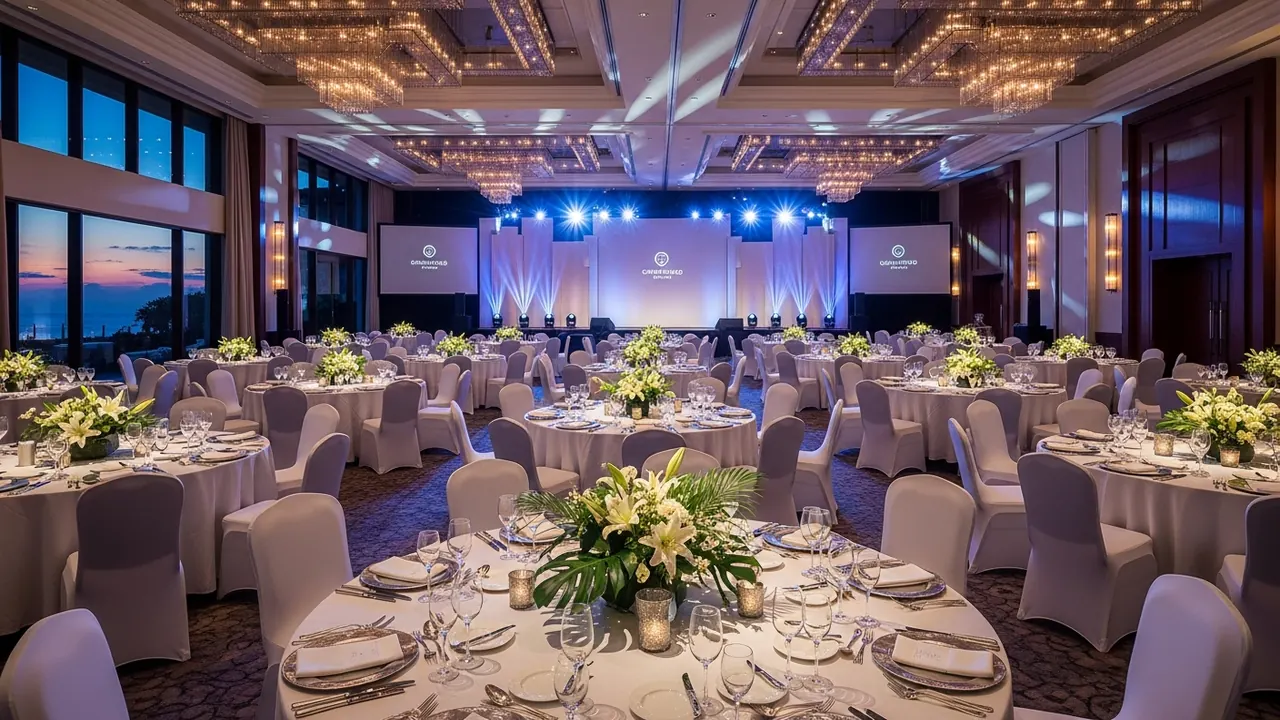
Ballrooms and convention-adjacent banquet halls give you weather certainty, sound containment, and full production control. You can run a full-stage awards presentation, manage table service for 600 people simultaneously, and bring the evening to a close without checking a wind forecast. The tradeoff is that a ballroom looks like a ballroom — you are importing Bali into the room rather than placing your guests inside it.
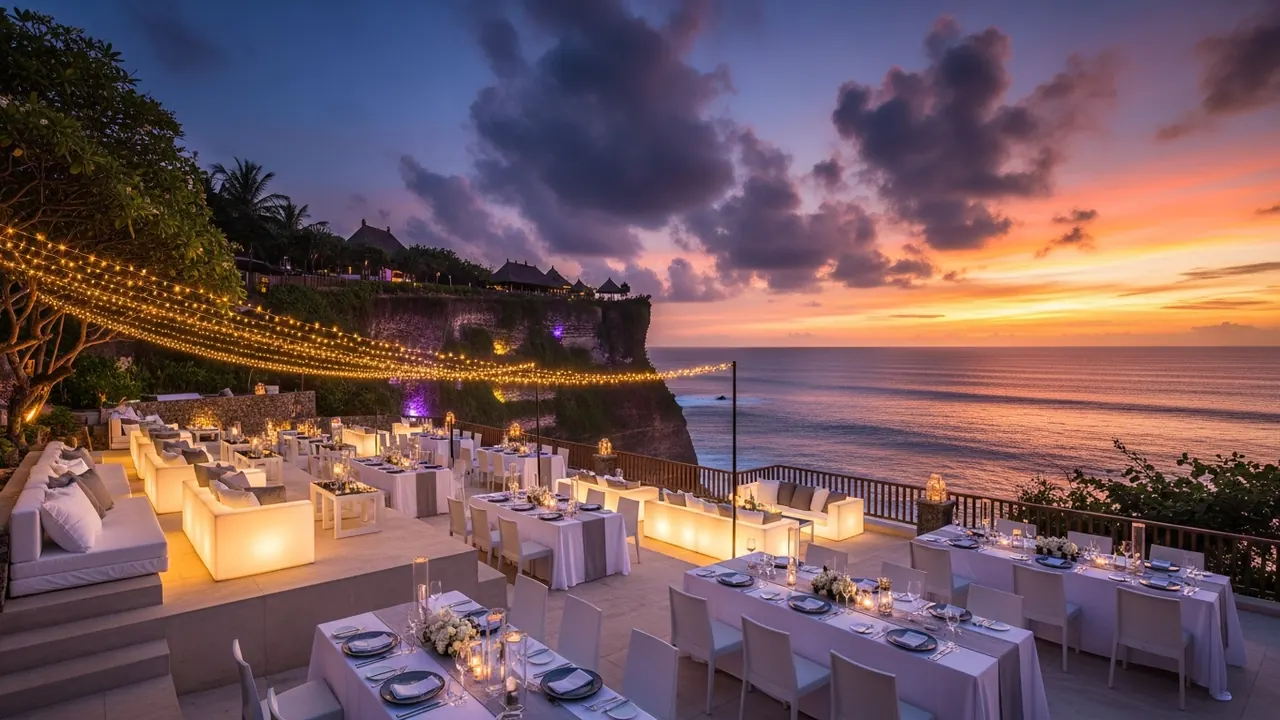
Beach clubs, cliff lawns, resort garden terraces, and cultural park plazas invert this. The backdrop is real — ocean, limestone cliffs, rice terraces, or the monumental scale of an outdoor cultural site — and the delegate experience is genuinely different from what you can deliver in any city. The tradeoffs are real too: outdoor sound dissipates and draws regulatory attention; load-in windows are tighter; end-time enforcement is hard; and a sudden tropical downpour during the gala course can reshape your whole evening.
The best Bali gala dinners often layer both: a pre-dinner reception at an outdoor venue for the spectacle, then a ballroom or tented space for the formal seated dinner and awards segment. Understanding the trade-offs in each type is the first discipline of bali gala dinner planning.
Ballroom and Indoor Banquet Venues: Weather-Proof Formality
What ballrooms give you operationally
Nusa Dua’s large resort belt — the cluster of international hotels south of the airport, roughly 12 to 15 kilometres by road — offers the densest concentration of purpose-built banquet ballrooms in Bali. These spaces are designed for large-format, multi-day events: high ceilings, pillar configurations that vary by property, pre-rigged AV infrastructure, in-house catering with capacity to handle high-headcount service, and an adjacent room block that removes delegate movement between dinner and accommodation. For a corporate awards night targeting 300 to 700 guests with a formal seated service, branded staging and a headline AV package, a Nusa Dua ballroom is the operationally sensible default.
The Bali International Convention Center at the Westin — a distinct facility from the Bali Nusa Dua Convention Center, and worth keeping separate in your venue research — was built for the 1992 Non-Aligned Movement Summit and sits within that same Nusa Dua precinct. It offers convention-grade infrastructure that includes banquet-capable space, though room configuration and capacity details must be confirmed directly with the venue; this guide does not publish figures that are not venue-issued or multi-source verified.
What to ask before signing a ballroom contract
Four questions matter more than the price per square metre. First: what is the hard end-time? Nusa Dua resorts typically enforce end-times related to local curfew and in-house noise policies — 11 pm is common, midnight is sometimes possible with pre-negotiation, and extensions beyond that are not guaranteed. Build your programme backwards from the contracted end-time, not from what you hope the venue will allow on the night.
Second: what does the AV exclusivity clause say? Many hotel ballrooms have preferred or exclusive AV suppliers. Bringing in an external production company — for a high-spec LED wall, custom rigging, or a specialist lighting design — may require the venue’s written consent, may attract a patch or cable-tie fee, and in some cases may not be permitted at all. Establish this before your production company builds a specification.
Third: what is the load-in window? Ballroom dinners for 500-plus guests with full staging typically need a minimum six to eight hours for load-in before doors open. If the ballroom is used for a conference plenary earlier the same day, you may be negotiating a very compressed turnaround. Confirm the room release time in writing.
Fourth: is outside catering permitted? Some venues allow partial outside catering for themed elements (an Indonesian street-food station, a dessert specialist) while requiring in-house for the main seated service. Others mandate full in-house F&B. This affects your themed event design more than most planners expect.
Beach Clubs and Cliff Venues: Spectacle Events in Bali
What these venues offer — and what they do not publish
The south Bali coast from Jimbaran to Uluwatu, and the Seminyak and Canggu strips, are home to a tier of beach clubs and cliff-top venues that genuinely have no equivalent in most MICE destinations. Savaya Bali (formerly Omnia) sits on a limestone promontory above the Indian Ocean. Karma Kandara combines a cliff lawn with beach access. AYANA’s oceanfront lawns and the Rock Bar have hosted events against a backdrop that photographs in a way that no ballroom can. Potato Head in Seminyak, Finns and Atlas in Canggu each carry a distinct atmosphere and a different demographic pull for incentive and evening programs.
This guide does not publish headcount capacities for any of these venues. No independently verifiable, neutral-source pax figure exists for event-mode configurations at beach clubs and cliff venues. Figures circulating in agency pitch decks and venue marketing — numbers like 800, 1,500, or 3,000 — are marketing or agency estimates, not venue-issued specifications confirmed by a neutral party. If you need a capacity number to make a decision, request it in writing from the venue directly and treat it as the venue’s representation, not a third-party-verified fact.
What you can reliably expect, based on the type of space: beach clubs and outdoor cliff venues are configured for cocktail-style standing receptions more naturally than for full plated-service seated dinners. A gala dinner format — multiple courses, table service, a formal programme — is achievable but requires a production layer that the venue itself may not provide. Tenting, flooring over uneven terrain, power distribution, stage and AV rigging, and kitchen logistics for plated service at scale are all production additions that must be budgeted separately from the venue hire fee.
The operational constraints vendors understate
Amplified sound at outdoor venues in Bali is subject to noise restrictions that vary by regency (Badung covers most of the south coast), by proximity to residential areas and temples, and by the time of night. Hard sound cut-off times are enforced. A DJ set or live band finishing at 11 pm can become a 10 pm instrument-down situation if a venue has not pre-cleared the programme with the relevant authority. Some beach clubs carry standing noise permits for their own operations that do not automatically extend to private buyout events — you need the venue’s written confirmation that your event is covered, not assumed to be.
For large or high-profile outdoor events, event permits may require separate police security and crowd clearance at the Polsek or Polres level, plus banjar (village council) consent. The specific threshold at which a private buyout triggers a police permit versus being handled entirely by the venue is not defined by a published numeric rule — it is practice-based and varies. A local DMC familiar with the specific venue’s permit history is the right resource to assess this, not a guide that cannot know your event’s specifics. This page covers the landscape; the permit page covers the mechanics.
Ready to scope your event? Use our enquiry form or reach the team directly on WhatsApp to be introduced to a vetted local partner who handles venue negotiation, permits and production logistics end to end.
Garuda Wisnu Kencana: Large-Format Outdoor Events
Garuda Wisnu Kencana Cultural Park in Ungasan — roughly 10 to 15 minutes from Ngurah Rai International Airport, at approximately 263 metres above sea level on around 60 hectares of karst terrain — is the venue cited most often for very large-scale outdoor events in Bali. The GWK statue, completed at approximately 121 metres in height (older sources cite 150 metres, which was the planned figure, not the final), is a legitimate landmark backdrop with no real equivalent in the region.
The park’s primary event space is the Lotus Pond, an open-air plaza conventionally cited at up to 7,000 people across multiple sources including Wikipedia and event industry listings. The plaza area figure of approximately 4,400 square metres comes from a single source and should be treated as indicative rather than confirmed. GWK’s own marketing material references figures considerably higher — in the tens of thousands — which reflects a festival standing-crowd figure, not a seated dinner or formal gala configuration. For planning purposes: the Lotus Pond is a large outdoor plaza capable of hosting very substantial events, but the precise setup-dependent capacity for a specific gala format must be confirmed with GWK directly. This guide will not transpose marketing figures into planner fact.
The park also includes an amphitheatre, conventionally cited at approximately 800 seats. This figure comes effectively from a single source — treat it as a reasonable working estimate to verify, not a specification. Additional spaces include Exhibition Hall, Plaza Wisnu, Street Theatre, and the Jendela Bali restaurant; no independently verified event capacities are published for these areas.
GWK operational realities for gala events
The Lotus Pond is an outdoor limestone plaza with no permanent overhead cover and limited in-built infrastructure for production. For a gala dinner at scale, you are bringing in staging, power, sound and lighting, kitchen logistics, flooring where needed, and either a permanent hard roof or a tented structure capable of handling a tropical downpour. This is not a deterrent — large-format outdoor events in Bali happen regularly and the production industry is experienced — but it is a production cost line that can be significant and must be budgeted explicitly. The site’s elevation means it is exposed to wind, and evening temperatures in the dry season are comfortable but can be noticeably cooler than coastal Bali.
Load-in windows at GWK need early confirmation with the park, particularly during periods when the site has its own programming. End-time enforcement applies here as it does elsewhere. GWK is a tourist destination as well as an event venue, and visitor-hours overlap with some early-evening event setups — coordinate the changeover carefully.
Themed Events and Awards Nights: The Production Layer
What themed event bali corporate buyers typically commission
Themed gala dinners range in production ambition from a modest décor refresh of a hotel ballroom — centrepieces, gobo lighting, a step-and-repeat backdrop — to a full environmental build where the venue is transformed into a different world. Bali’s production industry is strong in a few specific areas: Balinese cultural themes (traditional dance, textile décor, ceremonial food-station design), tropical luxury aesthetics (tropical botanical, ocean-reference, rattan and teak furniture builds), and international themes drawn from Bali’s long history as a hospitality design centre.
Production costs for a themed gala are not a single line item. They assemble from: venue hire or buyout fee; F&B (catering is typically by quote from the venue or a licensed caterer, with per-head costs varying significantly by menu tier, service style and headcount); AV and technical production (staging, LED wall, sound, lighting, rigging, power); décor and theming (florals, furniture, fabric, custom builds, props); entertainment (traditional Balinese performance, contemporary band, DJ, MC — foreign talent introduces additional permit steps); event management and on-site staffing; transport for delegates to and from the venue; and permit costs where applicable.
None of these lines have fixed public pricing. Décor builds for a themed gala of 300 people can range by an order of magnitude depending on the brief. Catering per-head varies with menu scope, service style, and whether alcohol is included. AV production for a full-scale awards night with a broadcast-quality LED wall and a live band is a very different number from a basic PA and uplighting package. All costs must be quoted against your specific brief — this guide presents the structure, not the numbers.
Entertainment: what works and what requires forward planning
For a bali awards night venue programme, entertainment typically comes in three tiers. First, Balinese cultural performance — Legong, Kecak, Barong, fire dance, gamelan ensemble — is locally available, generally well-priced relative to international talent, and works as both a reception experience and a formal programme segment. Second, local and regional bands or DJs are available across a range of genres; procurement is through Bali-based agencies or the DMC’s supplier network. Third, international headline talent — a well-known band, a global DJ, a celebrity MC — requires a licensed impresario in Indonesia, a work permit notification process that typically needs at least a month of lead time, and a coordination layer that is considerably more complex than the first two tiers.
Tourist visas are not sufficient for any performing or speaking role. If your awards night programme includes a foreign keynote speaker, a foreign MC, or a foreign band, the permit question is not optional — see the permits and visas page for the framework, and verify current requirements with a licensed local partner before contracting talent.
Venue Selection by Format: A Decision Framework
| Format | Venue type that fits best | Key constraint to check first |
|---|---|---|
| Formal seated awards dinner, 100-600 pax | Hotel ballroom (Nusa Dua/Seminyak tier) | Hard end-time; AV exclusivity clause; load-in window |
| Large outdoor gala, 500-2,000+ pax | Cultural park plaza (e.g. GWK Lotus Pond — capacity confirmed on quote from venue); resort garden buyout | Production scope and cost; weather contingency plan; sound permit |
| Incentive closing night / cocktail reception with spectacle | Beach club or cliff lawn (Uluwatu/Jimbaran tier) | Noise end-time; standing vs seated configuration; external catering permission |
| Themed gala with environmental build | Large ballroom or tented resort lawn | Venue landlord approval for structural rigging; load-in hours; power supply |
| Intimate awards dinner, fewer than 100 pax, premium experience | Private villa, resort private dining terrace, or boutique venue | Catering licence; noise permission; parking or shuttle logistics |
Note: all capacity figures in this table must be confirmed against your specific configuration with the venue. This table describes fit by format type, not verified pax ceilings.
Season, Weather and the Outdoor Risk Calculation
Bali’s dry season runs roughly from April to October; the wet season runs roughly from November to March. These are standard climatological ranges — no single verified weather data source has been pulled for this guide, so treat them as general knowledge to confirm for your specific dates and location. What they mean for outdoor galas: dry-season events carry lower rain risk but are not zero-risk; a tropical shower on an October evening in Uluwatu is not unusual. Wet-season outdoor events need a robust and contractually committed contingency plan, which typically means a tented alternative or an indoor fallback that is actually operational, not notional.
The dry season is also Bali’s peak season for leisure and MICE traffic. Premium beach clubs and cliff venues fill their buyout calendars early. If your preferred date falls between June and September, venue availability and pricing can tighten materially. Book the venue before you finalise the delegate invitation date — not after.
One hard constraint that catches planners who do not know Bali well: Nyepi, the Balinese Day of Silence. The island shuts down for approximately 24 hours — no movement, no lights, no sound — including the airport. The exact date shifts annually based on the Saka lunar calendar. If your event or your delegates’ arrival falls anywhere near the Nyepi period, verify the exact date for your target year through an authoritative Balinese calendar source and plan around it entirely. This is a non-negotiable constraint, not a planning preference.
Working With a Vetted Partner on Bali Gala Dinners
Venue sourcing for a gala dinner in Bali is a ground-level activity. Capacities are not standardised. Contracts contain clauses — exclusivity, curfew, catering, AV, rigging permissions — that require local experience to negotiate. Permit requirements depend on the venue’s existing approvals and your event’s specific profile. Production suppliers vary in capability and in what they will commit to in writing.
Bali DMC Agency is an independent editorial guide. We do not source venues, negotiate contracts, manage production or staff events. When you are ready to execute, we introduce you to one vetted, accredited local partner and we disclose that relationship openly. No one can pay to change what we publish; if you use our free guidance and proceed with a partner they may pay us a referral fee at no extra cost to you.
To scope your gala dinner, awards night or themed event, reach us on WhatsApp at +62 811 2859 0000 or at our enquiry form. Give us the event format, approximate headcount, target dates, and your outdoor-versus-indoor preference — and we will route your brief to a partner with the track record and accreditation to deliver it.
Everything on this page is general information, not legal, financial, permit or professional advice. Venue capacities, permit requirements, noise rules, and talent-permit processes change — verify current details with primary sources and licensed local partners before committing budget.
Frequently Asked Questions
What is the largest outdoor gala dinner venue in Bali?
Garuda Wisnu Kencana Cultural Park’s Lotus Pond in Ungasan is conventionally cited across multiple sources as capable of hosting up to 7,000 people, making it the largest outdoor event plaza in Bali typically referenced for large-format galas. The area figure of approximately 4,400 square metres comes from a single source and should be verified directly with GWK. For a specific event configuration — seated dinner, cocktail reception, hybrid — the operative capacity must be confirmed with the venue on your brief, as setup style changes the usable headcount significantly.
Do beach clubs in Bali allow corporate buyouts for gala dinners?
Yes, most of the major beach clubs and cliff venues in Bali — including those in the Uluwatu, Jimbaran, Seminyak and Canggu precincts — accept private corporate buyouts for gala dinners and evening events. The practical requirements vary by venue: some require minimum spend rather than a flat hire fee; most have hard end-times tied to their noise permits; and standing cocktail-reception formats are generally more natural to these spaces than full plated-service seated dinners. External production companies need the venue’s prior approval. Headcount capacities in buyout-event mode are not independently verified for any beach club in this guide — request written specifications from the venue directly.
What is the typical cost of a gala dinner in Bali?
There is no typical cost. A gala dinner budget assembles from venue hire or buyout, catering (priced per head and varying sharply with menu tier, service style and alcohol inclusion), AV and technical production, décor and theming, entertainment, staffing, transport, and permit costs where required. Each of these lines is quoted against your specific brief. Theming and production for a large-format event can be significant. The correct approach is to brief a vetted local partner with your headcount, format, date and production ambition and receive an itemised quote — not to work backwards from a per-head benchmark.
What permits are required for an outdoor gala dinner in Bali?
Permit requirements depend on the venue, the scale of the event, whether amplified sound is used, and which regency the venue sits in (Badung covers most of the south Bali tourism belt). Private indoor hotel events are generally handled by the venue or DMC under existing permits. Large or high-profile outdoor events — particularly those using amplified sound past a certain hour, bringing in significant crowd numbers, or taking place at venues without standing event approvals — typically require additional clearance. This can include police security permits at the Polsek, Polres, or Polda level, banjar (village council) consent, and a noise or environmental plan. No published numeric threshold defines exactly when each level applies — it is practice-based. See the permits and visas page for a fuller overview, and verify with a licensed local partner for your specific event.
Can foreign entertainers perform at a Bali gala dinner?
Yes, but with a permit requirement that must be planned for in advance. Foreign performers — bands, DJs, MCs, keynote speakers — require a licensed impresario in Indonesia plus a work-permit notification process. The lead time is typically around one month or more. A tourist visa is not sufficient for any performing or speaking role. Contracting foreign talent without confirming the permit pathway first is a risk: a performer who cannot legally appear at your event is a significant programme failure. A vetted local DMC with experience managing international entertainment will handle the permit process, but the timeline must be built into your planning calendar from the start. Verify current requirements with your local partner as permit processes can change.