How to use this page: Bali DMC Agency is an independent buyer’s guide to Bali MICE — we are not a DMC, PCO, venue, or transport operator ourselves. A DMC manages on-the-ground logistics, venues, and transport; it is not the venue or the conference organiser. Capacities, group sizes, and budgets shown are indicative ranges flagged [VERIFY] (mid-2026) and must be confirmed in writing with the relevant supplier, venue, or broker before you commit — this is general information, not legal, tax, or procurement advice; confirm delegate visas and event permits with the appropriate authority or your notary as relevant. We may earn a referral commission when we connect you to a vetted partner, which never changes the price you are quoted.
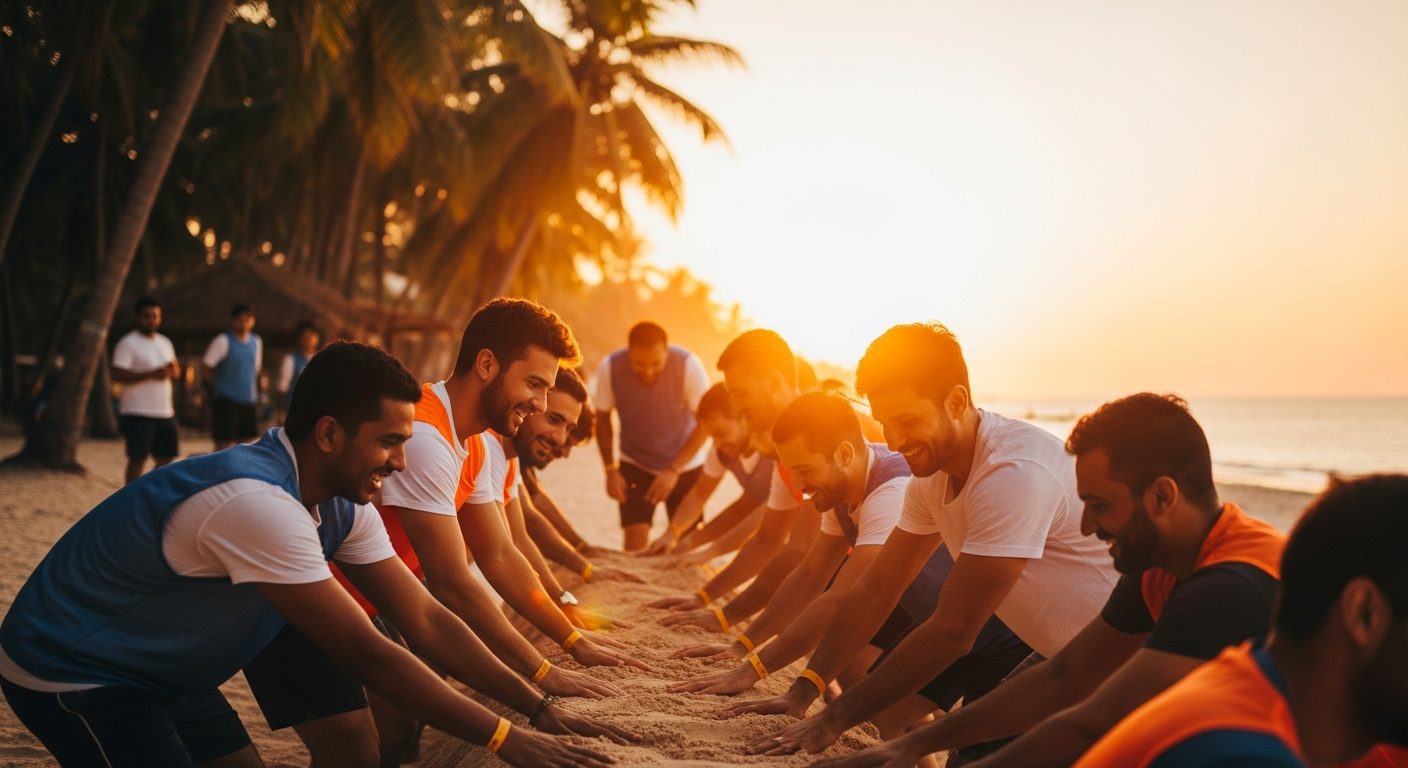
Corporate team building ideas in Bali cover a genuinely wide range: sunrise volcano treks, white-water rafting, Balinese cooking ceremonies, cultural craft workshops, CSR beach-cleanup projects, and facilitated challenge formats that borrow from reality-television race formats. The city-guide version of this topic just lists them. This piece assesses each one — audience fit, physical demand, weather sensitivity, and where the execution gaps tend to appear — because the right choice for a 40-person senior leadership group is rarely the same as the right choice for a 200-person regional sales force.
Every option below is an illustrative example of what the Bali market frequently offers. Scope, quality, and actual execution vary by operator; none of these are statistically verified as the most popular or most suitable. Use this as a structured starting point for your brief, not a confirmed catalogue.
Before the Activity List: The Question Vendors Do Not Ask First
Most activity briefs go to operators before the planner has articulated what success actually looks like. Operators then propose what they deliver most cheaply or most often — which is not the same as what fits your group. Three questions sharpen any team-building idea into a genuine brief:
What is the business objective? New-team integration after a merger requires activities built on genuine interdependence — tasks where the group physically cannot succeed without coordinating across unfamiliar relationships. Recognition programs for high-performers call for something more prestige-adjacent and experiential. Clarifying this before you shortlist activities eliminates roughly half the options immediately.
Who is in the room? A group of twelve regional directors from six countries, ranging from thirty-two to fifty-eight years old, has different physical thresholds, hierarchy sensitivities, and cultural norms around competition than a cohort of forty early-career salespeople in their late twenties. Mixed nationality is not a footnote — it is a design constraint that changes which activities land well and which ones create unintended friction.
Where does this sit in the program arc? An activity scheduled the afternoon before a gala dinner and CEO address should leave people energised, not exhausted, sunburned, or muddy. An activity positioned as the final morning of a three-day offsite can absorb more physical effort because recovery time is built in. Timing matters as much as the activity itself.
Operators who do not ask these questions in the first conversation are not the ones to trust with your group.
Idea-by-Idea Assessment
Balinese Cooking Classes and Culinary Workshops
Who it suits: Broadly applicable — this is one of the few team-building formats that works across seniority levels, fitness ranges, and nationalities without requiring significant adaptation. A well-facilitated cooking class is inherently collaborative: divided tasks, group preparation, a shared outcome that the group eats together. Senior executives are generally comfortable in a culinary setting in a way they may not be in a physical challenge format. Mixed-nationality groups tend to engage genuinely because food sits outside the hierarchy dynamics that other activities can trigger.
Executive appropriateness: High, with a caveat about execution quality. A Balinese cooking class held in a working local compound, beginning at a traditional market and guided by a practising cook, is substantively different from a hotel resort version that uses pre-measured ingredients, branded aprons, and a script. Both are called “cooking classes” in proposals. Push operators to specify the setting, the facilitator background, and whether the cultural context is explained or just the technique.
Weather sensitivity: Low. If the class is held in a traditional pavilion or a covered compound, it runs regardless of season. Some formats include an open-air market segment — build in a wet-weather alternative for that component if you are operating in the wet season (roughly November through March).
Physical demand: Minimal. Accessible to all fitness levels, mobility restrictions, and age ranges. Dietary diversity needs to be mapped early — halal requirements, vegetarian and vegan diets, shellfish and nut allergies all need to be briefed at the RFP stage, not confirmed the morning of the event.
Procurement flag: Ask whether the facilitator holds a genuine relationship with the setting. A hotel-contracted external vendor running a class in a venue they do not control introduces a logistical variable that a dedicated culinary team does not.
Cultural and Craft Workshops
Who it suits: Cultural team building in Bali — traditional craft formats like batik painting, Balinese offering-making (canang sari), silver jewellery work, weaving, or bamboo craft — works particularly well as executive group activities in Bali where the brief is relationship-deepening rather than challenge-based. Craft requires patience and focus, generates conversation naturally, and produces a tangible take-home. These formats also carry strong cultural grounding: participants engage with something genuinely Balinese rather than a generic team activity that happens to be located in Bali.
Executive appropriateness: High. The format does not require physical exertion, competitive scoring, or public performance — all of which can create discomfort in mixed-seniority groups. A kecak or gamelan introduction facilitated by a practising artist (not a tourist-show performer) and framed as genuine cultural exchange tends to generate more meaningful conversation than a competitive challenge format.
Weather sensitivity: Low to none if held in a covered traditional compound or indoor setting. Outdoor elements like village walks can be adjusted to covered options in wet conditions.
Physical demand: Minimal. The accessibility profile is broad.
The cultural sensitivity note: Balinese blessing or purification ceremonies are offered by some operators as a team-building format. When facilitated properly — with genuine permission from the local community and a clear participant briefing — they can be meaningful. When handled carelessly, they read as appropriation and generate internal complaints from the group itself. Ask any operator who facilitates ceremonial formats to explain the community consent process and how participants are briefed beforehand. If they cannot answer specifically, move on.
CSR and Community Projects
Who it suits: A CSR team building activity in Bali — beach cleanups, mangrove replanting, school infrastructure projects, community art — is increasingly common in corporate RFPs, particularly where the program needs to satisfy sustainability commitments or where the group has explicitly asked for purpose-driven content. This format works across a wide seniority and nationality range because the shared task is concrete and the benefit is tangible rather than abstract.
Executive appropriateness: Medium to high, depending on how the program is framed and who is in the room. Senior executives often engage more genuinely with CSR formats than with purely recreational team activities, particularly when the community need is real and the briefing is honest about what the project does and does not accomplish. What does not land well with senior audiences: a staged cleanup where the logistics overwhelm any sense of impact, or a “project” that clearly exists primarily for group photography.
Weather sensitivity: Medium. Beach cleanups at low tide in November or February carry real weather risk. Mangrove replanting in rain can be workable with appropriate gear. School or community infrastructure projects are more weather-independent. Build explicit wet-weather alternatives into the brief for any outdoor CSR component.
Physical demand: Low to medium depending on the format. A beach cleanup involves walking on uneven terrain; a mangrove planting involves kneeling in muddy conditions. Be specific in your brief about the physical expectations and whether a less physically demanding parallel track is needed.
The procurement test for CSR quality: Ask the operator for the community or NGO partner’s name, what the measurable output of past programs was, and whether the benefit remains after the group leaves. If the operator gives you a generic answer — “we partner with local communities” — that is not a CSR program. It is a walk with branding. See our sustainable and CSR events guide for a full briefing framework.
Mount Batur Sunrise Trek
Who it suits: Groups with a younger demographic, broad fitness levels, and a brief that explicitly values challenge, physical accomplishment, and shared adversity. The Mount Batur trek — an active volcano in Bali’s highland interior — is one of the most frequently cited examples in the Bali team-building market. The experience involves a pre-dawn departure (typically around 2–3 a.m. from accommodation), a two-to-three hour ascent on volcanic terrain, and sunrise at the summit. For the right group, it is genuinely memorable.
Executive appropriateness: Conditional. A senior leadership group that includes delegates with joint or mobility issues, who have travelled from a significant time zone difference, or who are mid-fifties-plus, requires a clearly signposted opt-out activity running in parallel. Forcing participation in a strenuous predawn hike creates liability and resentment. If your group’s composition is primarily C-suite or includes delegates for whom a 2 a.m. start followed by a physically demanding ascent is genuinely uncomfortable, this format is not the right primary option regardless of how well it photographs.
Weather sensitivity: High. Rain on the ascent makes the trail significantly more demanding. Summit cloud cover — common during the wet season and occasional even in dry months — eliminates the primary experience (the sunrise view). A credible operator will be honest about cloud probability for your specific dates and season rather than showing you archived summit photographs. Confirm what the contingency is if conditions do not cooperate, and get it in writing before you sign.
Physical demand: High. This is not an activity that can be adapted for low-fitness participants. Be direct with suppliers about the age range and fitness profile of your group; responsible operators will tell you if this does not match.
Season guidance: Dry season, broadly April through October, gives the most reliable weather window. Within that, the transition months at either end can still carry cloud risk. The G20 Leaders’ Summit in November 2022 and the IMF–World Bank meetings in October 2018 — both held in Nusa Dua, Bali — are evidence that Bali operates effectively in shoulder and wet-season months for large programmes, but outdoor adventure activities are a different risk category than controlled convention venues.
White-Water Rafting (Ayung River, Ubud Area)
Who it suits: Groups skewing younger, energetic, and broadly comfortable with outdoor physical activity. White-water rafting on the Ayung River near Ubud is one of the most commonly offered outdoor formats in the Bali MICE market. The river section typically used for corporate groups is classified as moderate — generally manageable for healthy adults without prior rafting experience — making it more accessible than the Mount Batur trek but still demanding enough to exclude participants with physical limitations.
Executive appropriateness: Medium. This works well for field-sales incentives, operations teams, and groups where a shared physical challenge is explicitly part of the brief. For senior leadership groups or those with significant age and fitness range, the comfort threshold varies widely. An opt-out is essentially mandatory.
Weather sensitivity: High. River water levels, current speed, and conditions change materially between dry and wet season. Rafting in wet-season months (roughly November through March) is offered by operators, but the conditions are meaningfully different from dry-season runs — higher water levels, stronger currents, and greater unpredictability. A credible operator should be asked directly: what is their policy if conditions deteriorate on the day, and at what point do they cancel? The answer tells you a great deal about how they manage risk.
What to confirm in writing before signing: Guide-to-participant ratio, safety briefing protocol, equipment inspection schedule, wet-weather policy, and what the alternative activity is if conditions require cancellation on the morning of execution.
Team Challenge and Amazing Race Formats
Who it suits: Larger, younger, more competitive groups where the brief is energy, engagement, and inter-team bonding across a cohort that does not know each other well. Challenge-format activities — Amazing Race-style city hunts, obstacle courses, dragon boat racing — are among the most logistically complex options in the Bali team-building market, requiring facilitation staff that scales with group size, clear pre-event logistics, and deliberate debrief facilitation afterward.
Executive appropriateness: Medium to low for mixed-seniority or senior-heavy groups. Competitive formats with public scoring, elimination rounds, and costume or costume-adjacent elements carry hierarchy risk in groups where seniority is mixed. Some participants — particularly from corporate cultures where being seen to lose publicly in front of junior colleagues carries real social cost — will disengage or resent it. The most culturally neutral version of a challenge format involves collaborative problem-solving between mixed teams rather than head-to-head competition with a clear winner and loser.
Weather sensitivity: High for outdoor formats. A city-hunt or Amazing Race activity in Bali’s central streets or temple complexes in heavy rain is an unpleasant logistical experience rather than an energising one. Operators running these formats should be asked specifically about their wet-weather version and how similar it is to the dry-season program in terms of participant experience.
The debrief requirement: Without a structured facilitated debrief connecting the activity to the stated business objective, a team challenge is a company sports day. The debrief is not an optional add-on — it is what converts an activity into a team-building program. Ask any operator to describe their debrief format and who facilitates it before committing.
Executive Wellness and Mindfulness Formats
Who it suits: Senior groups, mixed-nationality cohorts where competitive formats carry risk, and programs where the brief is relationship-deepening or recovery after intensive plenary sessions. Sunrise yoga at a rice terrace setting, sound healing in a traditional pavilion, guided meditation with a local practitioner, and spa-partner formats that build deliberate conversation time into the experience are increasingly included in corporate programmes as executive group activities in Bali.
Executive appropriateness: High when the setting and facilitator match the quality level of the rest of the programme. A sunrise yoga session led by an experienced local teacher at a genuinely beautiful outdoor location — a rice terrace compound in Ubud, a private villa with mountain views — lands very differently from one facilitated by hotel F&B staff in a conference room with “wellness” in the title. The gap between those two executions is large, and it is not visible in a proposal unless you push for specifics on who facilitates and where.
Weather sensitivity: Low to medium. Indoor or partially sheltered settings reduce exposure. Outdoor yoga at sunrise in wet-season months can be disrupted by rain. A named alternative setting should be confirmed in advance for any outdoor component.
Physical demand: Low. The most broadly accessible format in the market for mixed-age, mixed-fitness groups.
Quick Suitability Reference
| Activity | Executive-Appropriate | Mixed Nationality Fit | Weather Risk | Physical Demand |
|---|---|---|---|---|
| Balinese cooking class | High | High | Low | Minimal |
| Cultural / craft workshop | High | High | Low | Minimal |
| CSR beach cleanup / community project | Medium–High | High | Medium | Low–Medium |
| Mount Batur sunrise trek | Conditional | Medium | High | High |
| White-water rafting (Ayung River) | Medium | Medium | High | Medium–High |
| Team challenge / Amazing Race | Low–Medium | Medium | High (if outdoor) | Low–Medium |
| Executive wellness / yoga | High | High | Low–Medium | Minimal |
This table is a planning reference only. Actual suitability depends on your specific group composition, operator execution quality, and program context. Verify against your brief and operator proposals.
Weather and Season: The Planning Layer Vendors Skip
Bali has two seasons in broad climatological terms: a dry season running roughly April through October, and a wet season from approximately November through March. This is general pattern — actual week-by-week conditions vary, and neither season is uniformly reliable. What matters for team-building planning is not whether an activity is theoretically possible in the wet season but whether you have a genuine contingency designed and confirmed if conditions do not cooperate.
The split by risk category looks roughly like this:
- Low weather risk, either season: Balinese cooking classes in covered compounds, craft workshops in indoor or pavilion settings, executive wellness formats with an indoor fallback, indoor team challenges. These should be the backbone of any wet-season programme.
- Medium weather risk with planning: CSR projects (buildable with alternative indoor component), outdoor yoga (needs covered backup), some cultural formats with outdoor village elements.
- High weather risk, requiring explicit contingency: Mount Batur sunrise trek, white-water rafting, outdoor city-hunt formats, beach cleanups. For these, your operator’s written contingency is not optional — it is part of the proposal evaluation.
Dry season months — roughly May through September, with April and October as generally reliable transition months — are the most reliable for outdoor programming. They are also the highest-demand period for Bali overall, which means venue, accommodation, and transport availability can tighten and pricing can reflect that pressure. Availability and pricing for premium outdoor settings can tighten materially in high-demand periods. Planning around European and Australian school-holiday peaks within those months also matters for groups with delegates based in those regions.
There is no definitively optimal month. Trade-offs are real. The right approach is to work with an operator who has specifics about your dates, not one who sends you a calendar graphic that says “best season” with a green bar over June.
Ready to scope an activity program for your group? Share your group profile, dates, and objectives via our enquiry form or WhatsApp at +62 811 2859 0000 — we will route your brief to a vetted partner and disclose that referral relationship openly.
Group Size: What the Shorthand Actually Covers
Bali’s team-building market is commonly described as capable of handling groups from around 20 to 1,500 delegates [industry shorthand from a single DMC source — not independently verified across the market]. This describes the general range that Bali’s venues and operators collectively support across MICE programmes, not a guaranteed capacity for any specific activity with any specific operator.
In practice, most activities have meaningful functional ranges. A Balinese cooking class works well for 20 to 80 participants across multiple stations and breaks down logistically for 300 unless you are running parallel sessions at different locations and reuniting. A beach cleanup can accommodate hundreds in terms of physical space, but the quality of facilitation and the meaningful experience per participant typically degrades past a certain scale. A dragon boat regatta needs a minimum viable group to fill boats and maintain competitive structure.
When you brief operators, give them your confirmed headcount and ask them to describe how they will structure the activity for that group size specifically — not just confirm that they can do it. The specificity of that answer tells you whether they have executed it at that scale or are extrapolating from smaller programmes.
Cost Ranges: What to Expect and What to Ask
Team-building costs in Bali are quote-based. Any per-person figure you see published by an operator is a headline anchor, not a complete cost. The actual cost depends on activity type, group size, session length, facilitator calibre, location complexity, and inclusions. Pricing also moves with season — high-demand dry-season periods carry different pricing than wet-season months.
What is almost never included in a headline per-person price unless you specifically ask: group transport to and from the activity location, permits for outdoor or public-space use, gratuities for local facilitators, photography and video, a structured debrief session, and wet-weather backup arrangements. Ask for an itemised quote that separates each component. Itemised proposals allow honest comparison between operators; all-in package quotes obscure what you are actually paying for.
As a directional planner’s framework by activity tier:
- Lower complexity, indoor or covered settings (cooking classes, craft workshops, wellness formats)
- On quote — cost driven primarily by facilitator calibre, setting quality, duration, and group size. Ask whether the venue is hotel-managed or independently operated; the latter often reflects differently on the final number.
- Medium complexity, outdoor with safety requirements (rafting, trekking)
- On quote — guide-to-participant ratio, equipment quality, safety certification, and transport from accommodation are the primary variables. Do not accept a headline number without an itemised breakdown covering at minimum guides, safety gear, transport, and a weather-contingency fee or refund policy.
- Higher complexity, large-group facilitation (team challenges, CSR programs with impact reporting)
- On quote — facilitation staff count scales with group size, and the cost difference between a 50-person and 200-person programme is non-linear. Ask operators to break out facilitation staff hours separately from logistics costs so you can assess the ratio honestly.
Cancellation and headcount-adjustment terms matter as much as the initial price. Confirm in writing what happens if you need to reduce headcount 72 hours before the event, and what the refund or credit policy is if weather forces cancellation of an outdoor activity.
Combining Activities and CSR: How It Works in Practice
Combining a CSR component with team-building is increasingly common in corporate briefs, particularly where the programme needs to satisfy internal sustainability reporting. A beach cleanup or community project structured around a facilitated team-building debrief can serve both objectives simultaneously — shared physical task, genuine community benefit, and a structured reflection that connects the experience to the business objective.
The design requirement for this to work: the CSR component must be genuine. A real community or conservation partner whose name you can verify, a measurable output that does not evaporate when the group leaves, and a debrief that is substantive rather than five minutes of applause before dinner. The Bali context makes CSR formats particularly credible because the island’s relationship with coastal waste and single-use plastics is real and well-documented — participants can engage with an actual problem rather than a staged exercise.
For planning a combined format, ask your operator: who is the community partner, what did the last programme of this type produce in measurable terms, and what does the impact report cover? If the answers are specific, the programme is designed. If the answers are vague, the CSR component is branding.
The Brief That Gets Useful Proposals
A team-building brief that generates comparable, useful responses from multiple operators contains these elements:
- Confirmed headcount and group composition — nationality mix, age range approximate, seniority spread, any known physical limitations or dietary requirements
- Business objective in a single sentence: what does a successful activity look like in terms of group experience or behaviour at the end?
- Timing in the programme arc (morning of day two, afternoon before gala dinner, standalone day, etc.) and target duration
- Budget posture — not a fixed number, but a directional bracket (lean / moderate / premium) so operators calibrate the proposal appropriately
- Hard constraints: no alcohol involvement, no contact formats, must be weather-proof, must include a structured debrief
- Requirement for a named wet-weather contingency included in the proposal
- Required deliverables: photography, participant certificates, post-programme impact report for CSR components
Operators who respond with a generic brochure rather than a tailored response to your brief are giving you information about how they will manage your event when conditions deviate from plan.
Questions Worth Asking Any Operator Before You Sign
- What is your facilitator-to-participant ratio for this activity at our exact headcount?
- Who specifically facilitates — can we speak to them before contract signing?
- How many times have you run this activity at this group size in the last twelve months?
- What is your named wet-weather contingency, and at what point before the activity do you make the call to switch?
- Is the per-person price inclusive of transport, permits, photography, and debrief — or what exactly is excluded?
- What are your payment and cancellation terms, and what happens if headcount changes within 48 hours?
- For CSR formats: who is the community partner, what is the measurable output, and can you provide a post-programme impact report?
- For cultural or ceremonial formats: who holds the relationship with the facilitating community, and what is the consent and briefing process?
No team-building programme in any destination is without execution risk — weather, logistics, and supplier variability are real. What distinguishes credible operators is their contingency planning, their communication when conditions shift, and their candour about what they cannot guarantee. This is general information, not professional event-planning advice; all contracts should be reviewed by your own advisers before signing.
Working on a team-building brief? Share your group profile and programme context via our enquiry form or email [email protected] — we route enquiries to a single vetted partner and disclose that referral relationship openly. No obligations, no hard sell.
Frequently Asked Questions
Which corporate team-building ideas in Bali work best for senior executive groups?
Balinese cooking classes in a traditional compound setting and cultural craft workshops tend to be the most consistently well-received with senior audiences. Both are inherently collaborative, physically accessible to adults of all fitness levels, and culturally substantive enough that executives feel they are doing something genuinely interesting rather than an obligatory HR exercise. Executive wellness formats — sunrise yoga at a rice terrace, sound healing in a private setting — also land well when the brief is relationship-deepening and the group has spent heavy time in plenary sessions. The key test: would the most senior participant in the room feel this is a thoughtful use of their time? High-energy competitive formats tend to work better with younger, more homogenous cohorts where hierarchy is less of a variable.
What is the weather risk for outdoor team-building activities in Bali during the wet season?
Wet season runs roughly November through March. Outdoor activities carry meaningful weather risk in those months, but are not impossible — the operative requirement is a designed contingency, not an improvised one on the morning of execution. Any operator you brief for an outdoor activity in those months should include their named wet-weather backup as a standard part of the proposal; if they cannot or will not, that tells you something about how they manage risk generally. Indoor and covered formats — cooking workshops, craft sessions, wellness programmes in private villa settings — carry essentially no weather risk and can anchor a wet-season programme without compromise. The practical planning approach is not to avoid the wet season (costs and venue availability can be more favourable) but to design explicitly for it.
How can a CSR team-building activity in Bali produce genuine impact rather than just a photo opportunity?
Three things separate a genuine CSR programme from a branded walk: a named, verifiable community or NGO partner (ask for the organisation’s name and verify it independently); a measurable output that persists after the group leaves (kilograms of waste collected and tracked, trees planted, a completed infrastructure element); and a facilitated debrief that connects the experience to the group’s business objective. If an operator cannot provide specifics on all three before you sign, the CSR component is cosmetic. Bali’s coastal waste challenges are real and well-documented, which means beach cleanup formats can engage participants with a genuine issue rather than a staged activity — but only if the operator has a legitimate partnership behind it.
Can cultural team building in Bali work for a mixed-nationality corporate group?
Yes — in fact, cultural and culinary formats tend to be the most cross-culturally accessible option in the Bali market. Food and craft sit outside the hierarchy dynamics that competitive physical formats can trigger. The design requirements are practical: map dietary restrictions and requirements at the RFP stage, not the morning of the event; confirm whether facilitation is available in languages beyond English for groups where this matters; and ensure the cultural content is genuinely facilitated (what participants are doing, why it matters) rather than just a branded activity that happens to involve Balinese props. Operators experienced with multinational corporate groups will ask about nationality mix and language needs proactively; those that do not are accustomed to leisure groups, not corporate clients with genuine accountability for participant welfare.
How far in advance should corporate team-building in Bali be booked?
For groups under 50 in shoulder-season months, many operators can accommodate bookings six to eight weeks out. For groups above 100, for programmes running in dry-season peak months (roughly May through September), or for activities that require permits, specialist facilitators, or exclusive use of a specific location, three to six months provides meaningful planning room and genuine choice. Premium outdoor locations — private rice-terrace settings, specific cultural venues — can book out earlier than their availability calendars suggest during high-demand periods, because operators often hold tentative holds for larger groups ahead of confirmed bookings. Earlier engagement also gives you the ability to negotiate on inclusions rather than just accepting what is available.