How to use this page: Bali DMC Agency is an independent buyer’s guide to Bali MICE — we are not a DMC, PCO, venue, or transport operator ourselves. A DMC manages on-the-ground logistics, venues, and transport; it is not the venue or the conference organiser. Capacities, group sizes, and budgets shown are indicative ranges flagged [VERIFY] (mid-2026) and must be confirmed in writing with the relevant supplier, venue, or broker before you commit — this is general information, not legal, tax, or procurement advice; confirm delegate visas and event permits with the appropriate authority or your notary as relevant. We may earn a referral commission when we connect you to a vetted partner, which never changes the price you are quoted.
Information only — not legal, technical or professional advice. Bandwidth specs, permit requirements and visa rules change. Verify all operational and compliance details with your venue, your production supplier and qualified local advisers before committing a budget or issuing delegate instructions.
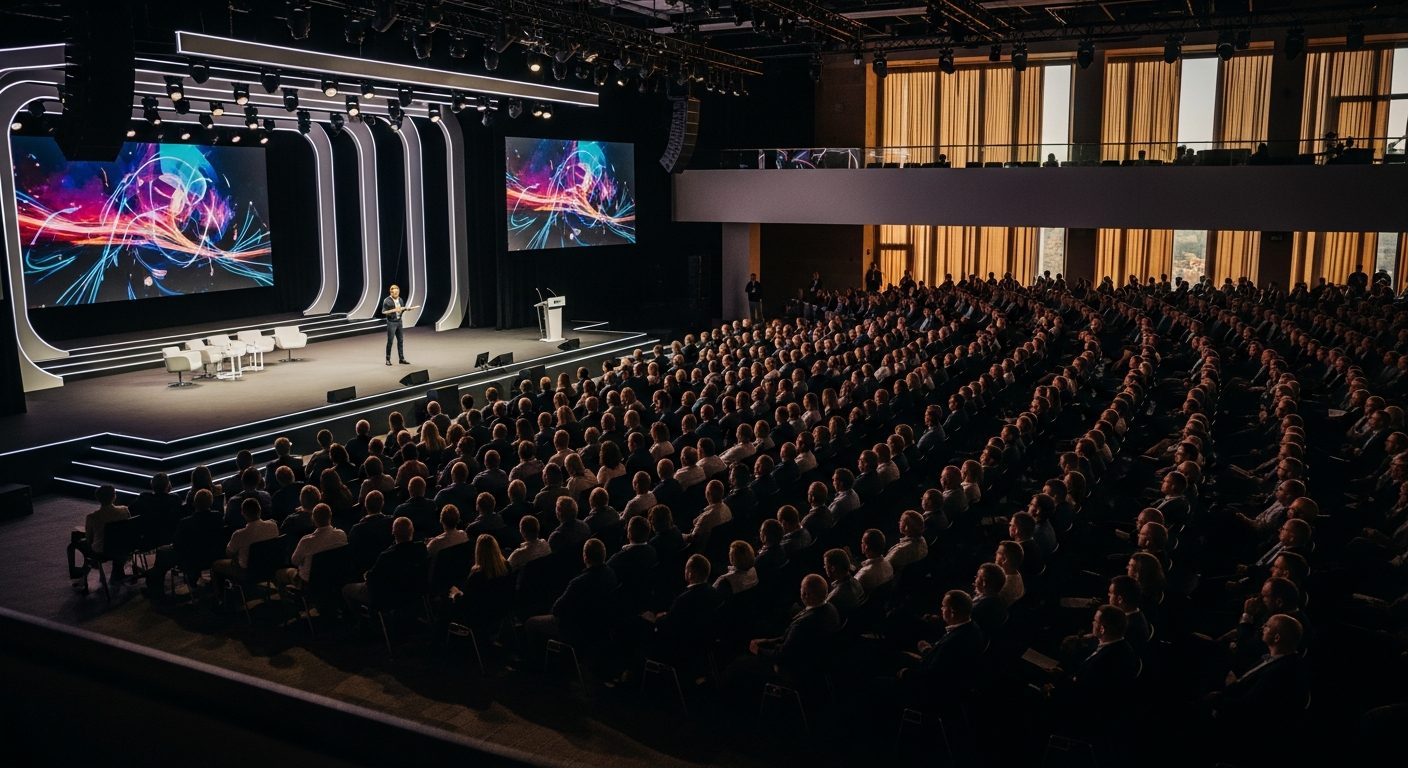
A hybrid event is a live, in-person gathering that simultaneously broadcasts to a remote audience — both groups participating in the same programme in real time, but from different physical locations. Staging hybrid events in Bali adds a production and compliance layer that most venue brochures do not address: reliable high-capacity internet, redundant connectivity, a streaming-capable AV crew, a content format designed to serve two very different rooms at once, and — depending on who is in front of the camera — potential work-permit obligations for foreign technical talent. None of this is insurmountable. But each element needs to be scoped, costed and verified before you sign a venue contract, because the assumptions that work for a standard in-person conference in Nusa Dua do not automatically carry over when a remote audience is watching live.
This guide maps the production requirements, the practical risks and the compliance considerations specific to running a virtual conference Bali-side. All costs are by quote — production scope varies too widely for any fixed figure to be meaningful here. This is general information, not legal or professional advice.
Why the Objective Has to Justify the Investment
Before covering the technical requirements, one honest framing point: hybrid adds cost and complexity to every line of your event budget. The in-person programme stays roughly the same. On top of it, you are paying for a production crew, a streaming platform, dedicated bandwidth infrastructure, additional rehearsal time and — potentially — a separate content strategy for the remote audience. You are also taking on connectivity and technical risk that does not exist in a purely in-person event.
The question to answer before you scope a hybrid format is whether the objective genuinely requires simultaneous live participation from remote attendees, or whether a high-quality recording distributed after the event would achieve the same outcome at a fraction of the cost and risk. When the objective is broad reach and content distribution, recorded-and-distributed often outperforms live hybrid in both production quality and audience experience. When the objective is live interaction — real-time Q&A, distributed voting, simultaneous decision-making across geographies — hybrid earns its premium. Be honest about which one you actually need.
Bandwidth and Connectivity: What to Verify, Not What to Assume
Connectivity is where hybrid events in Bali most commonly run into trouble. Bali’s venue infrastructure has developed significantly over the past decade — Nusa Dua’s convention precinct in particular benefits from the investment driven by G20-level events — but the gap between what a venue’s marketing materials describe and what the production team actually needs to run a live stream to 500 remote viewers is real and needs to be closed before load-in.
What to ask the venue — not what to accept from the brochure
Venue internet specifications are often stated as shared-building or theoretical capacity rather than the dedicated, guaranteed bandwidth your stream will need at peak load. The questions that matter are specific: What is the dedicated upload bandwidth available to your event, separate from the venue’s general guest Wi-Fi? What is the committed information rate (CIR) — the bandwidth that is guaranteed rather than “up to”? Who is the venue’s internet service provider, and what is the SLA on their uplink? Can the venue provision a dedicated fibre circuit for your event dates?
Do not accept verbal assurances. Ask for the technical specification sheet and, if the answers are incomplete, arrange a bandwidth test at the time of day your event will run before signing the contract. This is standard practice for hybrid meeting production Bali-side. A venue that resists a pre-event bandwidth test is telling you something important.
Redundancy is not optional
A single internet connection — regardless of how good it is on paper — is not an acceptable setup for a live stream. Your production supplier should be specifying a primary connection and at least one backup path that can take over without interrupting the stream. In practice this typically means a combination of dedicated fibre (primary) and 4G/5G bonded cellular (backup), sometimes augmented by a satellite link for the highest-stakes events. The backup path needs to be live and monitored throughout the event, not activated only when the primary fails. By the time you notice the stream has dropped, remote attendees have already been looking at a frozen screen for ninety seconds.
Power redundancy is the second layer. Streaming infrastructure — encoders, switches, production desks — needs clean, stable power with UPS (uninterruptible power supply) backing. Ask your venue what generator capacity is on-site, how fast the failover is on a power interruption, and whether your production equipment can be on a separate power circuit from the main venue load. These are not exotic requirements; they are standard asks for any production team running live broadcast from a venue that has not hosted a hybrid event recently.
Streaming and AV Crew for a Hybrid Corporate Event Bali
A hybrid event requires a production capability that goes beyond what a standard conference AV package delivers. The in-room AV — screens, microphones, speaker system, presentation switching — is necessary but not sufficient. On top of it, you need a broadcast production layer: cameras properly positioned and operated for the remote viewer rather than the in-room screen, a vision mixer (video switcher) operator managing the live cut, a streaming encoder feeding the platform, a graphic operator for lower thirds and name cards, and a dedicated technical director monitoring the outgoing signal quality in real time.
These are distinct skill sets from general AV technicians, and not every Bali AV supplier has all of them in-house. When briefing streaming corporate event Bali suppliers, ask specifically which elements of the broadcast stack are provided by their own crew and which are subcontracted. A supplier who subcontracts the encoder operator to a third party they have never worked with before your event is a different risk profile from one with an integrated broadcast team that has produced live streams together repeatedly.
Platform and encoding decisions
The choice of streaming platform — whether a corporate webinar tool, a dedicated event streaming platform, or a custom RTMP setup — affects every other production decision: encoding settings, latency profile, audience interaction capabilities and the technical demands on the bandwidth connection. This guide does not endorse any specific platform. What matters operationally is that the platform decision is made early enough to influence the production spec, not after the AV quote has already been submitted. The production team and the platform need to be selected in sequence, not in parallel by different parts of your organisation.
Rehearsal time
Hybrid events need more rehearsal time than in-person events, not less. The additional layers — camera blocking for the remote viewer, stream quality checks, latency testing between the venue and the platform, run-throughs of the Q&A moderation process, presenter training for camera rather than room delivery — all take time that many event timelines do not budget for. A full technical rehearsal the day before the event, plus a same-day run-through before doors open, should be treated as non-negotiable rather than aspirational. Discovering that your primary presenter cannot hear the remote moderator’s questions with two hours to go is a problem that a rehearsal would have caught.
Time Zone Scheduling: Designing for Two Audiences Simultaneously
Bali operates on WITA (Waktu Indonesia Tengah), which is UTC+8. That single fact drives a scheduling constraint that most hybrid event timelines underweight.
- Bali 09:00 WITA
- Singapore / KL / Hong Kong: 09:00 (same or one hour offset) — workable. Sydney: 11:00 — acceptable. Tokyo: 10:00 — fine. London: 02:00 — untenable for live participation. New York: 21:00 (previous evening) — marginal at best.
- Bali 14:00 WITA
- Singapore / KL: 14:00 — good. Sydney: 16:00 — workable. London: 07:00 — early but live-capable. New York: 02:00 — untenable.
- Bali 17:00–18:00 WITA
- London: 10:00–11:00 — optimal for European audiences. Dubai: 13:00–14:00 — good. Singapore: 17:00–18:00 — late afternoon, acceptable. Sydney: 19:00–20:00 — evening, viable.
The practical implication: a hybrid event that genuinely serves a global remote audience — Asia-Pacific plus Europe plus the Americas simultaneously — does not have a good session window from Bali. If your remote audience is primarily Asia-Pacific, the scheduling maths are comfortable. If Europe is a priority, late afternoon Bali time is workable but it shortens your usable programme day. If North America needs to be live rather than watching recordings, Bali is structurally the wrong time zone for that format regardless of how good the production is.
This is not a reason to avoid Bali for hybrid events when the audience profile fits. It is a reason to be specific about which remote audiences need live access and which are adequately served by high-quality same-day recordings.
Content Design for Two Rooms
The most common failure mode in hybrid events is not technical — it is content. A programme designed for in-person delivery and then pointed at a camera does not serve the remote audience well. The dynamics are fundamentally different: the in-room audience reads body language, reacts to the energy in the room and has social context from coffee-break conversations. The remote viewer has a screen, audio that depends on microphone placement and pickup quality, and none of the surrounding social fabric that makes live events work.
What this means in practice
Presenter training for hybrid delivery matters. Presenters who are comfortable commanding a room of 300 people may be weak on camera — eye contact is different, slide pacing is different, and the absence of immediate audience reaction requires a different kind of energy. Budget time for this.
Remote audience interaction needs to be designed in, not added as an afterthought. If Q&A from remote viewers is part of the programme, the moderation process — how questions come in, who screens them, how they reach the presenter — needs to be rehearsed until it is seamless. A clunky handoff between an in-room moderator and a platform chat window is visible to the remote audience and undermines the event’s credibility.
Consider segmentation rather than full parallelism. Not every session needs to run simultaneously for both audiences. Opening keynotes and headline speakers often benefit from hybrid delivery. Breakout workshops, networking sessions and collaborative working groups usually do not. A hybrid format that selects which elements are broadcast, rather than streaming everything indiscriminately, often produces a better experience for both audiences than an all-or-nothing approach.
If your programme scope is ready to discuss, submit a brief via our enquiry form or reach us on WhatsApp at +62 811 2859 0000 — we route qualified briefs to a vetted local production partner and disclose that referral relationship openly.
Permits, Foreign Talent and the Work-Permit Reality
Running a hybrid event often means bringing in specialised technical talent from outside Indonesia: broadcast engineers, encoder specialists, remote direction crew or experienced hybrid event producers who have run this format before in other markets. If any of that talent is foreign nationals who will be working at the event — not just attending as delegates — Indonesian work-permit rules apply.
Foreign technical workers and performing talent brought into Indonesia for a commercial event generally require a licensed Indonesian impresario to sponsor and manage the engagement, plus a work-permit notification filed with the relevant ministry authority. This process typically requires approximately one month of lead time, and can run longer depending on documentation from the foreign specialist’s side and processing volumes at the ministry. The permit page on this site covers this framework in detail — including the impresario requirement, the distinction between passive conference attendance and active working or performing, and the practical timelines that experienced Bali DMCs work to.
The takeaway for hybrid event planning: if your production spec requires foreign technical specialists, add the impresario and work-permit notification process to your planning timeline at the moment those specialists are confirmed — not as a logistics afterthought once the production schedule is already drafted. Tourist visas are not a legal workaround. This is an area where getting it wrong has real operational consequences, including talent being refused entry at Ngurah Rai International Airport on event week.
For event permits more broadly — outdoor events, amplified sound, public-facing elements — the same framework applies as for any Bali corporate event. Private, closed-door hybrid events held within licensed hotel or convention venues are generally managed under the venue’s existing operating permits. Large-scale hybrid conferences with outdoor components, public-facing live streams or significant production rigs may require separate permitting conversations with local authorities. A Bali-based DMC with hybrid event experience will map the specific permit requirements for your format and location as part of the brief stage.
A Buyer’s Checklist: Verifying Before You Commit
| Area | What to verify | How to verify it |
|---|---|---|
| Bandwidth | Dedicated upload speed and CIR for your event, separate from shared guest Wi-Fi | Written technical spec from venue; bandwidth test at event time-of-day before signing |
| Connectivity redundancy | Backup connection path (cellular bonding or satellite) and failover process | Production supplier’s technical spec; confirm live monitoring during event |
| Power redundancy | UPS on production equipment; generator capacity; failover speed | Venue technical rider; confirm dedicated power circuit for production |
| AV / broadcast crew | Which broadcast production roles are in-house vs subcontracted | Ask for crew CVs and prior hybrid event references; do not accept generic AV package |
| Streaming platform | Platform chosen and tested with the venue’s connection profile | End-to-end test from venue to platform before event week |
| Foreign technical talent | Work-permit notification filed via licensed impresario; ~1 month lead time minimum | Written confirmation from impresario; verify before talent travel is booked |
| Time zone schedule | Live session windows viable for target remote audience regions | Map WITA to audience locations; confirm which sessions must be live vs recorded |
| Rehearsal time | Full technical rehearsal (day before) and same-day run-through both in programme | Confirm in venue booking; confirm in production crew contract |
| Costs | Separate line-item quotes for hybrid production uplift vs base in-person event | Itemised quotes from AV/production supplier; confirm what changes if remote audience is dropped |
What Hybrid Events Actually Cost in Bali
Production costs for hybrid events in Bali are by quote, and the range is wide. The hybrid production uplift — the additional cost over a standard in-person AV package — depends on the size of the remote audience, the production quality required, whether you are using a platform that requires custom integration, and whether foreign specialist crew is involved. For a modest internal hybrid meeting (small in-person group, a few hundred remote viewers, a straightforward streaming setup), the uplift over a standard conference AV package can be material but manageable. For a large-scale hybrid meeting production Bali event with professional broadcast-quality output, multiple camera angles, real-time graphics and a custom streaming platform, the production line alone can rival the venue hire.
The cost components that are specific to hybrid (above what you would pay for the same event in-person) typically include: dedicated bandwidth provision or fibre circuit hire; streaming encoders and associated hardware; broadcast-capable camera package (different from presentation cameras); vision mixing and technical direction; platform licence or streaming CDN costs; additional rehearsal time on venue; and — where applicable — impresario fees and work-permit costs for foreign crew. Get all of these as separate line items. A bundled quote that does not separate in-person and hybrid costs makes it impossible to evaluate whether the hybrid format is delivering value for its premium.
Ready to scope your hybrid brief? Submit an enquiry or reach our concierge on WhatsApp at +62 811 2859 0000. We route qualified briefs to a vetted local production partner and disclose that referral relationship openly — if you proceed with that partner, they may pay us a referral fee at no extra cost to you.
Frequently Asked Questions
What bandwidth does a hybrid event in Bali actually need?
There is no single correct figure — it depends on stream quality (resolution and bitrate), number of simultaneous streams, and other event internet use happening on the same connection. What matters is that the bandwidth is dedicated to your event rather than shared with venue guests, and that it comes with a committed information rate (CIR) rather than a best-efforts “up to” figure. Ask your venue for a written technical specification and have your production supplier review it before you sign. The right production team will also specify a backup connection path — typically bonded 4G/5G or satellite — so that a single connection failure does not take down the stream. Do not accept verbal assurances in this area; only written specs and a pre-event bandwidth test are reliable.
Is the BNDCC or a Nusa Dua hotel a good venue for a virtual conference Bali-side?
The Nusa Dua convention precinct — including the Bali Nusa Dua Convention Center (BNDCC) with its Nusa Dua Hall of 4,400 sqm and verified theatre-style capacity of up to 5,000 persons, and the surrounding five-star hotel inventory — benefits from infrastructure investment driven by events including the G20 Leaders’ Summit in November 2022 and the IMF–World Bank Annual Meetings in October 2018. That track record suggests the precinct’s backbone connectivity is better developed than most Bali venues. However, what a venue delivered for a government summit with its own dedicated communications infrastructure is not automatically what your event will have access to under a standard venue hire agreement. Ask the venue to specify exactly what dedicated bandwidth and power redundancy they can provide for your dates, and test before you sign. Verified specs, not historical references, are what your production team needs.
Do I need a permit to stream a corporate event from Bali to a remote audience?
The streaming itself — broadcasting a private corporate event to a remote audience online — is not separately permitted in the way that outdoor public events are. The permit questions that apply to a hybrid event in Bali are the same as for any corporate event: whether the physical event requires location permits, police clearance, noise permits or banjar consent depends on the venue type, headcount, format and regency. Private, closed-door events in licensed hotel or convention venues are typically handled under the venue’s operating permits. Where hybrid events add a distinct compliance question is when foreign technical talent is involved — AV specialists, broadcast engineers or producers who are foreign nationals and will be working at the event need work-permit notification via a licensed Indonesian impresario, with roughly one month of lead time. This is general information; verify current requirements with a qualified local partner and the relevant Indonesian authorities before finalising your production arrangements.
What time zone should I schedule Bali hybrid sessions to reach a global audience?
Bali operates on WITA (UTC+8). There is no single window that simultaneously serves Asia-Pacific, Europe and the Americas comfortably for live participation. The most workable slot for Asia-Pacific plus Europe is late afternoon Bali time (around 16:00–18:00 WITA), which puts London at 09:00–11:00 and Singapore at 16:00–18:00. North American audiences face an unfavourable time gap regardless of scheduling. If your remote audience spans multiple regions with incompatible time zones, consider which sessions genuinely require live participation from each audience segment and which deliver equal or greater value as high-quality same-day recordings. A hybrid format designed around your actual audience’s time zones is more effective than one designed around the theoretical ideal of simultaneous global access.
Can I bring my own foreign AV or streaming crew to run the hybrid production in Bali?
Foreign technical crew members who will be working at the event — not attending as conference delegates — require work-permit notification filed through a licensed Indonesian impresario. This process typically needs approximately one month of lead time and requires documentation from the foreign crew members’ side. Tourist visas and standard business visas do not provide legal authorisation to work commercially in Indonesia. Engage a licensed impresario at the same time you confirm your production crew, not after travel logistics are already in motion. Your local DMC or production partner should either be a licensed impresario or have a formal arrangement with one — ask this question explicitly when briefing suppliers. See the permits and foreign talent page on this site for the fuller framework.
Reminder: This article is general information only, not legal, technical, immigration or professional advice. Bandwidth specifications, permit requirements, visa rules and work-permit procedures change and vary by circumstance. Verify all specifics with your venue, your production supplier, the Indonesian Directorate General of Immigration, and qualified local advisers before finalising your event plan or issuing any crew or delegate instructions. Nothing here should be relied upon as a statement of current law, official government practice or guaranteed technical performance.